
6 Lead Nurturing Mistakes to Avoid in 2026
14 min
Updated: June 23, 2026

Executive summary
Effective lead nurturing involves transforming buyer signals into actionable demand intelligence to create and strengthen relationships with prospective buyers. However, with larger buying groups, buying journeys longer, and expectations higher, missteps can quickly erode trust and stall revenue growth.
This article outlines six common lead nurturing mistakes and how to fix them. It explores how to:
- Replace generic messaging with personalized, valuable content that aligns with modern buyer behavior

- Replace generic messaging with personalized, valuable content that aligns with modern buyer behavior
- Build buyer-led journeys and automated workflows that mirror actual buyer decision paths
- Extend nurturing beyond the initial sale to drive retention, expansion, and advocacy
- Adopt omnichannel orchestration and iterative testing to keep messaging relevant, contextual, and measurable
By applying demand intelligence, B2B organizations can design nurture programs that enable confident buying decisions that accelerate pipeline performance and long-term loyalty.
Even the most promising prospects rarely make a purchase on first contact. B2B buyers today research independently, validate extensively, and expect every interaction with a brand to deliver value.
When executed with intent and careful planning, lead nurturing turns buyer signals into actionable demand intelligence. It reduces acquisition costs and builds long-term loyalty. However, 86% of B2B buying processes still stall or end in no decision, often because nurturing programs fail to align with how modern buying groups evaluate and validate solutions (Outlook 2026).
This guide explores the most common lead nurturing mistakes and how to design personalized, data-driven strategies that accelerate revenue.
What is lead nurturing?
Lead nurturing is the process of developing trust and building meaningful relationships with prospective buyers by delivering personalized, high-value content and interactions throughout the buyer’s journey.
Rather than focusing on immediate conversion, effective nurturing helps educate and guide prospects until they are ready to make a purchase. It creates long-term brand affinity and preference.
Effective lead nurturing enables organizations to stay present and relevant throughout the B2B buying process. By aligning personalized outreach with buyer intent signals, organizations can bridge the gap between awareness and purchase readiness, equipping each stakeholder with the information they need to make confident decisions.
Lead nurturing is about enablement, not persuasion. The most successful programs integrate data-driven insights, behavioral triggers, and content relevance to anticipate buyer needs, demonstrate expertise, and strengthen trust at every stage of the journey.
“Lead nurturing is not about sending louder messages, but rather, it starts with deeper understanding. When you focus on what your prospects are trying to solve, not what you are trying to sell, you achieve real momentum.”

Founder & CEO, INFUSE
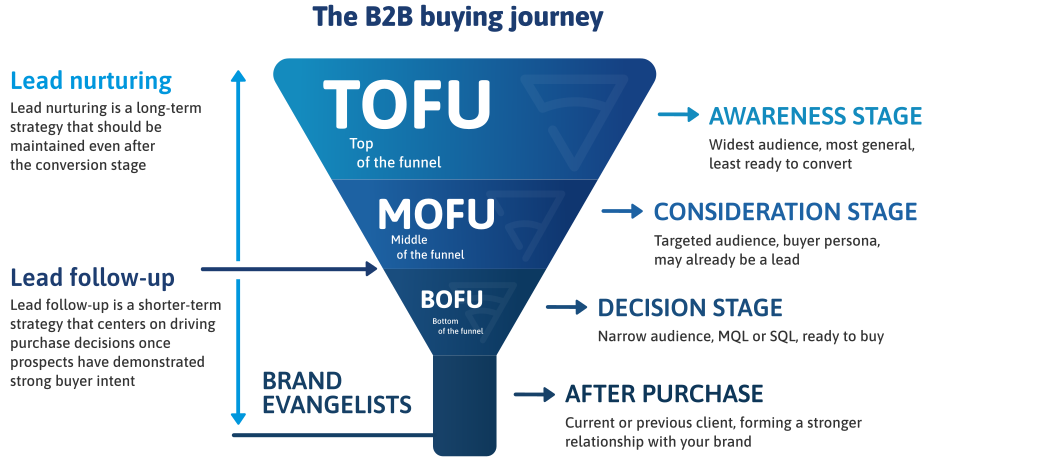
Lead nurturing vs. lead follow-up: What is the difference?

Lead follow-up focuses on immediate engagement by responding to an inquiry, demo request, or campaign interaction to qualify interest and determine next steps. It is short-term, aiming to capture active demand.
Lead nurturing is a sustained, strategic effort to build relationships with buyers who are not yet ready to purchase. It involves delivering content that helps prospects evaluate their options over time.
According to the Voice of the Buyer 2026, most B2B buying journeys average seven months. This highlights the need for long-term nurturing that maintains relevance well beyond initial follow-up.

6 lead nurturing mistakes to avoid

With the rise of the defensive buyer and increasingly complex buyer journeys, identifying the right messaging and optimizing lead nurturing strategies has become more important than ever.
Below are six common lead nurturing mistakes to avoid to enhance the buyer’s journey and generate more revenue.

Focusing lead-nurturing efforts solely on sales
One of the most common and costly misconceptions in B2B marketing is treating lead nurturing as an extension of sales outreach. While effective nurturing ultimately supports pipeline growth, its primary objective is to build trust, deliver value, and guide buyers through a complex, often months-long decision process.
How should organizations align engagement timing with B2B buyer dynamics?
Buying groups are larger and more risk-averse, making trust and timing critical factors in B2B engagement. Aggressive, sales-driven touchpoints can alienate buyers who are still educating themselves and validating their research, as these buyers do not want to be met with a sales pitch or pushed toward a decision prematurely. Few mistakes are more damaging than pressing for a sale before a buyer is ready.
Buyers increasingly expect to lead their own journeys and to be enabled rather than sold to. As 6sense’s 2025 Buyer Experience Report indicates, 61% of buyers prefer to conduct all of their research independently. Interrupting this process with aggressive outreach risks eroding trust and disqualifying a brand before a meaningful conversation begins.
As a result, lead nurturing should prioritize buyer enablement over immediate conversion. Effective strategies focus on understanding and addressing the evolving priorities of buying groups, while personalizing content to these needs.
By educating buyers, demonstrating relevant use cases, and providing credible, data-backed insights, organizations can help de-risk the buying decision and reinforce value without introducing artificial urgency.
Using behavioral insights for relevance
Applying behavioral insights and intent signals allows GTM teams to identify when buyers are shifting from research to consideration. This creates an opportunity to adjust messaging in real time. Prioritizing timing, relevance, and behavioral alignment is a better fit with how modern buyers operate.
This can be achieved by:
- Tracking engagement and content consumption patterns to identify sales readiness signals
- Aligning marketing and sales teams on intent-based prospect qualification to avoid premature handoffs
- Maintaining continuous value delivery through personalized content streams to sustain trust and momentum

Delivering generic messaging
Modern buyers expect personalized, insight-driven engagement that reflects their unique needs, industry context, and stage in the buying journey. As a result, communicating with them through generic messaging can actively undermine trust.
According to 6sense’s Buyer Experience Report (2025), 94% of buying groups had already ranked their preferred vendors before any direct sales contact, reinforcing how little time marketers now have to shape perception before the short-list is locked in.
This means that by the time prospects encounter your content, they expect it to deliver immediate relevance and value, not boilerplate messaging.
How to operationalize relevant, non-generic messaging:
- Segment nurture audiences by role, industry, buying stage, and priority rather than relying on a single global messaging stream
- Define a minimum personalization standard that specifies which message elements must change by segment (e.g. problem framing, KPIs, proof points)
- Prioritize early-stage content that validates buyer assumptions and risks rather than introducing product positioning
- Align messaging to pre-shortlist behavior, recognizing that perception is formed before direct sales engagement
- Review engagement data by segment on a recurring basis to identify where generic messaging suppresses performance
Nurturing strategies for buying groups
According to the Voice of the Buyer 2026 report, most B2B buying groups now include an average of nine members, each with different priorities, challenges, and success metrics.
Focusing your nurturing on a single prospect misses the broader questions that the entire buying group faces. Doing so risks losing traction with other stakeholders who hold equal or greater influence.
To engage prospects effectively, nurturing strategies should be built around buying groups, not individuals. This requires mapping pain points, motivations, and decision criteria across roles, and developing content streams that speak to each persona’s priorities.
How to operationalize buying group-led nurturing:
- Identify the core buying group roles involved in your deals (e.g. economic buyer, technical evaluator, operations, security, finance)
- Document each role’s primary concerns, success metrics, and perceived risks to guide content development
- Build parallel nurture tracks that deliver role-specific value while reinforcing a consistent overarching narrative
- Ensure value, differentiation, and risk mitigation messages remain aligned across personas to prevent internal buyer misalignment
- Measure engagement at the account and buying-group level rather than evaluating leads in isolation
Content quality and timing
Equally important is the quality and timing of content delivery. 2026 Voice of the Buyer data shows that buyers and buying groups consume an average of nine unique content pieces throughout their purchase process to make a decision.
This signals that offering quality content is more important than ever. Every touchpoint must deliver substance, insight, and clear next steps.
How to operationalize content relevance and timing:
- Limit nurture streams to a defined set of high-impact assets aligned to each buying stage (awareness, consideration, decision)
- Use behavioral and intent signals to trigger content delivery based on real activity rather than fixed cadences
- Assign a clear objective to every asset, such as educate, validate, de-risk, or enable the next action

Stopping nurturing streams too early in the buyer journey
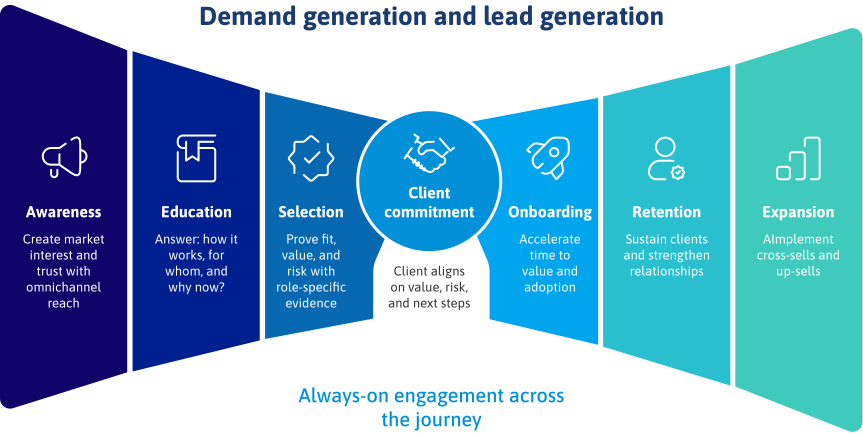
The buyer’s journey does not end with a signed contract. Rather, it evolves into a client experience journey that is just as important as acquisition.
Research by Bain & Company reported that improving retention by just 5% can increase profits by up to 25%. This is a clear indicator of the value of post-sale engagement and client advocacy.
Yet many organizations make the mistake of ending their nurturing efforts once a sale is closed, missing a major opportunity to strengthen relationships, drive renewals, and unlock expansion revenue.
Post-sale nurturing is a core growth strategy. According to research by Zuora, existing clients account for an average of 76% of revenue, which reflects the market reality that buyers are risk-averse, budgets are tightening, and client trust has become the ultimate differentiator.
Yet, Voice of the Marketer 2026 shows that only 42% of marketing teams are directly accountable for client retention, expansion, and advocacy, despite these being the strongest levers of sustainable growth. This gap highlights how many organizations still underinvest in the very stage of the journey that drives recurring revenue and long-term trust.
Effective post-sale nurturing focuses on enablement, education, and advocacy. The goal is to help clients realize value from their purchase faster, reduce friction in adoption, and continuously reinforce ROI.
This can take the form of onboarding programs, knowledge hubs, user communities, and proactive check-ins that surface insights before issues arise. When done well, nurturing transforms your client success efforts into a measurable demand engine that generates upsells, renewals, and referrals.
The Voice of the Buyer 2025 report highlights that today’s buyers increasingly favor partners who help them maximize existing investments rather than push for new ones. This mindset highlights the fact that clients expect vendors to act as long-term optimization partners who help them achieve measurable business outcomes. Getting this right means:
- Maintaining continuous engagement through personalized post-sale communication streams
- Using behavioral and product usage data to anticipate needs and proactively offer relevant solutions or upgrades
- Encouraging feedback loops and advocacy programs to turn satisfied clients into brand champions

Missing optimization and iterative testing
Lead nurturing cannot take a “set it and forget it” approach. With B2B buyers engaging across multiple channels and taking longer to reach a purchase decision, static nurture programs risk losing relevance.
Continuous optimization and testing separate high-performing nurture programs from those that stagnate. Optimization starts with developing clear KPIs aligned to business outcomes, such as engagement rates, content consumption depth, conversion velocity, and influenced pipeline. However, the real impact comes from interpreting and acting on those metrics.
Today’s buyers are more skeptical and defensive than ever, often withholding engagement until they see evidence that a vendor truly understands their needs. This makes continuous testing and refinement essential to proving value early and often.
How to operationalize continuous optimization:
- Define a focused set of KPIs tied to business outcomes, including engagement depth, stage velocity, and influenced pipeline
- Review nurture performance at the sequence, asset, and segment level on a recurring cadence
- Establish testing roadmaps for subject lines, sequencing logic, content formats, and delivery timing
- Use intent and behavioral data to dynamically adjust nurture paths mid-stream rather than waiting for campaign completion
- Share insights across marketing, sales, and client success to ensure learnings inform the full buyer lifecycle
Iterative testing allows GTM teams to continuously improve each touchpoint. When combined with AI-powered intent analysis and behavioral tracking, teams can dynamically adjust nurture flows mid-campaign to ensure every interaction remains relevant and contextual.

Nurturing on a single channel
Due to fatigue in the buying journey, relying on a single channel for lead nurturing is one of the fastest ways to lose buyer engagement. Channel fatigue occurs when buyers become desensitized to repeated outreach in the same channel, causing engagement to drop sharply.
B2B buyers navigate multiple platforms and content formats throughout their decision process. Limiting outreach to one touchpoint fails to meet buyers where they are.
An omnichannel nurture approach ensures message continuity across email, display, social, content activation, and even direct outreach. When channels are synchronized, each touchpoint reinforces the next, which builds familiarity, trust, and recognition.
How to operationalize omnichannel nurturing:
- Identify where target buying groups actively research, validate, and compare solutions
- Define the role of each channel (e.g. email for depth, display for reinforcement, social for credibility)
- Adapt content formats to each channel’s context while maintaining consistent messaging and value propositions
- Use unified data and orchestration tools to sequence engagement across channels
- Measure cross-channel influence rather than evaluating channels in isolation
“Today’s buyers move fast and across more channels than ever. If your nurture strategy cannot adapt in real time, you are not just behind, but you become invisible.”

COO, INFUSE

Not designing a clear buyer journey and nurturing workflow
Without a defined buyer journey and structured workflow, even the best content and data strategies fail to convert.
Effective lead nurturing begins with a mapped buyer’s journey that mirrors how buying groups progress from awareness to decision, incorporating all stakeholders, touchpoints, and decision triggers along the way. It is important to note that this map will not be perfect and will need consistent updates, but it will serve as an essential guiding foundation.
An effective workflow should align marketing and sales efforts through automated sequences informed by behavior, engagement level, and intent. Each interaction should have a clear purpose (to educate, validate, or enable) supported by content calibrated to that stage.
How to operationalize buyer journeys and workflows:
- Create a buyer journey map that reflects real buying behavior rather than internal funnel assumptions
- Define stage-specific objectives, decision criteria, and required validation for each persona
- Build automated workflows triggered by engagement, intent, and inactivity signals
- Clearly define handoff rules between marketing and sales to prevent premature outreach
- Review and refine the journey regularly using performance data and buyer feedback
Key takeaways

- Lead nurturing is about enablement, not persuasion: The most effective nurturing programs focus on building trust, demonstrating expertise, and helping buyers navigate complexity, rather than driving premature sales conversations.
- Personalization and relevance are essential: Generic, one-size-fits-all messaging undermines trust. Nurturing content should be value-first, contextually relevant, and aligned to the unique needs of both individual stakeholders and the buying group as a whole.
- Continuous optimization and omnichannel orchestration are key: Single-channel or static nurture programs fail to meet buyers where they are. Integrating multiple channels and continuously testing your approach ensures engagement remains consistent and measurable.
- The buyer journey does not end at conversion: Stopping engagement after the sale leaves revenue on the table. Post-sale nurturing builds loyalty, reduces churn, and fuels expansion.
BUILD A MORE EFFECTIVE NURTURE ENGINE WITH INFUSE
Activate buyer-led journeys, real-time intent, and omnichannel engagement that moves deals forward.