Results for “”

Webcast
How AI, trust, and discoverability are
reshaping B2B vendor selection
45 min
•Updated: August 12, 2026

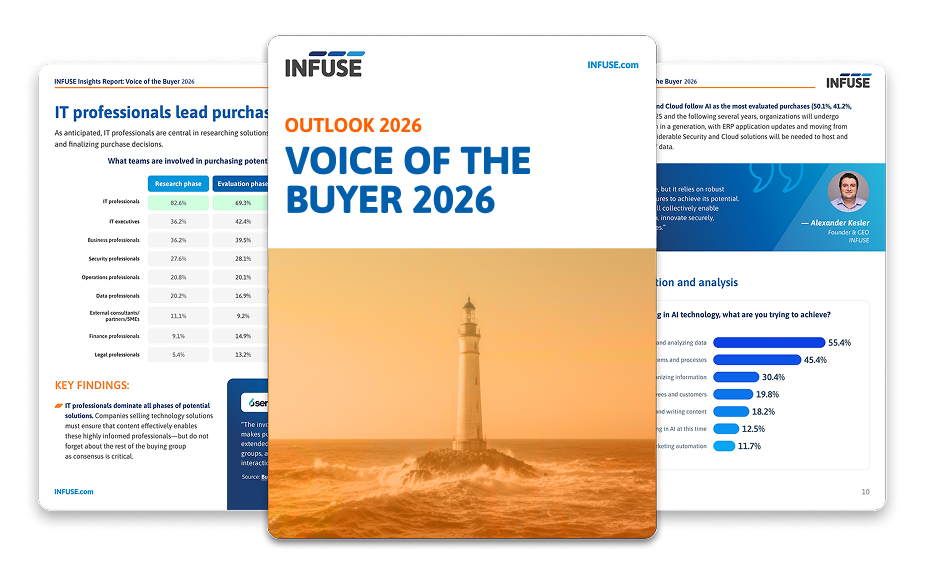
B2B buying groups have expanded to an average of nine stakeholders, operating on compressed seven-month cycles, as the complexity of B2B buying processes compounds (Voice of the Buyer 2026).
Content consumption per deal has increased to an average of nine pieces. Yet, buyer confidence has not kept pace: only one in four buyers report deep satisfaction with their current vendors (Voice of the Buyer 2026). This market reality is known as the trust gap.
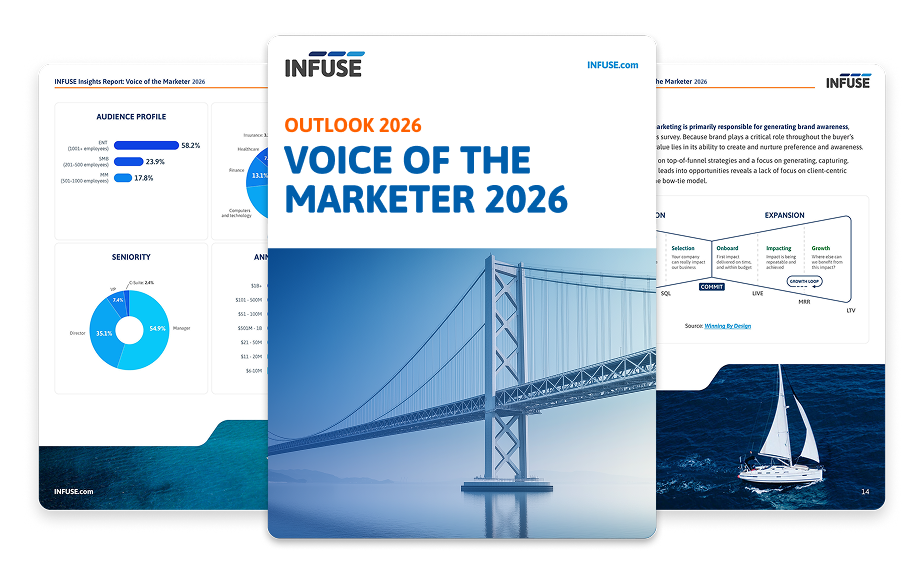
This on-demand session draws on top findings from INFUSE Voice of the Buyer and Marketer 2026, a survey of 2,300+ GTM leaders. Victoria Albert (INFUSE CMO) and Scott Vaughan (GTM Advisor) explore the forces widening the vendor trust gap, examining what the shift to AI-enabled buying behavior demands from marketing and revenue teams.
This webinar explores:
Watch the webcast to explore the latest insights and strategies regarding vendor trust and discoverability in B2B.
In this video
02:42 The discoverability and trust problem
09:00 More information does not result in confidence
10:43 Brand is the price of admission
19:14 Tech buyers are under pressure
24:46 Content essential for building trust
29:15 The discoverability bottleneck
34:52 Lead with proof
00:07 Victoria Albert: Hello and welcome everyone to INFUSE's installment of this year's research, AI, Trust, and Discoverability: Why CMOs and Go-To-Market Teams Must Think Differently and What Exactly They Must Do Differently in 2026. I'm joined today by Scott Vaughan, Chief Marketing Officer, Go-To-Market Advisory, and my name is Victoria Albert. I'm the CMO of INFUSE.
00:33 Scott Vaughan: I love this topic, Victoria, and I love doing this with you. I know we have been sharing and comparing notes this last year as the market changes, the craft of marketing and sales and go-to-market (GTM). We're all trying to figure out our playbooks. I'm really excited to dive into this research and some of its implications with you.
00:54 Victoria Albert: Thank you for being here, Scott. I'd like to start off by telling our audience what today's session is not about, because I think that's equally important, as important as what it is about. This session is not going to be about your content strategy. It is not going to be about your lead generation tactics. It is not going to be about tactics at all. This session is going to be instead about a problem that we believe every single marketer and go-to-market leader is dealing with, and that is a massive discoverability and trust problem that exists out there in the tech SaaS go-to-market world, whether or not we have named it yet.
01:39 Scott Vaughan: Yeah, Victoria, I think the other thing I'm glad, you know, there's certainly implications and we'll touch on some of the playbook elements, but I think what many people aren't recognizing, because we're in such transition and under a pressure cooker and trying to keep up, what I love about the INFUSE research, it's focused on the business technology professional and the buying groups that are out there that's driving the change in the playbooks and the marketing strategy. And gosh, if we can really connect those two pieces and align and integrate those efforts, we're going to be in a much better position.
02:18 Victoria Albert: So, Scott, you know this, I've been with INFUSE for 6.5 years, and for 5 out of those 6.5 years, we've been doing research and putting out our outlook for the year ahead. This year's outlook is one that sends shivers down my spine. It's incredibly impactful, may I say monumental, in the way we go to market, in the way we think about what the tech markets are doing, what the go-to-market strategies are doing. Everything we're going to be sharing today is grounded in that research. We interviewed more than 2,300 go-to-market leaders, both on the buying side as well as on the marketing side, for our INFUSE Outlook 2026 report. This report dropped on January 7th. It is brand new. Voice of the buyer and voice of the marketer, both halves are out there. Scott and I are not going to give you benchmark data from 5-year-old surveys. We're going to give you what B2B leaders told us they're experiencing today, right now, in this market, in this moment, in this AI cycle.
03:36 Scott Vaughan: I think that's the beauty of it, Victoria, that we're balancing the buyer's perspective, who so many of us go-to-market leaders are trying to figure out how to connect with them, but we also benchmark where marketing is and go-to-market leaders are on that journey. It's two pieces of research that can actually be put together to identify the gaps.
04:00 Victoria Albert: Exactly. Which brings us to this theme of this year's research. Scott, would you do me the honors?
04:07 Scott Vaughan: Yeah. So what we found, if you really analyze the entire body of the research, all the interviews, and that includes the many, many hundreds of thousands of interactions that INFUSE gets to do with both business technology buyers and with go-to-market leaders, is that we find that there's a trust gap and it's pretty big. I will say this is not unusual when a market's in transition. And if you want to go old school, you can go from mainframes to PCs, PCs to client-server, client-server to the internet, you know, internet to SaaS and cloud. We're in a market that's in transition, and anytime buyers are under pressure to adopt new thinking, new strategies, new technology like AI, you're going to have a stop-and-wait moment. And right now, with the experience many of the buyers and buying groups and leaders in organizations across the globe have had with SaaS, wasn't so delightful. So as we transition into a world that's more AI-driven and AI-powered, buyers don't believe us. We're going to have to take a different playbook to build our brand, to build our credibility and show proof. And that's really one of the big takeaways in what's creating this trust gap on the vendor-buyer relationship.
05:35 Scott Vaughan: But it's also creating a confidence gap on the buyer side because they're under tremendous pressure.
05:43 Victoria Albert: And I will say this, I will add that this will be very near and dear to any marketer's heart. I think it's common knowledge now that more than 50% of the internet out there is synthetic content. Our buyers are consuming more and more of it. I know we'll touch on it in a couple of slides, but more content does not produce more trust. And in fact, it's producing quite the opposite. It's producing more mistrust and more anxiety. Buyers have almost developed an immune response to this synthetic content out there. They consume more of it, they trust less of it. And more importantly, I think they're not waiting for our next campaign to form an opinion about our brand. Those opinions are formed through peer conversations, review sites, AI summaries. Yes, still bars and golf courses on some occasions, long before we know those deals exist, which is why it's our strong opinion that our content needs to be useful. And useful to us is being able to answer buyers' questions early on throughout the dark funnel. Which I think brings us really nicely to this.
07:07 Victoria Albert: Our research this year revealed 3 tensions that define the B2B buying experience. Number 1, buyers are aggressively adopting AI technologies, of course, but they're starving for proof that they work. They want outcomes. They no longer want experimentation. They don't yet trust the claims. Number 2, buyers are consuming more content than ever, yet their confidence in vendor-produced content is dropping more and more every year in our data. And number 3, buyers are selecting vendors based on trust, confidence, and technical fit. But that trust is really fragile. We'll address it in a couple of slides. 3 out of 4 buyers are not deeply satisfied with their current vendors. So taken all together, these 3 tensions point to a single underlying problem. More information is not creating more confidence. It's creating more noise, and more noise creates more anxiety.
08:16 Scott Vaughan: And that's the irony, Victoria. In the research, you clearly see that vendor content is essential because it's the only place that you can get the business use case and technical fit that they crave, but yet they don't trust it yet. So that is upon us to rethink and change how we produce and deliver information at the pace that, and the almost anxiety or the confidence level that many of our buyers and buying groups have.
08:50 Victoria Albert: But let's talk about the one positive part of the research, and it's exactly this. This is good news for brands and for vendors out there. Brand confidence matters enormously in the shortlisting process. Taking together that 45% and 42% extremely or very influential, whether your buying group shortlists you in the consideration process, plus moderately influential, that's 87% of the buyers telling us that brand is really, really important. That matters. That's really important. On the flip side, of course, if brands don't know your name before they're in market, we're not competing. We're invisible through that dark funnel. This is why brand investment, as I say, is not a luxury that's reserved for large organizations. It's the price of admission. But here's a critical nuance. And this one we like to talk about a lot. This is what most organizations and go-to-market teams often get wrong. Brand does get you discovered, but it does not yet get you chosen. What gets you chosen are all of these things. Look, we've had years of innovation claims from vendors, right? Every pitch deck has an innovation slide. Some of it was delivered, some of it, you know, was not.
10:17 Victoria Albert: Well, this year, 58% of the buyers are telling us that strong alignment with their use cases, technical requirements, ecosystem, and tech stack is really important and what will get the vendor chosen. That is a massive number. Going down the list, you'll see 37, 36, 36, 33, 32, all capabilities that we would normally expect, ROI, AI native, quality of customer care, et cetera. All the way down the list, 19% personalized outreach, 18% analyst validation. Now, Scott, I think you and I are aligned here to say it doesn't mean that those things are not important. It just means those things are table stakes. Buyers just expect personalized outreach. Buyers just expect third-party validation. But it's the ecosystem alignment that will get that brand chosen off the consideration set.
11:20 Scott Vaughan: Here's what the research really revealed for me and so many of the conversations I've had with other go-to-market leaders. One is it's not just about brand awareness in this transition. It's about brand credibility and about brand trust. You can be the incumbent vendor. They could know who, let's pick a very broad one, IBM is, but they may not know that cloud analytics and IBM are synonymous. So as buyers and buying teams go look for new solutions, that's the big difference. You may have awareness, but you may not have credibility and proof. And what we're seeing as well in the research, for many years we've had a cadence that, well, let's do education and thought leadership in that first to build brand awareness. It's not that that goes away, it just looks different. We've got to bring more business case and technical fit information and make that available up front because they want their questions answered, Victoria, as you articulated. Just answer the damn questions. And so as go-to-market teams, we have to know and anticipate what those questions are and be able to have that information, not just content, available while they're doing that research, while they're evaluating their existing incumbent vendors.
12:43 Scott Vaughan: Maybe some they're aware or know, or one they're trying to get to know. That's your opportunity to differentiate and build brand credibility. That's why the power of brand, which has always been there, is just double exclamation point of why that's so important as people make that transition.
13:04 Victoria Albert: Make technical validation effortless, right? That's the story of this slide. There's something interesting.
13:12 Scott Vaughan: They can't get that from the analyst. That's why we see that number at 18%. It's not that analysts are bad, it's just they can't answer the damn questions for the vendor fit and use case. And herein drives, I think, the crux of what's really happening in the market. We talked about that transition from SaaS and cloud alone to AI. It doesn't mean enterprise software goes away, not at all. But the types of providers they work with, if your incumbent vendors have not done a good job of customer care, delivering on innovation, the news here is the research shows they are very open to switching vendors during this market transition, and that has a couple of big ramifications. One is you need to protect your flank, make sure that you're wrapping your arms around the customers and your current buyers, and the expanded buying group know about your AI-integrated capabilities that you can bring so that they don't switch vendors. On the other side, the beaming smile Victoria and I have as marketers, it's also an opportunity for competitive displacement where you can go in and run campaigns to bring the brand and proof and credibility as a new provider to unseat the incumbent.
14:35 Scott Vaughan: This is a very, very opportunistic time to make a shift. And so you've got to know when you're playing offense and when you're playing defense. This research and the data is very telling about where we are right now.
14:50 Victoria Albert: I would say other than AI, this is probably one of the biggest opportunities for marketers and for selling teams in the last few years, and that's competitive displacement. If your marketing team is not aggressively going after the customers of your competitors, please have them call me. I'd love to understand why. I'd love to talk to them about this because this is a monumental opportunity and one that brings a smile to my face for sure. Okay, so we have a trust gap. I think Scott and I have established that pretty cleanly. Now let's talk about what's making it worse, and that's this AI buying paradox. I'll build the slide, and as I do that, this research is really striking at the heart of some known knowns we've been talking about over the last several years, and that's buying groups have now grown from an average 8 to an average 9 stakeholders this year. Now, before I go any further, I'll step back to say this is global research. So North America, EMEA, and APAC, mid-market to enterprise. This data is pretty heavy in the enterprise segment. If we were just to isolate the enterprise away from mid-market, this buying group number would be around 10.5 to 11.5 people.
16:26 Victoria Albert: And the numbers here, I think, are less important. What's more important is the movement and the trend trajectory, and that's plus 1 person regardless of the size of the company or in many cases region we're dealing with. Number 2, buying cycles have compressed from an average 8 months to 7 months, again, across all company sizes, regions, and industries. Number 3, content consumed per deal has increased from 8 pieces to 9 pieces. So taken all together, we're now dealing with more stakeholders, faster timelines, more content to process for these buying groups. And so the paradox here is by every measurable input, buyers are working harder to make purchase decisions, yet confidence has not improved. It has actually deteriorated.
17:21 Scott Vaughan: Yeah, when you have a new set of capabilities and offerings, and you have even vendors that are trying to scramble and keep up. Our business technology buying groups are under the pressure cooker and tremendous pressure to bring AI capabilities into their organization. We talk about that as the AI effect, whether it has AI or not, they're still going to evaluate all that. It's new, it's moving fast, and I'm trying to learn more. But if you can't deliver information and the right answers to the question, which is our last box there, that's where you can really make a difference at this point. You must answer their damn questions. And that is a big difference as we move from this thinking around how much content can I produce, but can I actually package useful information that answers their questions. This is all coming together to bring that trust and confidence gap that we're finding, especially as Victoria noted, with all the synthetic content that's out there. It kind of raises an eyebrow, or can I trust this? Is this right? Is it going to deliver the innovation it promises? Can it integrate with my existing capabilities?
18:46 Scott Vaughan: We're really in an interesting place right now.
18:48 Victoria Albert: Yeah, and let's think about this. As a typical go-to-market team, we have more stakeholders to convince, we have less time to do it, they're consuming more content pieces but trusting less of it. AI has really accelerated all of these inputs. But it hasn't really solved the confidence gap. And if anything, it has only widened it, which really brings me to this next really interesting piece. This is coming from our marketer side of the research. So this is the Voice of the Marketer. And we've pulled out this specific data point because we think it really tells the story. On the marketer side, the adoption of AI is really significant but deeply uneven. 53% of the marketers tell us, these are marketing managers and above and all the way to the CMO, 53% of them are telling us that they're deploying or scaling predictive analytics and modeling. So, okay, good. Not great, but good. But only 6% of them are telling us that they're deploying or scaling AI-driven segmentation and personalization. When we think about what this means, right, marketers are using AI to predict the buying behaviors, but they're not using AI to deliver the experiences that feel relevant to those buyers and buying groups.
20:24 Victoria Albert: So the infrastructure is there, the backend exists, but the front-end delivery has not caught up. And if you remember what the buyers told us just a few slides ago, they expect these capabilities as table stakes, as table stakes. And this is where this trust gap really compounds itself. Buyers are expecting personalization at scale that AI should deliver, but they're not receiving it.
20:52 Scott Vaughan: Victoria, this just screams that we focused on so much over the last 3 or 4 years of how to predict and use intent and signals and predictive analytics and all kinds of things. But we have to finish the swing. We have to answer their questions. And the way to do that is to be able to segment and personalize and take advantage of the skills. That's what's so great about this research. We look at what the marketers are actually doing based on what the buyers want and need. And here we see a pretty big disconnect. So I would circle this and really underline that this is really the big win that we can now bring for marketers and go-to-market teams to bring AI in for this level of work.
21:44 Victoria Albert: And then let's come back to the trust signals and be really precise about what this chart is telling us. Now, for the purposes of this recording, Scott and I just pulled out 3 numbers out of a whole massive dataset that we can talk about offline. But these 3 are really telling us kind of the story that runs in the opposite direction of what most people here expect. So I'll sort of set the table with this, what this question and the chart was, and then I'll turn it over to you, Scott. Year over year for a number of years now, we ask our buyers and our marketers the same or very similar questions. What content do you trust? What sources do you go to? What formats actually work? The questions are the same or similar year over year. And 2025 to 2026 saw one of the biggest massive drops that we've seen in this data in all of the years that we've done this research. And it's exactly this.
22:54 Scott Vaughan: Case studies are probably no surprise to anybody listening and watching this, are essential. But when you dig deeper into case studies, when you talk to the buying groups, it's not about some simple math and some ROI statistics. It's understanding what that company went through to get there. So that continues to be a top player to help them make the business case and build their confidence. On the other hand, the other stat we pulled out is webcasts. One is there's a boatload of webcasts that are out there, and not all webcasts are created equal. So it's not that the format of a webcast is bad, but the kind of how they are answering the questions and providing insights is important. And this goes back not just to high-level education, but being able to talk about what other companies are doing or what their customers are doing? What's the technical fit and scope and requirements and getting a bit more into the detail quicker? So think of your how-to, not just about your products, but how it integrates with clients' existing environments. You see webcasts really going down as an instrument because there's too much muddiness in not answering the questions.
24:13 Scott Vaughan: And probably the big shift that continues is analyst reports. And when you really drill into what buyers are saying there and how marketers or go-to-market leaders are reacting to that is that we've gone from 45% usage to 11%. And that's because the information in most analyst reports don't give us the business case, the technical fit, and the proof points that are needed to make decisions quickly today. They're more general and comparative. It's not that they're bad, but they're not a go-to resource while we're in this phase. And we could have a whole different webcast on where the analysts need to go in that point, but we're talking about the information sources. And so we see a picture here is very much on the move in terms of what information that we need to create and how we need to make sure that it's personalized, segmented, and directed at the right buyers on the buying groups in our key accounts.
25:20 Victoria Albert: Now, let's be precise here, Scott. We're not telling our clients and our prospects to never do a webcast again. This is a webcast. To never work with an analyst again. That's not exactly what we're saying at all. Right? What we're saying is, build in the proof points in all of the content that you are delivering to your buyers. Make your content useful. And there are really two things that the buyers are telling us will make the content useful. Number one, answer their damn questions, right? Very early on. And number two, proof, proof, proof points. Nothing should leave your ecosystem without evidence attached, whether that's a webcast, a case study, a white paper, any other format.
26:09 Scott Vaughan: It's less about the format and more about the information that's being delivered. You probably see Victoria and I purposely use the word information more. I think we've so drilled in our head going through this research the last handful of months and studying these markets is that I've dropped the word content a lot internally and used what information are we creating, not what content assets are we creating, but what information are we providing and how are we packaging that to anticipate and answer the questions of the individual buyers, the personalization, and the buying groups, the segmentation. Because we know when we get into buying groups that they're going to be sharing information, and everybody's going to be at a different level of both brand awareness and credibility about the vendor and about the issues. So this really does require some thinking about our strategy and not just pushing the AI button to create more content, but really being able to package it in a way and then deliver it in a connected way to answer their questions.
27:22 Victoria Albert: That's exactly it. And I'll just put this thing in there and I'll move on. A content strategy is something that we can do probably 10 of these webcasts and it's not going to be enough time. But whatever we're producing has, in today's world, served two audiences, both the human audience as well as the robot audience equally. There's so much more there. We should probably move on, which brings us to this. So all of that, the trust gap, the AI readiness, is what I believe is bringing us to the most under-addressed problem in B2B marketing today. And that's this discoverability bottleneck. And so let's think about what that means. If buyers are about 70%, 61, 65, 70, 72, whatever the number is, of the way through their journey before we know they exist, then really the question is not how well we convert the opportunities that we see. The question is rather how many opportunities are closing or shortlisting without us ever seeing them because we are not visible in the channels where buyers are researching anonymously. It's really important to understand that the dark funnel is not a metaphor. That's exactly where the majority of B2B buying research happens today.
28:55 Victoria Albert: And most organizations that we work with have very little to no presence in those channels. And the reason why is exactly this. So again, coming from our Voice of the Marketer research, we asked our marketers what channels they're investing in, and I've just pulled up 2 data points from that research. 48% of marketers have SEO meaningfully funded. Okay, I would argue that's not enough. That's better than the second number on that page. Only 21% are investing in AEO and GEO. So the answer engine optimization and the generative engine optimization. And this matters because AI-driven search is not the future. It's today, it's current state and a significant growing portion of B2B research behavior. In fact, I hear numbers 94, 96, 92% of B2B buyers will start their search on LLMs. That's probably accurate. When a buyer asks an LLM which vendor to evaluate for a specific use case, the vendors that appear are the ones who have structured their content and authority signals for AI search, not just for traditional search. And the organizations that are still optimizing for 2019, 2020 era of SEO dominance are missing that significant opportunity today.
30:29 Victoria Albert: I would say that the gap between 48% and 21% is the gap where buyers are researching and where budgets are allocating, and that gap has a direct revenue implication for B2B companies today.
30:48 Scott Vaughan: And I think if we boil this down is we don't have to shift all the way to the left side of the boat so it tips over to AEO. But if you don't have an AEO strategy as well as with the rest of your go-to-market strategy, we're going to be in dire straits to keep that theme going. And that's really because if you think about how the buying groups are buying today, it's not a radical change from the last couple of years. The difference is they're under pressure to make a decision. Do I stick with my incumbent vendors or do I move to a new vendor when I'm looking to add these AI-native and AI capabilities? The second thing they have to consider, the buyers, is which brands do I know and trust and can I rely on to help me make this transition? And if they don't know, even if you're a brand that has some awareness, but they don't know what your capabilities are, you're going to have a huge gap. So don't run and move everything to AEO and that we're just going to feed the machines. We have to get that balance right.
32:01 Scott Vaughan: But the first step, and I know we're a broken record, that we've really learned and understood through this research is we have to get our information right to answer the questions. If we do that, then our AEO work will get a lot easier. Then we can apply it in the right places to be able to feed the machines that we need to, as well as be able to personalize and segment to get to the buying groups and to the buyers. I know this is a lot of information. We've had a chance to adjust our strategy here, and we're working on it every day, so we know it's a work in progress. Victoria, I'd also say you and I both believe those numbers, 48% SEO, 21% AEO, will likely look different 3, 6, 9 months from now because we're all catching up and catching on.
32:53 Scott Vaughan: Okay, so the big takeaways from the Outlook research and really taking the cue from a voice of a buyer is lead with proof. Don't wait and offer high-level education information and that's all you offer. Make sure they have the opportunity to get the depth of information, that they have a chance to look at your client stories, your case studies, your examples, because you need proof early, fast, not just brand promises. You can see with the switching that's happening and the openness to switch vendors that brand promises are not enough. As Victoria articulated, and we're also trying to master, you have to optimize for AI discovery. Your content has to be discoverable, your brand has to be discoverable, your solution has to be discoverable. So it's not just about transitioning from SEO to AEO, it's about getting a discoverability strategy built and tying that to the ability to be able to personalize and segment, not just predict who's going to buy, but actually be able to personalize that information and answer their questions. And 3, out of all this, we know with the faster timelines, bigger buying groups, and consuming more information because of the confidence gap, you must have a strategy that enables your buying groups information that's going to help them build consensus, information that's going to help them sell and defend internally more confidently.
34:34 Scott Vaughan: That's why we talk about this as an era of the trust gap, and we have to fill and deliver on that confidence gap as this market transitions and the AI effect infiltrates most business technology organizations that are out there, no matter if you're in EMEA, no matter if you're in APAC, no matter if you're in North America, or you're a global organization.
34:58 Victoria Albert: So this is not a roadmap, to be clear. These are 3 very clear imperatives that our research points to that will differentiate between companies that are growing in this environment and companies that are stalling. There's a lot more there. Scan this QR code, which will lead you to personalized outlook recommendations if you'd like. And Scott and I are here to help.
35:26 Scott Vaughan: Yeah, I'd just also say, Victoria, the playbooks here are more tactical. They do actually have step-by-step frameworks that we've been developing as we learned from this research and the trends from both buyers and where marketers and go-to-market leaders are in this journey. So the QR code will get you some concepts and playbooks, and you can also personalize the data for your environment. Using AI. Imagine that.
Thank you!
A member of the INFUSE team will contact you soon.
To provide the best experiences, we use technologies like cookies to store and/or access device information. Consenting to these technologies will allow us to process data such as browsing behavior or unique IDs on this site. Not consenting or withdrawing consent, may adversely affect certain features and functions.