

Read Now

Executive summary
Top of funnel lead nurturing is critical in today’s buyer-led landscape. But, are you using the most effective tactics for nurturing early intent prospects? This whitepaper outlines ten proven strategies to engage prospects early, build trust, and guide them confidently through the first stages of the buying journey.


Learn how to transform top of funnel nurturing to accelerate sales and build stronger buyer relationships.
Lead nurturing is integral to growing and improving the success of marketing and sales strategies.
Effective lead nurturing provides prospective buyers with valuable resources and information that facilitates their decision-making. It indirectly demonstrates the authority and value of a brand, building the trust that is crucial for converting modern B2B buyers.
To truly understand the role of lead nurturing, it is important to consider buying journeys begin long before a prospect ever fills out a form. In today’s funnel, buyers complete up to 69% of the purchase process before they even engage with a vendor (6sense, 2024).
Therefore, top of funnel nurturing should be focused on enabling prospective buyers with the insights and tools they need to move forward on their own terms.
Below is an example of what different funnel stages look like and how prospects can be nurtured during each stage:
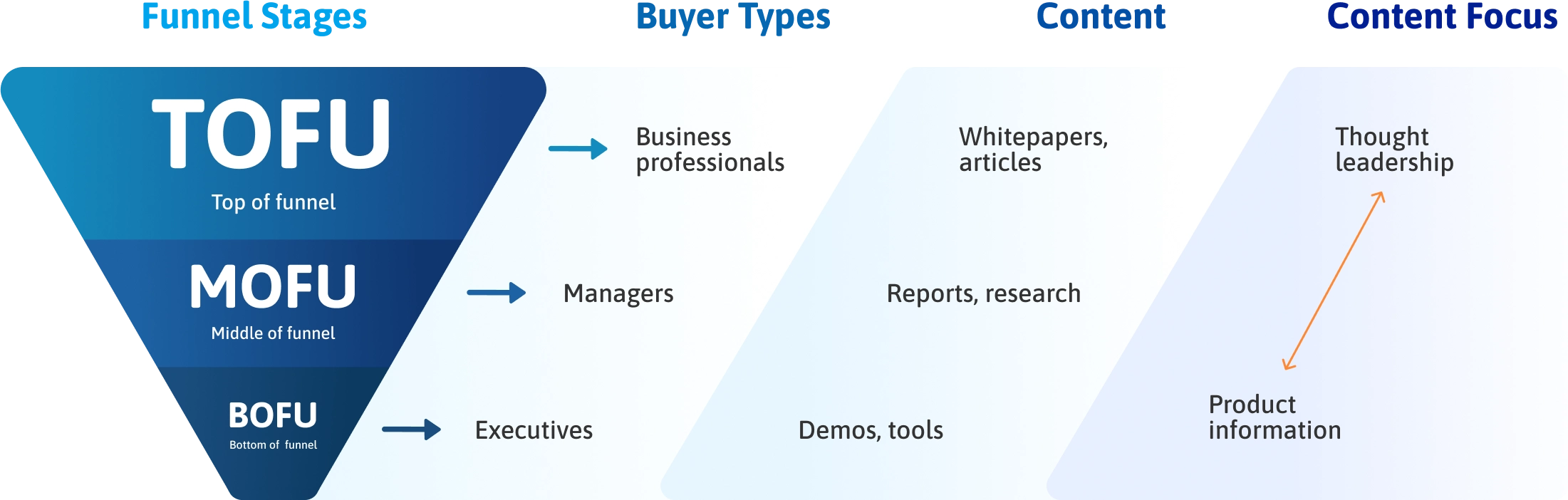
By delivering early value to prospects, you guide them from invisible interest to confident action. As a result, nurturing strategies that enable buyers from the very beginning of their buying journey are far more likely to support business goals, while building long-term and high-value client relationships.
This whitepaper outlines ten key practices for top of funnel lead nurturing that can be implemented to ensure success.
Understand your target prospects
1.

A strong understanding of your buyers is the foundation of any successful top of funnel strategy. To achieve this, you should surpass basic buyer personas to uncover how your prospects think, research, and make purchasing decisions.
By developing a deeper understanding of your ideal client’s behavior, your teams can better engage potential buyers in ways that are helpful, relevant, and timely. Success here requires meeting buyers where they are and guiding them forward, allowing them to approach you when they are ready to do so.
Importantly, B2B purchases rarely involve a single decision maker. Instead, buying groups encompass a range of stakeholders, including economic buyers, technical evaluators, and operational influencers. Each stakeholder brings their own distinct priorities and perspectives to the process.
Therefore, focusing solely on the economic buyer risks overlooking the wider buying group that shapes the purchasing decision, decreasing the likelihood of influencing decisions at an account level.
Below are three core tactics for addressing this complexity.

1.1. Build buyer intelligence for personalized engagement
To engage all stakeholders meaningfully at the top of the funnel, you need precise buyer intelligence. This forms the foundation for segmenting your audience, based on factors such as industry, role, company size, and observed buying signals.
These segments enable you to craft more relevant, tailored outreach strategies. This is important, considering 89% of leaders believe personalization is crucial to their business’s success in the next three years (Twilio Segment, 2024).
Targeting in these strategies must reflect the varied ways these groups consume content. For example, an IT influencer will not engage with the same material as a finance director or an operations leader.
Below is an example of how segmented audience priorities may exist within a single buying group:
Stakeholder type
Content preference
IT Professionals
Technical guides, integration frameworks
Operations Managers
Process improvements, efficiency use cases
Executive Sponsors
Business outcomes, ROI focused content

1.2. Align messaging with buyer priorities
Beyond segmentation, effective messaging must align with the highest priority challenges and goals of today’s B2B buyers. According to the Voice of the Buyer 2025, the most important B2B buyer priorities are:
Rather than focusing on product features, successful messaging should reveal how your solution addresses these business outcomes.

1.3. Maintain buyer personas that evolve with behavioral change
Buyer personas must evolve alongside shifting buyer behavior to remain effective.
Regularly revisit and refine your targeting to reflect new behaviors, preferences, and signals from the dark funnel. This ensures that every touchpoint is responsive to the way buyers actually move through their journey.
Keep your buyer personas up to date by:
Build awareness with high-value, ungated content
2.

At the top of the funnel, the objective is to support prospects with self-directed discovery that answers their questions, rather than collecting contact details.
Introducing barriers at this stage, such as gating content, risks deterring buyers who remain in the research phase and are not yet prepared to engage directly with a potential vendor.
Effective early-stage nurturing begins with providing relevant, ungated content that addresses authentic buyer concerns. Whether in the form of a detailed guide, explainer video, or interactive tool, the primary goal is to educate and enable buyers as they navigate the early stages of their decision-making process.
On average, B2B buying groups engage with four to six content pieces throughout the technology buying process (Voice of the Buyer 2025). Therefore, every asset must deliver tangible value and contribute meaningfully to the buyer’s journey.

Implement SEO to enhance visibility
To ensure your content reaches prospective buyers when they are actively seeking information, a strong search engine optimization (SEO) foundation is essential.
SEO continues to generate a significant return on investment. In B2B SaaS, the three-year average SEO ROI sits at 702% (firstpagesage, 2025).
A strong SEO strategy for top of funnel engagement does not need to be complicated. Focusing on the following elements will significantly boost your search visibility:
Organic search is one of the most dependable channels for driving consistent website traffic, but sustaining that momentum requires a dynamic SEO strategy. In practice, this involves actively monitoring keyword performance, addressing content gaps, and updating high performing assets to stay relevant. As buyer behaviors evolve, so should your keyword targeting.
Top of funnel success is not only about generating traffic, but about visibility and delivering genuine value. By aligning your content with the way buyers search, you can help them find answers and make confident decisions early in their journey. Doing so builds trust and establishes a robust relationship.
As AI search platforms grow in influence, brands should also adopt emerging practices like answer engine optimization (AEO) and generative engine optimization (GEO), ensuring content can be understood, cited, and surfaced by AI crawlers as well as traditional search engines.
Develop an effective email nurture strategy and automate workflows
3.

Email marketing remains one of the most effective channels for top of funnel engagement, delivering an average return of $36 to $40 for every dollar invested (Omnisend, 2024). It is also a fully automated way to send outreach to prospects, allowing you to deliver the right message, at the right time, to the right audience.
Buyers in the awareness stage want practical insights over sales pitches or generic updates. As a result, each email should prioritize delivering real value in line with their buying journey stage.
Personalization plays a critical role in achieving this. According to a survey by Khoros (2024), 65% of buyers have switched providers following a poor experience, and 67% have shared that negative experience with others.
These figures highlight the importance of using behavioral and engagement data to shape your messaging.
Successful top of funnel email strategies are built on segmentation, as outlined in the buyer intelligence section above. From there, leverage automated drip campaigns to deliver consistent and timely communications.
Automation enables you to respond to prospect behavior, such as viewing a whitepaper or returning to your website, with content that feels relevant and intentional.
Cadence is important for effective automation. While frequency will vary by audience and context, a weekly send often provides the optimal balance: maintaining brand visibility without oversaturating inboxes. However, a weekly cadence should be adjusted as necessary, according to the habits and preferences of your prospects.
To further enhance your strategy, incorporate data enrichment tactics, such as:
These methods will help deepen your understanding of each segment, improving future targeting and engagement.
Implement omnichannel, journey‑aligned distribution
4.

Effective top of funnel nurturing cannot be confined to a single channel. Today’s buyers move across platforms, consuming content, participating in peer communities, and evaluating solutions independently.
This fluid behavior requires marketers to adopt an omnichannel approach, aligned with each stage of the buyer journey. 70% of marketers report significant ROI improvements as a result of omnichannel efforts (Firework, 2024).
The foundation of this approach is audience segmentation using buyer intelligence. By grouping prospects according to their journey stage, from early awareness to active consideration, you can align messaging to meet buyers where they are.
Below is an example of buyer needs by buying journey stage:
Buyer stage
Buyer need
Recommended focus
Problem awareness
Clarity on challenges and industry trends
Educational content and market insights
Solution exploration
Comparing available solutions
Use cases, explainer content, and product primers
Purchase consideration
Evaluating specific providers and offerings
Case studies, proof points, and ROI calculators
Behavioral data and engagement signals provide the intelligence needed to personalize these interactions.
By monitoring how prospects engage with your brand, you can dynamically adjust your messaging.
Personalization here should extend across key channels, including:
Coordinated execution across these channels increases your chances of reaching buyers in critical moments in their buying journey.
Each touchpoint should add new context to the buyer’s journey, rather than repeating the same message in multiple formats. This layered approach ensures your outreach remains relevant and engaging at every step.
Capture dark funnel signals using intent and behavioral data
5.

In most cases, buyers are already researching, comparing, and shortlisting products before you can track buyer signals. This activity commonly happens in the dark funnel.
Dark funnel activity refers to anonymous buyer behavior that indicates interest but remains invisible to traditional tracking methods. Tools such as 6sense and G2 Buyer Intent can provide insights into this activity by identifying patterns in online research and engagement.
Inside the Dark Funnel
Where intent starts before you can see it.
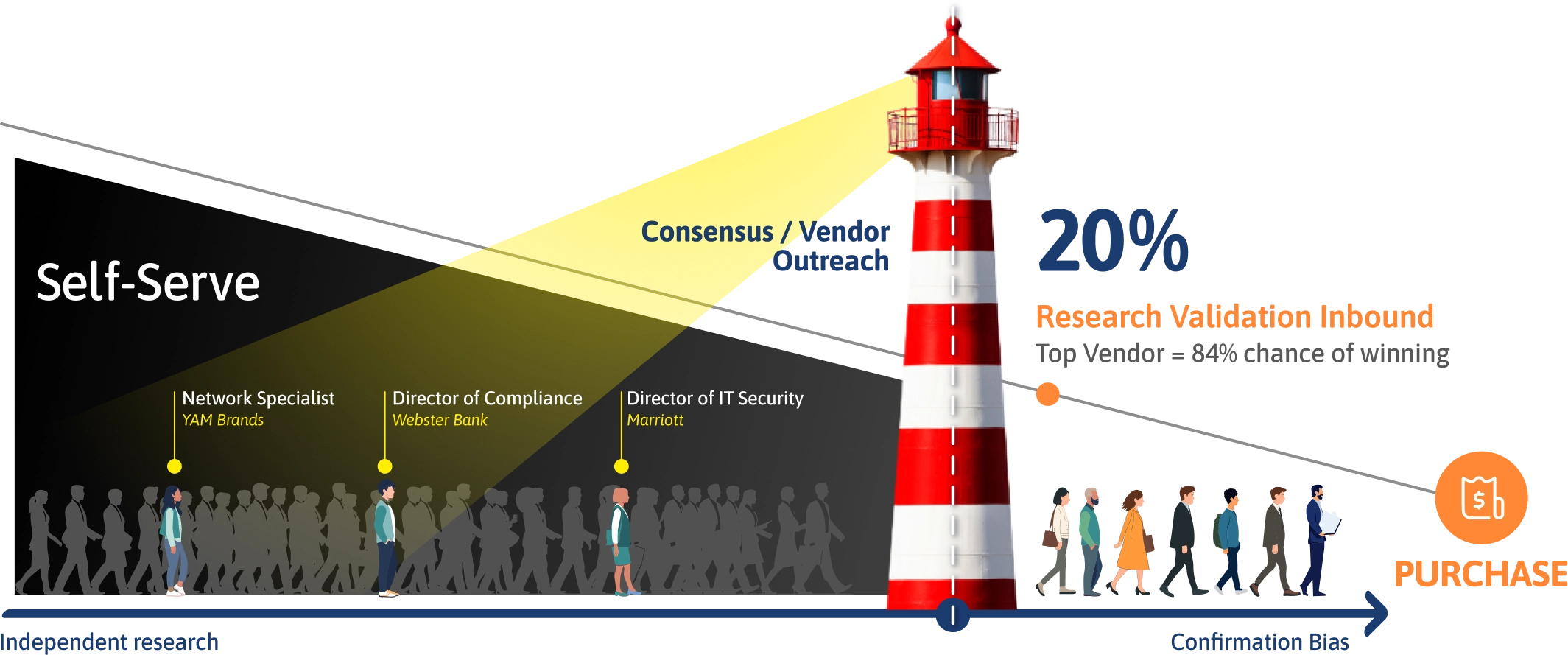
Some key indicators of early buyer interest include:
1.
Anonymous research
Buyers explore solutions, compare vendors, and consume content without revealing who they are.
2.
Off-platform signals
Engagement happens on third-party sites without filling out forms or making direct contact.
3.
High-intent page visits
Frequent unconverted traffic visits pricing, solutions, or comparison pages, signaling active interest.
4.
Surge in topic searches
Your ideal buyers are searching more often for key terms in your category or niche.
5.
Repeat account-based engagement
Anonymous users from target accounts engage with your site or content repeatedly.
6.
Unsolicited return visits
Buying group members revisit content without filling out forms or requesting a demo.
Beyond your owned channels, social listening offers another layer of insight. By tracking conversations and activities on social platforms, you can detect early interest well before prospects visit your website.
Intent data enables a shift from static demographic targeting to dynamic behavioral segmentation. Rather than waiting for form submissions, marketing and sales teams can trigger actions based on observable buying signals.
Below are examples of buyer behaviors and recommended responses:
Buyer behavior
Recommended response
Repeat content views from an account
Launch an educational nurture sequence
Visit to the pricing page
Deliver a tailored solution overview
Surge in topic searches by a buying group
Trigger sales outreach with relevant context
Industry forum engagement on key challenges
Serve targeted thought leadership content
Enable buyer-led journeys from the very first touchpoint.
Our INFUSE demand experts help you create full funnel strategies that activate interest, capture intent, and guide prospects from invisible to engaged.
Sync with sales using real‑time intent triggers
6.

Successful nurturing requires coordinated efforts between marketing and sales. This alignment requires clear definitions, consistent timelines, and a mutual understanding of when a prospect is ready for engagement.
The first step is to establish service-level agreements (SLAs) between both teams. These agreements should clearly define:
Well-defined SLAs require a shared source of truth, preventing misalignment and reducing the risk of missed handoffs.
Intent data is essential for informing these handoffs. High-value buyer behaviors, such as returning to a pricing page, viewing a product demo, or downloading multiple resources, should trigger alerts for sales teams.
These engagement signals provide context, enabling sales teams to prioritize outreach and tailor their conversations effectively.
To operationalize this approach, sales teams must have real-time visibility into buyer behavior. But just as critically, they need to know when not to engage. If sales teams reach out too early, they risk interrupting the nurture flow before the buyer is ready. This is why timing, context, and coordination with marketing are essential.
Ensure that key engagement insights, such as content views and interaction history, are integrated into your CRM or sales engagement platform. This transparency helps sales stay aligned with the nurture journey and act only when signals indicate genuine readiness.
Depending on your technology stack, AI and automation can further streamline this process by:
Even incremental automation, such as surfacing timely insights on a contact record, helps maintain momentum without cutting the journey short. Technology may enable speed, but nurturing requires precision.
Audit and segment your contact list
7.

While building prospect lists is a foundational step in demand generation, this alone does not drive results. For nurturing programs to succeed, prospect data must be carefully maintained and strategically segmented. This ensures your nurturing strategy reaches the right audiences with relevant, timely communication.
The first priority is database hygiene. Regularly review and cleanse your contact lists to remove:
This process protects your email deliverability and improves the accuracy of your targeting efforts.
Once your database is healthy, use segmentation to move beyond basic demographic filters.
Consider segmenting your contact base using multiple dimensions, such as:
Segmentation criteria
Example data points
Firmographics
Industry, company size, region
Technographics
Current technology stack, complementary tools
Buyer journey stage
Awareness, consideration, decision
Role and function
Job title, department, level of influence
Behavioral signals
Content interactions, site visits, email engagement
Install-base data
Existing product use within target accounts
Incorporating install-base data, when available, enhances your targeting precision by identifying accounts already using related technologies. Doing so ensures your nurture efforts are directed toward active prospects with relevant needs. Relying exclusively on engagement creates blind spots, as many early-stage buyers research anonymously.
Segmentation is only part of the equation. To nurture effectively, apply lead scoring models that prioritize contacts based on their likelihood to convert. Lead scoring helps uncover reactivation opportunities and guides where to focus nurturing efforts next.
Dynamic segmentation, which automatically adjusts as prospects engage with your content, further improves your ability to respond in real time.
For example, as a prospect’s interest in a particular solution increases, you can trigger targeted nurture tracks that reflect their evolving needs. When engagement declines, adjust your messaging to reignite interest or reduce touchpoints without dropping off completely.
Consider account based efforts to target key players
8.

Account based marketing (ABM) is not necessary for every nurturing program. However, for instances with high-value accounts or long buying cycles, taking an ABM approach enhances the nurturing focus and makes your efforts more relevant.
This approach allows marketers to prioritize accounts showing early intent signals for nurturing, encouraging them to progress through their buyer’s journey.
With ABM, you can track intent behaviors that originate from identified companies. This means monitoring specific engagement patterns that suggest a buying group is beginning to explore solutions. These insights are what power your ability to build meaningful nurture journeys, tailored to the needs, timing, and interests of each account.
Effective ABM relies heavily on personalization. Tailor content and messaging to the unique context of each buying group. Then, dynamic content can support these personalized journeys. Use first-party data from your CRM and marketing automation tools to reflect past engagement and known account characteristics.
Enrich this foundation with third-party intent signals to build a more comprehensive understanding of the exact buyers involved and what their needs are.
To maintain visibility across the buyer’s journey, integrate retargeting and social outreach into your ABM programs. These channels help reinforce your message while prospects continue their independent research.
Effective ABM requires a higher degree of effort and coordination. Building hyper-personalized journeys takes time, but the increased relevance typically drives stronger engagement and accelerates buying decisions.
Measure the full buyer’s journey, from invisible to closed
9.

Traditional prospect tracking captures only a limited view of the buyer journey. To accurately assess the impact of your top of funnel efforts, it is essential to measure the signals buyers generate well before they enter your database.
These early interactions represent the invisible stages of the journey, where interest is built but not yet declared. This requires tracking anonymous engagement patterns and early intent signals.
Attribution platforms play a critical role in connecting these early-stage signals to pipeline progression and ultimately to closed revenue.
By applying attribution across the entire buyer journey, marketers can understand which content assets contribute to advancing deals rather than simply generating traffic. This distinction is essential.
Regularly adapt and refresh your strategies
10.
Prospect nurturing is never a static process. Buyer expectations evolve, engagement behaviors shift, and preferred channels change over time.
To sustain meaningful engagement and drive consistent results, your nurturing strategies must evolve in response to this progression.
Review your analytics weekly to understand what is resonating and where prospect engagement declines or ends. Consider leveraging AI-powered tools and dark funnel attribution platforms to surface hidden patterns in buyer behavior. Combine this with A/B testing of your content to refine messaging, formats, and timing.
Continuously update your content map and nurture flows as you learn more from your prospects. Refresh channels and tactics as new opportunities to reach buyers emerge.
Sustained optimization ensures your strategy remains aligned with current buyer behavior. By adapting in real time, you position your brand to meet buyers where they are in their journey.
This agility transforms your nurturing efforts from static campaigns into dynamic, responsive experiences that confidently guide buyers forward.
Key takeaways


Build a top of funnel engine that engages your ideal prospects.
INFUSE demand experts partner with you to create top of funnel nurturing strategies designed for complex, buyer-led journeys.
Whether you are looking to surface dark-funnel signals, enable decision-making with high-value content, or deliver engaging omnichannel experiences, our team is here to help.

Fill out the form to access the full case study
Fill the Form