6 Steps to Engaging Your Defensive Buying Groups
17 min
Updated: September 14, 2026

Executive summary
B2B purchases are not the responsibility of an individual, but rather a complex journey fulfilled by large, risk-averse buying groups. Engaging these multi-stakeholder teams across every stage of the buyer’s journey requires a practical, proven approach to support marketing and sales leaders on their strategies to influence decision making and accelerate conversions.
This article offers guidance on how to tailor outreach, content, and enablement to drive alignment, build consensus, and move buying groups forward. These frameworks and best practices remain true amid compressing sales cycles, expanding buying groups, and fragmented engagement paths.
Key insights:
- A 6-step framework to engage buying groups throughout the B2B buyer journey, from awareness to post-purchase
- Best practices in buyer persona development, journey mapping, and GTM alignment
- Role-specific tactics for both marketing and sales to accelerate buyer group progression
- Content formats and messaging matched to funnel stages and stakeholder needs
The reality of B2B buyer behavior
B2B purchasing decisions are made by interconnected buying groups, composed of multiple stakeholders from various departments. The use of AI has made this process even more complex. Buyers face pressure to compress cycles, while having access to more information than ever, creating a widening trust gap between buyers and vendors.
This shift has fundamentally changed the buyers’ behavior, as the buying groups are built to align on priorities well in advance of engaging directly with their vendors of choice.
In fact, according to the INFUSE Insights Voice of the Buyer 2026 report, the average B2B buying cycle has shortened to seven months. However, the influence window closes even earlier than that compression suggests. By the awareness stage, buyers are already reaching for case studies (38%) and product demos (33%) to validate opinions they formed invisibly in the dark funnel.
This compressed, self-directed timeline reflects a broader trend of buyers becoming increasingly defensive, choosing validated, low-risk solutions that integrate seamlessly with existing investments.
To meet this change, leading go-to-market (GTM) teams have shifted from legacy intent signals from form fills or content downloads to aggregated behavioral and intent-based indicators that span the full activity of an account.

CMO, INFUSE

“In B2B marketing, the buying decision is often made before a salesperson ever enters the conversation, with buying groups reaching internal consensus early in their journey. The key is enabling brand champions within those groups to influence peers, which is something we have observed by analyzing how buyer behavior unfolds across stakeholders before outreach even launches.”
How have B2B buying groups changed?
There has been a significant shift in B2B buyer behavior, marked by caution, complexity, and a demand for efficiency, which, according to INFUSE Voice of the Buyer 2026, remains the top technology investment driver at 31% (down from 41% in 2025).
Buying groups now average nine stakeholders, and 21% involve 15 or more (INFUSE Voice of the Buyer 2026).
The complexity of buying groups compounds when stakeholders enter at different stages of the funnel, each with distinct needs and pain points. With 89% of buyers now using GenAI in their research, much of this activity unfolds anonymously.
As new members join, they enter at the top of the funnel. As a result, a large account is always, in some part of itself, in the discovery stage.

Inside the new B2B buyer journey, buyers move together, but not in sync:
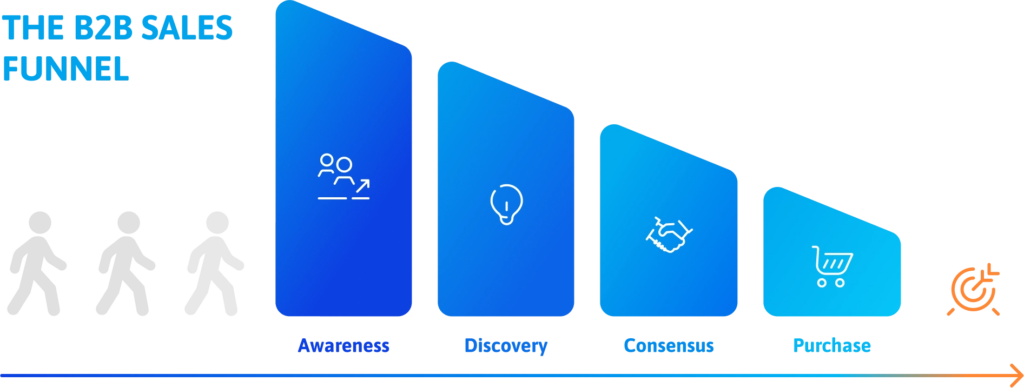

The 6-step strategy for engaging the entire B2B buying group
The following framework maps the six stages of a modern B2B purchase, with responsibilities split between marketing and sales at each one. Treat it as a coverage model rather than a sequence.
1. Becoming aware of a need
This stage represents the buying group’s realization of a problem, their assessment of whether it warrants action, and their first look at what solutions exist. However, this is not your first contact with the buyer.
Buying groups already form a shortlist by the time they formally identify a need. This is the Day Zero shortlist, which is formed through the activity that precedes day one of a buying cycle. Day Zero activity includes brand exposure, thought leadership, peer recommendations, content consumed months earlier, and any prior professional experience with a vendor. Together, these factors determine which names a buyer already knows and trusts when the journey begins.
This changes what the awareness stage asks of a GTM team. Instead of introducing your brand at the moment of need, your objective is to have already earned a place in the buyer’s consideration before the need surfaces. INFUSE Voice of the Buyer 2026 shows that only 4% of buying groups say brand familiarity plays no role in whether a vendor is shortlisted.
Two forces make Day Zero both more difficult to influence and more decisive:
- Buyers are increasingly independent and risk-averse. They research anonymously in the dark funnel and default to validated, low-risk options that integrate with existing investments, with 58% ranking alignment to their current stack as a top shortlist factor.
- When a buyer researches vendors in your category through AI, the model returns a shortlist. If your brand is not legible to that model, you are absent before a human evaluates anything.
The work of this stage is therefore Day Zero work, which involves creating a sustained presence, discoverability, and accumulated proof.
Marketing team’s responsibilities
- Develop and promote demand generation content that addresses pain points, challenges, and trends
- Create and deliver content that can assist buyers with independent research through enablement
- Treat brand authority as a primary deliverable
- Invest in AI discoverability
- Provide content that enables the entire buying group
- Remove friction from self-led evaluation by ungating decision-critical material
- Lead with realistic, quantified proof rather than ROI promises
Sales team’s responsibilities:
- Adapt outbound materials to match the prospects’ most common pain points and support this knowledge with relevant industry trends
- Focus on light, value-driven engagement, acting as helpful advisors ready to discuss challenges, not make a sales pitch
- Treat outbound as a Day Zero contribution, where consistent, useful presence in target accounts long before a need is declared
- Engage the full buying group rather than a single champion
Content recommendations to help buyers identify their needs:
Content type
Purpose
Client case studies
The most valued awareness asset at 38%. Buyers use them to validate opinions formed on Day Zero, so make outcomes and relevance immediately visible
Product demos, self-serve and recorded
Let buyers see the solution working without booking a call
Original research and benchmark reports
Give buyers data they cannot source elsewhere and a reason to cite your brand internally. These are also the most citable asset type for AI answer engines
Trend and industry insight reports
Educate buyers on market shifts, risks, and future-state thinking
Subject matter expert (SME) and executive thought leadership
Share big-picture views that challenge assumptions or spark curiosity, focused on industry pain points, buyer trends, or misunderstood risks
Webcasts and explainer videos
Introduce new ideas or solutions through simple, low-commitment formats that deliver value without requiring commitment
Educational blog posts
Answer the specific questions buyers ask early, in a non-promotional and insight-led way, and structure them so answer engines can extract clear responses
Integration and compatibility documentation
Address the stack-alignment gate at the point of discovery rather than late in evaluation
Infographics
Highlight key stats, frameworks, or processes in easy-to-scan overviews
Self-assessment and diagnostic tools
Support buyers in evaluating current performance and framing the problem internally
2. Making a commitment to change
By the commitment stage, buyers have defined the specifics of their needs and have identified clear challenges to be solved. This is a critical turning point when stakeholders or decision makers actively enter the B2B buying process.
Help buyers commit with targeted content that builds credibility and trust, which will guide them toward ultimately shortlisting your brand for consideration later on.
Marketing team’s responsibilities:
- Track engagement at account level rather than contact level, aggregating behavioral signals across every stakeholder to inform the nurture streams that go out to the group
- Create content that builds awareness of your products, services, and brand
Sales team’s responsibilities:
- Leverage credibility in the form of client reviews or feedback, as well as any relevant accolades, to build trust and communicate product value
- Messaging should align with buyer pain points and needs
Content recommendations to help buyers commit to change:
Content type
Purpose
Product demo videos/live demos
Showcase how the solution works and solve specific challenges
Client case studies
Highlight measurable outcomes for similar organizations, ideally with metrics (ROI, conversion lifts, time saved)
Technical one-pagers
Show how the solution fits into their existing tech stack with minimal disruption
Implementation guides
Help buyers visualize a smooth transition and set expectations around support
Security and compliance documentation
Deliver essential information for enterprise and regulated industries
Executive endorsements/peer testimonials
Provide senior stakeholders with social proof from trusted voices
3. Investigating options during the B2B buyer research process
During this evaluation stage, buyers begin actively researching solutions and comparing vendors to see which is the best fit. Buyers will likely revisit research and identify the organization best suited to meeting their needs from a curated shortlist.
Therefore, the priority should be earning a spot early on, particularly as only 20% of buyers switch vendors once the buying group establishes consensus (INFUSE Voice of the Marketer 2026).
During evaluation, buyers rely most on direct information from vendors and ecosystem partners (24%), internal peers and cross-functional colleagues (22%), and independent subject matter experts (20%) (INFUSE Voice of the Buyer 2026).
Position your solution as the best-fit choice through educational tools and omnichannel presence.
Marketing team’s responsibilities:
- Prioritize the assets buyers value at this stage: case studies (36%), product demos (35%), and technical documentation, which surges to 28% as IT and security stakeholders join the evaluation (INFUSE Voice of the Buyer 2026)
- Consider your buyer personas’ specific content preferences and focus on fueling omnichannel nurturing throughout the journey
Sales team’s responsibilities:
- Use this time to form an accurate understanding of the buying group’s needs, considering each individual member so as to best position yourself to provide expertise and guidance
- Align with marketing to ensure engagement occurs when buyers express intent
Content recommendations to help buyers with competitor comparison:
Content type
Purpose
Solution comparison guides
Help buyers evaluate different approaches, tools, or vendors
How-to guides and playbooks
Provide tactical, step-by-step guidance that positions your approach as the best path forward, validated by data insights
Case studies and success stories
Show real-world outcomes from organizations with similar pain points
Expert webinars
Host topic-specific sessions with experts or client participation to build trust
Whitepapers and eBooks
Educates on frameworks, methodologies, or outcomes with authoritative content
Product overviews
Educate about the product, tying the solution to the buyer’s problem
Client testimonials
Build social proof and trust in your expertise
4. Building internal consensus
Buyers at this stage of the B2B buying process have shortlisted their options and are seeking to secure buy-in from other stakeholders within the buying group. Consensus is required before a purchasing decision can be made.
The goal of marketing and sales teams is to create a seamless buying journey that enables buyers to reach a consensus independently. Make your brand the top choice by enabling internal champions and simplifying the B2B purchase decision process.
Marketing team’s responsibilities:
- Content should speak directly to the buying group and focus primarily on tangible, revenue-focused results
- Leverage content to aid the evaluation process by making information easily accessible, such as providing product comparisons and one-pagers with product features
Sales team’s responsibilities:
- Answer all queries, address objections, and prove the value of your solution above that of your competitors
- Leverage up-to-date competitor comparisons and market surveys to ease this process
Content recommendations to help buyers shortlist vendors:
Content type
Purpose
Stakeholder-facing business case decks
Offer pre-built presentations or slides to help internal champions articulate value, ROI, and implementation readiness
Executive summaries
Make available concise overviews focused on business impact and alignment with strategic goals
Case studies featuring cross-functional success
Provide examples where marketing, sales, IT, and operations benefited, showing the solution solves more than one department’s pain point
Security, compliance, and IT integration documentation
Remove objections from legal and IT with tailored technical assets to satisfy procurement and technical reviewers
Client advocacy content (testimonials, videos, peer connects)
Reinforce trust and relatability by telling human stories from credible buyers in similar roles/industries
Implementation timeline or change management guide
Reduce inertia and reassure executives with clear visibility into “what happens next”
Pricing breakdown and option matrix
Show flexible tiers, use-case packages, or phased rollout options to support stakeholder negotiation
5. Validating choice
With the support of all members, the buying group will be finalizing the last details of deciding on a purchase. They will be prioritizing low-risk solutions that meet their performance goals, are easy to implement and integrate, and hold tangible business value. In fact, 47% of buyers now rank proven integration with their existing tech stack as their top AI evaluation criterion (INFUSE AI Research Reality Check, 2026).
Small details hold greater importance and may be the deciding factor between one solution and another. At this stage, efforts should be focused on reinforcing trust and removing final objections with proof points that match stakeholder priorities.
Marketing team’s responsibilities:
- Make the messaging about building credibility
- Leverage content such as case studies and client testimonials to encourage purchases
Sales team’s responsibilities:
- Consider the unique biases and agendas of the decision makers within the buying group and provide a detailed breakdown of costs associated with each solution (including competitors) to support negotiations
- Focus and relate the differentials of your product to the specific needs of each account to increase your likelihood of success
Content recommendations to help buyers validate vendors:
Content type
Purpose
Final pricing and packaging sheets
Establish clear expectations by clearly breaking down tiers, inclusions, optional services, and volume-based pricing
Contract walkthrough
Accelerate legal review and build trust in the relationship
Implementation readiness checklist
Reinforce preparedness on both sides and reduce perceived onboarding friction
Client references
Add credibility and emotional assurance with live validation from a real client
IT and integration confirmations
Help IT feel confident that integration will be fast, secure, and compatible
Legal/compliance FAQ
Provide assurance of legal or regulatory compliance
6. Making a purchase
The buyers who will use your solution directly will typically research best practices to avoid losing time learning at the time of implementation, placing them at a different stage of the funnel than the rest of the buying group. Support confident adoption and accelerate onboarding by anticipating user needs pre-sale.
Marketing team’s responsibilities:
- Support and encourage the curiosity of bottom of funnel buyers by moving them into a new, tailored nurturing cadence
- Attention to detail is essential even after a purchase has been made
Sales team’s responsibilities:
- Focus on resolving any of the buying group’s final objections as they seek to increase the value they stand to receive from making a deal
- Personalize your offering in a way that meets all buyers’ needs, yet still meets ROI goals
Content recommendations to help buyers make a final decision:
Content type
Purpose
Onboarding guides
Help users feel prepared before kickoff, including timelines, responsibilities, and setup checklists
Best practices content (videos, blog posts, guides)
Share how other teams have succeeded quickly with your solution
Client enablement hub/resource library access
Provide early visibility into training resources, documentation, and support contacts
4 best practices for your full-funnel buying group strategy
When engaging buying groups, it is important to build a thoughtful understanding of all its members. This should encompass
- Their different needs and pain points associated with each B2B decision maker’s role
- The stages they enter into and influence the buying journey
- Consistency across all stages of engagement for the entire group
To help ensure your campaigns are effective and well-received, these four best practices are the pathway to full-funnel engagement:
1. Research the buying group and understand the B2B buyer research process
Researching the buying group and organization provides you with an understanding of the status quo and establishes what would make their day-to-day and GTM goals more achievable.
To establish a clear understanding of how to approach the buying group of each target account, gather as much information on each member’s preferences, both in terms of the type of content they consume and the channels they typically frequent.
Your research should also include their background within the organization and the authority they hold in buying decisions. This can help determine the role of each buyer within the group to guide your messaging and targeting strategy.
Best practices for researching buying groups:
- Use LinkedIn, company websites, and buyer intent data to identify key stakeholders involved in the decision making process
- Search for roles across functions such as executives, influencers, champions, and gatekeepers
- Map roles and responsibilities to understand each stakeholder’s role in the buying decision and reporting structures
- Understand the account’s strategic priorities by reviewing press releases, investor briefings, and blog posts
- Look for triggers like recent funding, leadership changes, technographics and install base data, or strategic initiatives
2. Create buyer personas
When reaching out to a buying group, it is important to first understand whether the individuals involved align with your buyer personas and Ideal Client Profile (ICP). Drive relevance and alignment with personas tailored to roles, pain points, and journey stages.
Developing multiple buyer personas for different roles and offerings can help you identify the most suitable content for outreach. This approach also guides your engagement strategy, helping to ensure your message remains relevant, well-received, and tailored to their individual needs.
Four best practices for creating buyer personas:
- Use a mix of qualitative and quantitative insights such as CRM and marketing automation data, intent signals and engagement history, and sales feedback from the field
- For each persona, outline attributes such as job title and responsibilities, pain points and goals, influence in the purchase process, and preferred content channel
- Understand which stage in the journey each persona is in to align content and engagement strategies accordingly
- The needs of your buyer personas will shift over time, so revisit and refine them regularly
3. Map your buyer’s journey
Ensure content alignment and reduce friction with journey maps that reflect how groups actually buy. A seamless B2B buyer journey is a frictionless, personalized path that guides buyers from awareness to decision and beyond, aligned with how buying groups research and engage.
The overall objective is to help buyers recognize a challenge or opportunity and introduce your brand as a trusted resource. It starts by attracting interest through thought leadership and intent-based targeting, then nurtures consideration with educational content, webinars, and personalized ABM campaigns. As buyers approach a decision, validation assets like case studies and product comparisons reduce risk and accelerate consensus.
Three best practices for mapping the buyer’s journey:
- Outline the core stages of the journey, buyer behaviors, and needs at each stage
- Use CRM data, engagement analytics, and intent platforms to understand how buyers move across stages
- Map your buyer’s actions and needs at each stage by defining what information they need and what content or engagement fits best
Journey mapping is a foundational component of any full funnel marketing strategy.
4. Establish cross-organizational alignment
Alignment is essential for executing a successful full funnel marketing strategy. Organizations can maximize campaign impact through unified GTM strategies, real-time feedback loops, and multithreaded outreach.
Client success teams maintain relationships with existing accounts, while sales engages directly with active prospects, making both critical sources of insight. Their feedback can validate persona accuracy, refine messaging, and confirm whether campaigns are addressing real buyer pain points.
To reach the full buying group effectively, it is essential to establish clear, ongoing information flows between marketing, sales, and demand professionals. This enables true multithreading: nurturing every stakeholder involved in the decision, across roles, seniority levels, and geographic regions.
Since different personas enter the journey at different times and influence distinct stages, alignment across teams is key to ensuring a cohesive, responsive GTM approach. This complexity requires a coordinated approach to the B2B buying process.
Five best practices for aligning teams to target B2B buying groups:
- Establish a unified engagement strategy to coordinate outreach across functions
- Develop a multithreading strategy that accounts for regional, role-based, and journey-stage engagement
- Build shared dashboards for real-time visibility into buying group interactions
- Define and align on success metrics across teams
- Use sales and client success feedback to continually refine targeting, messaging, and content delivery
Key takeaways
- The traditional linear funnel no longer applies: B2B decisions now involve complex buying groups with multiple stakeholders, entering the process at different stages
- Engagement must be stage-specific and persona-driven: Buyer personas must be clearly defined and aligned to their role in the process, pain points, and content preferences.
- Modern GTM requires precision buyer enablement: Sales and marketing must collaborate to identify account-level intent signals, personalize outreach, and nurture groups over time.