
5 Steps to Establishing a Compelling Omnichannel Presence
14 min
Updated: September 27, 2026

Executive summary
This article outlines what B2B omnichannel marketing is and provides a strategy for creating a compelling omnichannel presence, crucial for enhancing demand generation performance by engaging prospects consistently across various touchpoints.
Key insights:
- Utilize data: Use demand intelligence tools to harness AI for effectively identifying, engaging, and converting potential buyers across channels
- Implement omnichannel solutions: Integrate data from multiple sources to ensure consistent messaging, utilize advanced analytics for tracking client behavior, and optimize omnichannel marketing campaign performance
- Apply best practices: Use omnichannel marketing automation to personalize engagement and enhance client insights, thereby mitigating churn and increasing client lifetime value (CLTV)
- Explore further: Dive into the full asset to gain deeper insights into optimizing your omnichannel marketing strategy for successful demand generation and enhanced client experiences
What is omnichannel marketing?
Omnichannel marketing is a marketing approach that focuses on providing a seamless and consistent buyer experience across all channels and touchpoints, both online and offline.
The goal of omnichannel marketing is to ensure brands are discoverable across the channels where buyers conduct research, while providing a consistent experience that helps them validate their decisions throughout the buying journey.
B2B omnichannel marketing plays a significant role in B2B marketing given the changing behaviors of prospects, the increased role of data and personalization in the buying journey, and buyers’ expectations of a seamless experience at every touchpoint.
According to INFUSE Voice of the Buyer 2026, buying committee members are gathering information from a variety of sources before making buying or partnership decisions:
24%
Direct information from vendors and partners
22%
Internal peers and colleagues
20%
Subject matter experts
11%
Analysts
10%
Conferences, trade shows and events
4%
AI tools
Buyers do not accept vendor claims at face value. Vendor and partner information leads at 24%, but peers (22%) and independent experts (20%) closely follow (INFUSE Voice of the Buyer 2026).
Prioritizing an omnichannel presence keeps your brand discoverable and helps buyers validate decisions throughout the journey.
Why is omnichannel marketing important for B2B demand generation?
By applying B2B omnichannel marketing, organizations can improve discoverability across the channels buyers use for research, while delivering relevant content and proof that supports decision making and generates quality demand.
What is discoverability?
Discoverability is a B2B GTM concept describing how easily a brand can be found and recognized by buyers during the earliest, largely invisible stage of their research. Because most of that early research happens anonymously, often AI-assisted, through peer conversations, communities, and independent sources rather than direct vendor contact, a brand’s presence and recognition at that stage functions as a prerequisite for even making it onto a buyer’s shortlist later on.

Effective omnichannel marketing is built on tailoring messaging and creative assets to suit the unique strengths and limitations of each channel. By matching content to each platform, target audience, and the buying journey stage, businesses can deliver a more relevant and seamless brand experience, driving interactivity and engagement. In fact, 61% of B2B buyer research occurs before vendor contact, meaning brands must establish visibility and trust while buyers are still researching anonymously (6sense, 2025).
The reach of an omnichannel presence lets businesses nurture prospects at every stage of the journey, increasing the likelihood of generating and capturing demand and encouraging buyers to progress through the funnel.
According to INFUSE Voice of the Buyer 2026, the average B2B technology buying cycle has compressed from eight months to seven months, while buying groups have expanded to an average of nine stakeholders.
A compelling omnichannel presence provides the proof that all of these buying group members need to validate a vendor across the channels they use for research.

COO, INFUSE

Prospects navigate through various touchpoints and stages of the buyer’s journey according to their unique preferences. Businesses need to be ever-present to consistently drive engagement with them across the marketing channels they use.
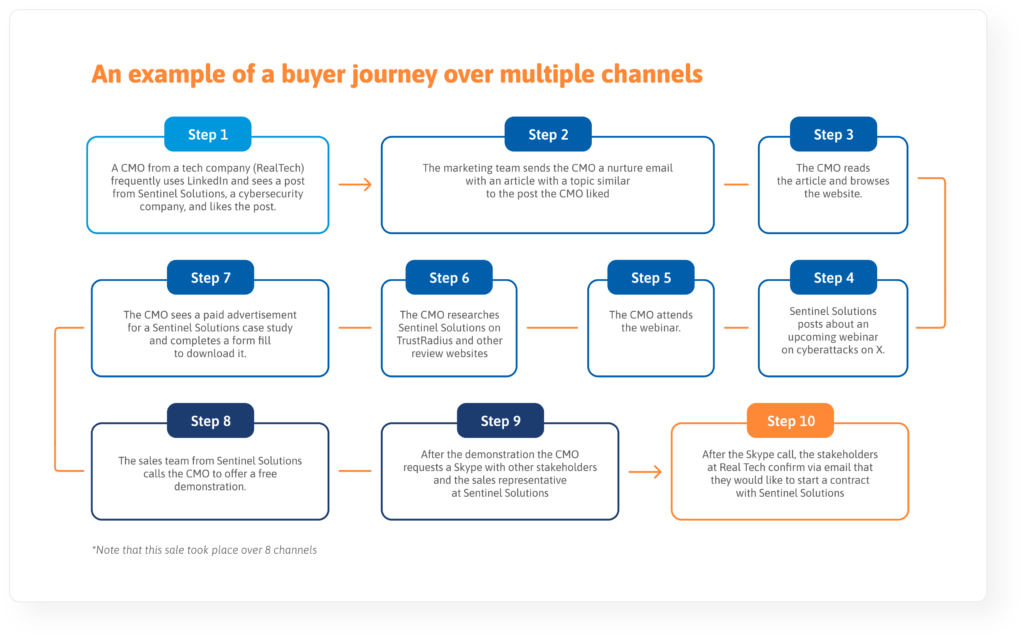
Omnichannel vs multichannel marketing
While omnichannel and multichannel marketing may have similarities, their implementation and focus are vastly disparate.
The table below highlights the key omnichannel vs multichannel marketing differences:
Aspect
Omnichannel marketing
Multichannel marketing
Definition
Offers prospects and clients a seamless, integrated experience across all channels, ensuring consistent messaging and branding.
Utilizes multiple channels to reach prospects, but each channel operates independently with its messaging and potentially, its branding.
Focus
Emphasizes prospect and client experience, as well as engagement, by providing a cohesive journey across all touchpoints.
Concentrates on maximizing reach by targeting various channels to increase visibility and reach different client segments.
Communication
Provides a unified and personalized communication approach, allowing prospects to switch channels seamlessly without losing context.
Engages prospects through individual channels that may not be connected or provide a consistent experience when prospects switch channels.
Consistency
Maintains consistent branding, messaging, and user experience across all channels, ensuring a coherent brand image.
Channels may have inconsistent branding, messaging, or user experience, as they operate independently without synchronization.
Data integration
Integrates data from all channels to create a holistic view of the client, enabling personalized and targeted marketing strategies.
Data from different channels may not be integrated, resulting in fragmented lead insights and limited personalization capabilities.
Strategy
Focuses on creating a seamless and consistent experience throughout the buyer journey, with a comprehensive strategy that aligns all channels.
Concentrates on deploying multiple channels to increase prospect touchpoints, often without a centralized strategy or coordination.
Requirements
Achieving seamless integration across channels requires a significant investment to set up and maintain processes and an optimized tech stack. Meticulous planning is also crucial to ensure the effective combination of all elements.
As multichannel marketing often uses the same or similar messaging and treats each channel as a separate entity, the costs, and tech stack required are generally less. For this reason, multichannel is often considered a starting point for marketing strategies.
Benefits of B2B omnichannel marketing
When implemented successfully, B2B omnichannel marketing can assist an organization in achieving multiple goals.
Increased client satisfaction and less churn
According to Forrester, 80% of B2B buyers remain dissatisfied with their chosen providers.
Prospects have higher expectations of brands to provide an accurate and strong experience that meets their individual needs. By providing buyers with the experience they expect, such as nurturing on their preferred channels and improving the onboarding and post-sale experience, you not only work to reduce churn, but also increase CLTV.
Higher revenue generation
Prospects are more likely to increase spend when they encounter a personalized omnichannel experience. Because B2B buyers use multiple channels to interact with vendors, consistent, shareable, and targeted information drives more impact than traditional sales conversations alone.
Improved client lifetime value (CLTV)
According to INFUSE Voice of the Buyer 2026, 37% of buyers prioritize demonstrated ROI when creating shortlists. To understand the proof of returns that vendors offer, external review platforms have become increasingly important for helping buying groups reach a consensus.
Omnichannel experiences that integrate review platforms and external trust signals are central to maximizing client value and supporting opportunities for upselling and renewals.
Optimized budgets
Despite a greater initial investment, an omnichannel approach improves the accuracy and ROI of demand generation strategies, generating higher engagement, conversions, and sales.
Creates a seamless experience
Catering to individual preferences across channels creates a seamless experience, while the data from those channels helps organizations continually refine their strategies.

CMO, INFUSE
Adopting an omnichannel approach allows businesses to assess the performance of a wide range of channels and structure their channel mix to suit their buyers. Rather than spreading their resources across all available channels, they can focus only on those that their specific target audience uses the most.
Channel types, KPIs, and best practices for omnichannel marketing
B2B teams can implement a range of marketing channels, each with distinct strengths, audiences, and opportunities to engage buyers.
Below is a comprehensive breakdown of digital channels:
Channel type
Key Performance Indicators (KPIs)
Function
Best practices
Social media
- Reach
- Engagement
- Follower growth
- Building brand awareness
- Driving client engagement
- Social listening
- Define clear goals
- Post relevant content consistently
- Engage with followers
- Monitor and respond to comments
- Open rate
- Click-through Rate (CTR)
- Conversion rate
- Direct marketing
- Client retention
- Lead nurturing
- Segment your audience
- Personalize emails
- Optimize subject lines and content
- Use A/B testing
Mobile apps
- Downloads
- Active users
- Retention rate
- Events
- Enhanced client experience (CX)
- Client Loyalty
- Push notifications
- Personalization
- Offer valuable features
- Simplify user interface
- Send targeted push notifications
- Gather user feedback
Websites
- Traffic
- Bounce rate
- Conversion rate
- Events
- Information hub
- Lead generation
- E-commerce platform
- Optimize for mobile
- User-friendly navigation
- Clear call-to-action (CTA)
- Regular content updates
Organic search
- Organic traffic
- Click-through Rate (CTR)
- Keyword rankings
- Generating website traffic
- Driving conversions
- SEO strategy
- AEO and GEO
- Optimize website for search engines
- Conduct keyword research
- Create quality content
- Monitor rankings
Display advertising
- Impressions
- Click-through rate (CTR)
- Cost per thousand impressions (CPM)
- Brand awareness
- Targeted reach
- Visual storytelling
- Define target audience
- Create eye-catching designs
- Prioritize relevant placements
- Monitor and optimize campaigns
Given the diversity of the capabilities of each marketing channel, it is essential to implement a comprehensive content marketing strategy to support omnichannel marketing campaigns.
However, omnichannel does not mean distributing more content across more channels. Buyers consume an average of nine unique content pieces during a technology purchase, yet high content consumption has not eliminated purchase stalls or buyer regret.
The priority should therefore be precision, with each asset designed to answer a specific stakeholder question and provide the proof needed to advance consensus (INFUSE Voice of the Buyer 2026).
By aligning your content marketing efforts with each channel, you can:
- Expand your reach
- Engage with your audience
- Improve SEO and organic traffic
- Establish brand awareness and authority
- Cater to diverse content consumption preferences
- Amplify your overall marketing efforts
- Support sales teams
4 common omnichannel marketing mistakes
1. Inconsistent messaging
One of the most common mistakes in B2B omnichannel marketing is inconsistent messaging across channels. When the brand message, tone, and style vary significantly across platforms, it can cause a disjointed experience for prospects and dilute brand identity. Adapting tone for channels is important (particularly social media networks), but it is still essential to maintain an overall cohesive brand voice.
2. Poor integration between channels
As the aim of omnichannel strategies is to deliver a seamless experience across various touchpoints, if channels are not properly integrated, prospects may face difficulties transitioning between them, leading to a fragmented experience.
3. Neglecting the importance of data-driven decision making
Ignoring data analytics is a significant mistake in omnichannel marketing. To optimize omnichannel marketing campaigns and understand prospect behavior, it is crucial to collect and analyze data from all channels.
4. Lack of mobile and answer engine optimization (AEO)
With the growing reliance on smartphones and answer engines for buying research and decision making, failing to optimize marketing channels for mobile devices and AI searches (through AEO) can greatly affect the performance of an omnichannel marketing strategy. According to HubSpot, AI-powered search impacts web traffic for 47% of B2B marketers, primarily increasing rather than decreasing visibility.
Brand websites, emails, or other marketing assets must be mobile-friendly to not risk losing prospects who prefer using mobile devices. This should also include ensuring that all content and designs are responsive and optimized for the mobile experience.
How to create an omnichannel strategy: 5 steps to a compelling omnichannel presence
1. Identify target audiences
How to create an omnichannel strategy starts with identifying and understanding your target audience, ideal client profile (ICP), and buyer personas. In the case of account based marketing (ABM), this process should be at a much more granular level to include the individual buying committee members at target accounts.
Gaining a deep understanding of target audiences allows organizations to identify their preferences, needs, pain points, and preferred channels, which provides the opportunity to tailor marketing messages and content to resonate with them effectively on the mix of channels that they frequent.
COO, INFUSE
Accurately identifying and categorizing target audiences is the foundation for successful omnichannel marketing. It involves researching and analyzing data to draw insights. This can include market segmentation data, intent data, as well as qualitative data from surveys, action groups, and more in combination with data from Client Relationship Management (CRM) systems.
2. Selecting relevant channels
Begin by auditing the channels you currently use. For most B2B organizations, this includes a website, email, and a few social platforms. Before adding channels, evaluate existing ones against your targeting data and performance metrics to confirm that channel and messaging align with the audience.
Assess each channel against:
- Reach and engagement potential
- Cost
- The content types and formats it supports
- Capacity for interactive, real-time, and personalized communication
3. Integrating channels and messaging
To ensure successful integration, consider the following five steps:
- Implement a central client data platform (CDP): Consolidate client interactions, preferences, and purchase history from every channel into a unified client profile.
- Enable cross-channel communication: Use integrations and APIs so conversation history follows the buyer. If a client starts on social media, that context should be visible when they move to live chat or email.
- Personalize messaging: Use CDP data to tailor content, timing, and channel to individual preferences and behaviors, with automation and AI delivering at scale without bloated workloads.
- Provide consistent branding: Maintain consistent messaging, visuals, and tone of voice across every channel. A style guide is invaluable for onboarding teams and keeping brand identity coherent as content volume grows.
- Implement a unified inbox: Aggregate messages from all channels into one interface, so support teams respond consistently, and clients never repeat themselves. It also unifies intel in one place, surfacing more relevant insights.
4. Optimizing prospect and client experience
To be truly compelling, an omnichannel presence needs a buyer experience that is as seamless and specific as possible. Use target audience data to deliver personalized messages and content tailored to each prospect’s needs. This data can include:
- Browsing behavior
- Purchase history
- Engagement patterns
In B2B, effective personalization must account for the buying group, not just the individual contact. With buying groups averaging nine stakeholders, content should reflect the different questions, risks, and success criteria of technical, financial, and business stakeholders.
Omnichannel personalization
Delivering this at scale requires the right tech stack to gather detail on prospects. Comprehensive data combined with automation allows organizations to identify and address pain points in the formats and channels prospects prefer.
Client journey mapping
Journey mapping surfaces the friction that causes prospects to drop off, along with the opportunities and brand interactions that need improvement. Applying these insights lets organizations optimize the experience at each stage and recognize the moments where value, support, and information matter most. Because prospects can enter the journey through any channel, mapping should leave room for flexibility.
Omnichannel marketing automation and AI tools
Omnichannel marketing automation tools enhance the efficiency and personalization of a brand’s efforts. Triggers based on prospect behavior can be configured to deliver automatically relevant content at the right time.
For example, sending follow-up emails with related resources after a prospect downloads a whitepaper, or providing personalized product recommendations based on specific activity-based triggers.
5. Measuring success
A central element of maintaining an effective omnichannel presence is assessing the performance of your strategies and continually optimizing them based on results.
Define brand goals and omnichannel metrics
Start by defining quantitative and qualitative goals that indicate whether strategies are worth the investment. These goals should be tied to the key metrics relevant to each channel you are utilizing. This approach should also align with the brand’s overall business objectives, such as increasing sales, prospect or client engagement, or brand awareness.
Tracking these goals will inform your optimization efforts and refinement of your channel mix in the case of low performance.
Utilize cross-channel attribution
Use analytics tools to track data across channels. Then implement cross-channel attribution by assigning credit to the channels contributing to a conversion using unique tracking codes or UTM parameters. First-touch, last-touch, and multi-touch attribution models each reveal the impact of a channel on the buyer’s journey.
Consistently monitor, test, and pivot
Analyze channel performance metrics such as click-through rates (CTR), conversion rates, engagement rates, and revenue generated to optimize resource allocation and prioritize high-performing channels.
Other factors to consider during an evaluation of each channel include ease of navigation (UX in general), personalized messaging, and responsive client service. Optimization should also include content reviews per channel to identify what resonates best with target audiences.
Performing A/B tests on different channels, messages, creative elements, and offers will aid this initiative.
CMO, INFUSE
Prospect experience is also an important aspect of omnichannel strategies to monitor and evaluate across all channels and touchpoints. Use prospect/client satisfaction surveys, feedback, and reviews to gauge how effectively the omnichannel strategy is delivering a seamless and consistent experience.
Key takeaways
- A compelling omnichannel presence lets organizations engage prospects consistently across touchpoints, tailor content to each channel, and nurture relationships
- Strong B2B omnichannel marketing improves client satisfaction, revenue, and CLTV while reducing churn
- Understanding each channel’s strengths, weaknesses, and best practices is a prerequisite for execution
- Target audience data should inform personalization at every stage, accounting for the full buying group
- Data analytics, automation, and AI optimize the prospect experience at every touchpoint
- Measure performance regularly, with effective cross-channel attribution

ENGAGE YOUR BUYERS ACROSS THE CHANNELS THEY FREQUENT
Let us work together to craft omnichannel demand strategies that effectively target and engage your prospects to drive conversions. Contact our team to learn more about how we build demand programs to meet your unique needs.