
The Agency Playbook for Personalized B2B Content Strategies
8 min
Updated: August 6, 2026

Synopsis:
- The importance of personalizing content to engage buyers
- How to develop an omnichannel content strategy for targeting the entire buying group
- Key metrics to calculate the ROI of personalized content

Recommended audience:
This article is tailored specifically for marketing agency professionals operating within the EMEA region.
Given the shifts in B2B buyer behaviour, agencies face the difficult challenge of proactively addressing their buyers’ unique needs and challenges across multiple regions—and marketing channels to secure buy-in.
The rise of independent buyer research has brought a refocus on the role of high-quality, buyer-led content in the buyer’s journey. Engaging and supporting buyers requires personalized content that leverages buyer behavioural data to deliver an enriched experience.
Successful demand content acts as a competitive strategy, supporting buyers as they navigate complex buying journeys and ensuring brands stay top of mind.
With buyers becoming increasingly defensive, establishing clients as trusted sources of information—and derisking their solutions—has never been more critical.
This playbook outlines strategies designed to help B2B media agencies create tailored, high-impact content that aligns with their clients’ needs and drives demand generation success.

Buyers have become more independent and informed in recent years, conducting extensive research in the dark funnel before reaching out to their vendors of choice. This takes place up to 70% of the way through their buying process, only after a consensus is reached with the rest of their buying group (6sense, 2024).
Buying cycles can take more than a year from the time research begins, with this process varying greatly from region to region. Buyers in Belgium and the UK have longer cycles than buyers in the Netherlands, for example (6sense, 2024).
Given the extended period of time buyers spend in the consideration stage, content has become essential for enabling buyer-led research. In fact, between 33% to 50% of buyers rely on seven or more pieces of content when evaluating technology solutions (Voice of the Buyer, 2025).

Managing Partner,
onebite
Below are four key steps to developing a personalized content strategy that engages buyers and derisks offerings.

1. Develop or optimise ICPs
In order to drive conversions, demand content must be created with a deep understanding of prospective buyers’ behaviours, preferences, and intent—across geographies.
In many cases, clients will already have developed their own Ideal Client Profiles (ICP). However, agencies can fulfill an important role by enriching these personas with demand intelligence to ensure that content strategies address the specific challenges and needs of each member.
The more precise and relevant the content, the greater the value it delivers—enabling better performance, including conversions and ROI.
Below is a list of data sources for enriching ICPs:

Intent data from website and social analytics


Sales and marketing data

First-party client feedback

Third-party tools and social listening
Combining these sources ensures a comprehensive, data-driven approach to building personas that accurately reflect buyer needs and behaviors.
When enriching ICPs with behavioural and intent data, agencies working with UK or EU-based audiences must ensure strict compliance with the General Data Protection Regulation (GDPR).
This means verifying that all personal data used is lawfully obtained, consent is properly managed where necessary, and data processing aligns with the client’s stated purpose.
Leveraging first-party data—such as direct interactions, surveys, and trade show engagements—is often the most compliant path.
For third-party intent data, agencies should prioritise partners who adhere to GDPR standards, offer full data transparency, and allow clients to audit consent mechanisms. Balancing demand intelligence with data privacy safeguards not only mitigates legal risk but also builds trust with both clients and prospects.

2. Personalize content to drive engagement
Personalization is key to ensuring your content speaks directly to the needs, challenges, and motivations of each prospect within a buying group—to drive demand.
Combine data from ICPs and account intelligence on the roles of each member in the purchasing process, with their stage in the buyer’s journey. These insights can guide your content strategy and allow you to craft highly relevant content that captures attention, nurtures engagement, and accelerates conversions.
This content should support the buying process and encourage engagement among buying group members. Building personalized content hubs (also known as content libraries) is a useful tactic to employ here, as they can contain a large amount of information relevant to specific buyers and personas, which can answer all their questions and act as a useful research tool.
For example, educational content that supports buyer-led research will enable prospects to make a more informed purchasing decision about a client’s product or services, as well as field questions from other buying group members. When developing your content, consider how it will enable buyers to advocate for solutions within their group.
Below is an example of how content can be used to engage various members of a buying group.
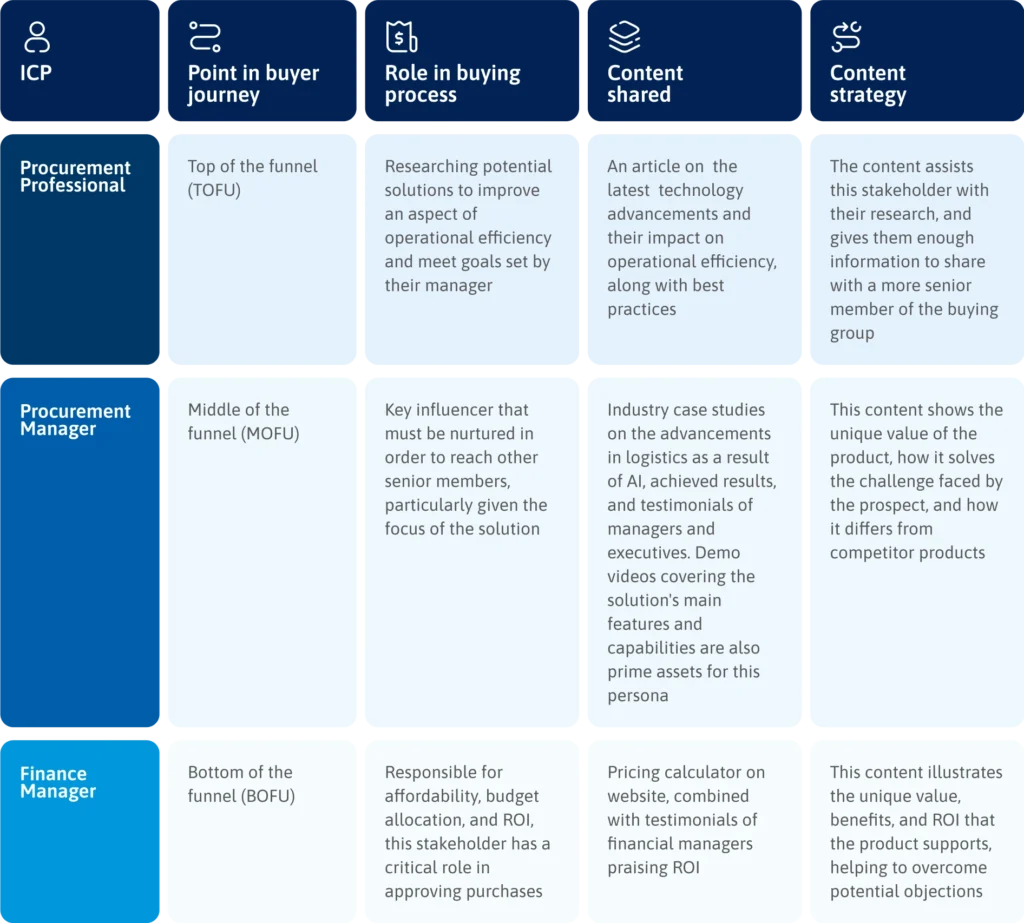
Whilst this is a simplified view, the example above illustrates the complexity of the buying process and the importance of personalization for nurturing buying groups.


3. Customise content for omnichannel distribution
Orchestrating omnichannel marketing requires a strategic approach to content delivery, ensuring consistent messaging across marketing channels such as social media, email marketing, and in-person events.
The challenge lies in balancing personalization with scalability—each channel must feature tailored content that resonates with its specific audience while maintaining a cohesive brand message.
Therefore, to truly engage buying groups, brands must leverage journey mapping to align marketing efforts with the decision-making process of buying groups. This approach helps prioritise channels and optimise content placement to guide buyers seamlessly through their decision process.
Journey mapping typically involves the following key steps:
With some exceptions for buyer preferences, each channel plays a distinct role across the buyer’s journey. Planning your channel mix effectively ensures a frictionless experience.
To maximise engagement, consider how each channel supports:

By strategically integrating journey mapping into omnichannel marketing, agencies can help clients create more meaningful connections with buying groups and drive higher ROI for campaigns.

4. Measure the success of personalized strategies
To ensure customised content strategies support business outcomes, it is essential to track key metrics, establish attribution methods, and implement feedback loops.
Key metrics to calculate the ROI of personalized content include:
Attribution and ROI
Measuring the return on investment (ROI) of tailored content requires clear attribution strategies and intentional orchestration of the buyer’s journey.
By strategically aligning personalized content with key decision-making moments across the journey, agencies can ensure their efforts drive impact.
For media planners especially, omnichannel attribution models play a crucial role in identifying which content assets resonate most at different stages, from early engagement to conversion. By linking content to orchestrated touchpoints—such as landing pages or social campaigns—agencies can better demonstrate how content influences pipeline and client success.
Feedback loops for optimisation
To ensure personalization is precise, content performance should be continuously analysed through feedback loops that capture buyer data and interactions.
This process involves gathering insights from how prospects engage with personalized content—whether through click patterns, drop-off points, or social listening—and leveraging data insights to inform iterative adjustments. These optimisations help refine content strategies, ensuring they evolve alongside changing buyer behaviours and preferences.
By maintaining a data-driven approach, agencies can continuously innovate content strategies to enhance relevance, drive deeper engagement, and deliver measurable results that maximise the long-term impact of client campaigns.