
9 Reasons to Invest in Enhancing User Experience
13 min
Updated: September 24, 2026

Executive summary
User experience (UX) goes beyond the design layer, as it is a critical factor in driving B2B discovery, trust, and revenue. This article outlines 9 reasons why investing in UX improves brand preference, accelerates buying decisions, and increases long-term value across the buyer journey. Organizations that treat UX as commercial infrastructure are positioned to:
- Increase shortlist inclusion by improving clarity, navigation, and first impressions
- Build trust with proof-driven UX that supports validation across stakeholders
- Accelerate evaluation and reduce friction with accessible technical and decision-stage content
- Improve conversion, retention, and lifetime value through seamless, user-centered experiences
Read to discover how to optimize UX to ensure it delivers measurable ROI.
Buyers form opinions long before they ever speak to sales. If users cannot quickly discover, understand, and validate your organization’s value on their own, you are effectively invisible during the most important part of the journey.
This makes UX a critical element in brand discovery that drives trust, clarity, and confidence across buying groups. With 33% of buyers prioritizing recognized brands, your UX is already doing the selling: the experience itself becomes the brand signal that shapes preference before contact ever happens (INFUSE Voice of the Buyer 2026).
What is user experience (UX) in marketing?
User experience (UX) refers to the overall impression a person has when interacting with your brand’s digital presence, from your website and content to your product interfaces and support materials. It ultimately encompasses how easy, efficient, and enjoyable those interactions are.
In a B2B marketing context, UX is not only about how a solution feels to use. It is about the experiences buyers encounter while they research, evaluate, and validate your organization, long before they become users. That includes the clarity of your positioning, the structure of your site, the accessibility of your proof points, and how easily each stakeholder can find the information relevant to their role.
Good UX considers the entire B2B buyer’s journey, from a person’s first impression through ongoing use. It aims to make interactions intuitive, satisfying, and meaningful while minimizing friction or frustration.

The basics of user experience in marketing
UX is a relatively broad term that spans every touchpoint a buyer encounters while researching and evaluating your organization, all of which shape how they perceive your brand:
- The visual design and usability of your site, landing pages, and content experiences
- The emotional response those interactions evoke, from confidence to confusion
- The accessibility of key information, such as pricing, proof points, and technical detail
- The speed and reliability of page performance across devices
- The capacity to answer each stakeholder’s questions without requiring them to contact sales
Together, these elements determine how easily buyers can find, understand, and validate what you offer, and how positively they view your brand as a result.
9 reasons why user experience important in B2B marketing
Organizations that improve user experience can enhance every step in a buyer’s journey, from the initial discovery of a brand right through to retention.
Below are nine of the core reasons why user experience optimization is important.
1. Enhanced brand perception
According to INFUSE Voice of the Buyer 2026, brand reputation is the most influential factor for 33% of buyers. User experience plays a critical role in shaping brand perception, as the interface defines how accessible and engaging a digital experience feels.
Users tend to remember frustration more than positive experiences, in what is called in psychology as negative bias: the human brain’s tendency to react in a more intense way to negative stimuli than to positive ones.
In practice, even small moments of friction, such as unclear navigation, slow-loading pages, or difficult-to-find information, can undermine trust and leave buyers with a lasting negative impression of a brand.
To support a positive brand perception and overcome the negative bias, user experience design should cover the following five elements:
- Clear user pathways that help visitors quickly find pricing, proof points, and company background. This matters because only 20% of buyers trust company-generated content, so case studies and third-party validation need to be just as easy to find as the pricing page (INFUSE Outlook 2026)
- A consistent and purposeful color palette to guide attention and signal importance (this is especially important for actions, like buttons and CTAs)
- Maintaining sufficient negative space to avoid clutter and improve readability
- Prioritizing mobile responsiveness, which allows users to navigate easily across devices
- A clean structure, intuitive navigation, and clear hierarchy help ensure users associate your brand with ease and reliability rather than confusion
2. Improved client retention
Retaining clients is essential for sustained growth and predictable revenue.
81% of B2B buyers report dissatisfaction with the providers they ultimately chose, signaling that retention is far from guaranteed without continued UX investment (Forrester, The State of Business Buying 2024).
UX plays a central role in achieving this by shaping how users interact with products and services. A smooth and intuitive experience increases satisfaction, making users more likely to continue using a solution rather than switching to alternatives.
User experience optimization can improve client retention through the following reasons:
- Ensuring users can consistently achieve their goals without friction by optimizing core journeys
- Strengthens trust by delivering clear navigation, reliable performance, and accessible features
- Increases engagement by helping users feel confident and supported throughout their experience
- Reduces frustration by identifying and removing usability barriers early
- Maintains long-term client relationships through a consistently smooth and dependable UX

3. Increased client lifetime value (CLTV) and revenue
Client lifetime value reflects the total revenue generated over the duration of a relationship. UX directly influences this by reducing churn and supporting ongoing satisfaction.
After a bad experience, 38% of consumers reduce their spending with a company and another 13% stop spending entirely, putting an estimated $3.7 trillion in global sales at risk (Qualtrics XM Institute, 2024 Global Consumer Study). The upside is just as clear, as companies that prioritize client experience grow revenue 41% faster, profit 49% faster, and retain 51% more customers than those that do not (Forrester, 2024 US Customer Experience Index). Together, these confirm just how much of an impact UX makes as a direct driver of both churn risk and lifetime revenue.
Organizations can apply the following user experience design basics to enhance CLTV:
- Design navigation that allows users to easily find and use core product features
- Ensure users can consistently achieve their goals within the product to maintain active usage
- Implement personalization, clear interfaces, and responsive interactions to sustain engagement
- Continuously deliver value to extend the length of client relationships
- Reduce churn risk by creating a consistently useful and reliable user experience
- Use strong UX to support long-term revenue stability and improved financial outcomes
4. UX increases shortlist inclusion
Buyers typically create shortlists early and rarely look beyond them, which increases the importance of strong first impressions. In fact, 95% of winning vendors appear on the day one shortlist (6sense, 2025). This is largely why, according to INFUSE Voice of the Marketer 2026, brand preference has become the top marketing responsibility at 62% (up from 58%).
The risk of getting this wrong is significant. 75% of buyers consider switching suppliers due to barriers caused by outdated systems and inaccurate data (Sana Commerce, B2B Buyer Report 2025), making strong UX a direct lever for protecting shortlist position, not just winning it in the first place.
UX supports this by ensuring clarity, consistency, and relevance from the first interaction, helping brands stand out and remain competitive throughout the buying process.
UX plays a direct role in moving buyers from discovery to revenue by shaping how easily they understand and navigate your offering. Good user experience design fundamentals like clear navigation, fast access to what your company does, and role-based pathways help users find relevant information without friction.
Structuring content with scannable layouts, concise definitions, and proof points that are easy to reference enhances a smooth buyer journey filled with value. Each buyer persona should see a clear value proposition immediately on arrival, which reduces confusion and supports faster decision making.
5. UX builds trust with proof
A significant portion of purchases stalls due to a lack of trust, with 86% of B2B purchases stalling during the buying process and resulting in no decision (Forrester, 2024). UX can reduce this risk by making technical requirements, integrations, and constraints easy to understand, helping users quickly determine whether a solution meets their needs.
Trust is established through what users can verify. As a result, UX should translate trust into visible elements such as transparent messaging, statements backed by evidence, and clearly defined limitations or ideal use cases.
Content and interface design play a key role in supporting validation. This can be achieved by embedding case studies, reviews, and measurable outcomes directly within the experience, allowing users to confirm claims without leaving the page.
According to INFUSE Voice of the Buyer 2026, buyers rely on three primary forms of validation before shortlisting: direct vendor information (24%), internal peers (22%), and independent SMEs (20%). They also expect clear evidence of fit, such as client references or case studies, prior experience, and market visibility. When this information is difficult to find, skepticism increases and decisions slow down.
6. UX enables buying group consensus
B2B purchases involve an average of nine stakeholders (INFUSE Voice of the Buyer 2026), each with different priorities. The size of buying groups increases the complexity of the decision making process in B2B.
Effective UX implementation can address this by offering tailored pathways for roles such as marketing, IT, finance, and executives. Role-based navigation and dedicated stakeholder hubs help each group access the information most relevant to their responsibilities.
UX can also simplify buying group journeys by making content easy to share and reuse internally. Features such as summaries, one-page documents, and comparison sheets support internal discussions and alignment.
By addressing each stakeholder clearly, UX helps teams reach consensus more efficiently and reduces delays caused by misalignment.
7. UX improves conversion and reduces wasted traffic
While generating traffic is critical, converting visitors is where the real value lies.
Self-service is now the default mode of B2B evaluation, with 67% of buyers preferring a rep-free buying experience, making UX a primary conversion mechanism on most B2B sites (Gartner, 2026 Sales Survey).
Effective UX can support a range of micro conversions, such as saving content, sharing resources, previewing demos, or using interactive tools. These actions allow users to engage without committing too early, which better reflects how buyers evaluate solutions.
Instead of relying heavily on gated content, UX can support progressive profiling and self-service exploration. This approach reduces friction and allows users to move forward at their own pace.
By improving UX, organizations can capture more value from existing traffic by encouraging meaningful engagement and guiding users through the decision process more effectively.
8. UX accelerates evaluation
Technical validation is a critical stage in B2B buying. In fact, 58% of buyers prioritize “strong alignment” with use case/technical requirements when creating vendor shortlists, ahead of demonstrated ROI at 36% (INFUSE Voice of the Buyer 2026). UX can accelerate this process by making key information accessible and easy to understand.
This includes clear integration details, structured security documentation, implementation guidance, and access to demos or sandbox environments. When technical evaluators can find answers quickly, the evaluation process becomes more efficient.
Reducing friction for technical users requires well-organized documentation, intuitive navigation, and clear explanations of system architecture and APIs. Many buyers prioritize strong alignment with their technical requirements when building shortlists, and concerns around complexity or integration can delay decisions.
UX can address these issues by removing uncertainty and presenting information in a structured, user-friendly way.
9. UX supports ROI justification
UX should make it easier for buyers to justify investment decisions, particularly as demonstrated ROI is cited by 36% of buyers as a shortlist driver (INFUSE Voice of the Buyer 2026).
This involves presenting clear outcomes, relevant benchmarks, and case studies that demonstrate measurable impact. Industry-specific examples and transparent pricing or comparison details help users understand value in context.
As more organizations prioritize technology investments for revenue growth, the ability to present credible and measurable outcomes becomes increasingly important. UX supports this by ensuring all claims are clear, based on evidence, and easy to interpret. Doing so helps buyers make informed and defensible decisions.
How to improve user experience in B2B marketing
Improving user experience requires shifting from design preferences alone to adopting a complete buyer-led approach that supports discovery, validation, and decision making.
User experience research is critical in this context, as it allows organizations to perform changes aligned with how B2B buyers actually evaluate solutions across multiple stakeholders and stages. This means that the UX research findings are the driving force behind how organizations should combine clear navigation, relevant content, and proof-driven experiences across their site, product, and supporting assets.
As a result, user experience design goes much further than purely visual adjustments. A practical way to approach this is to structure UX improvements around the buying journey:
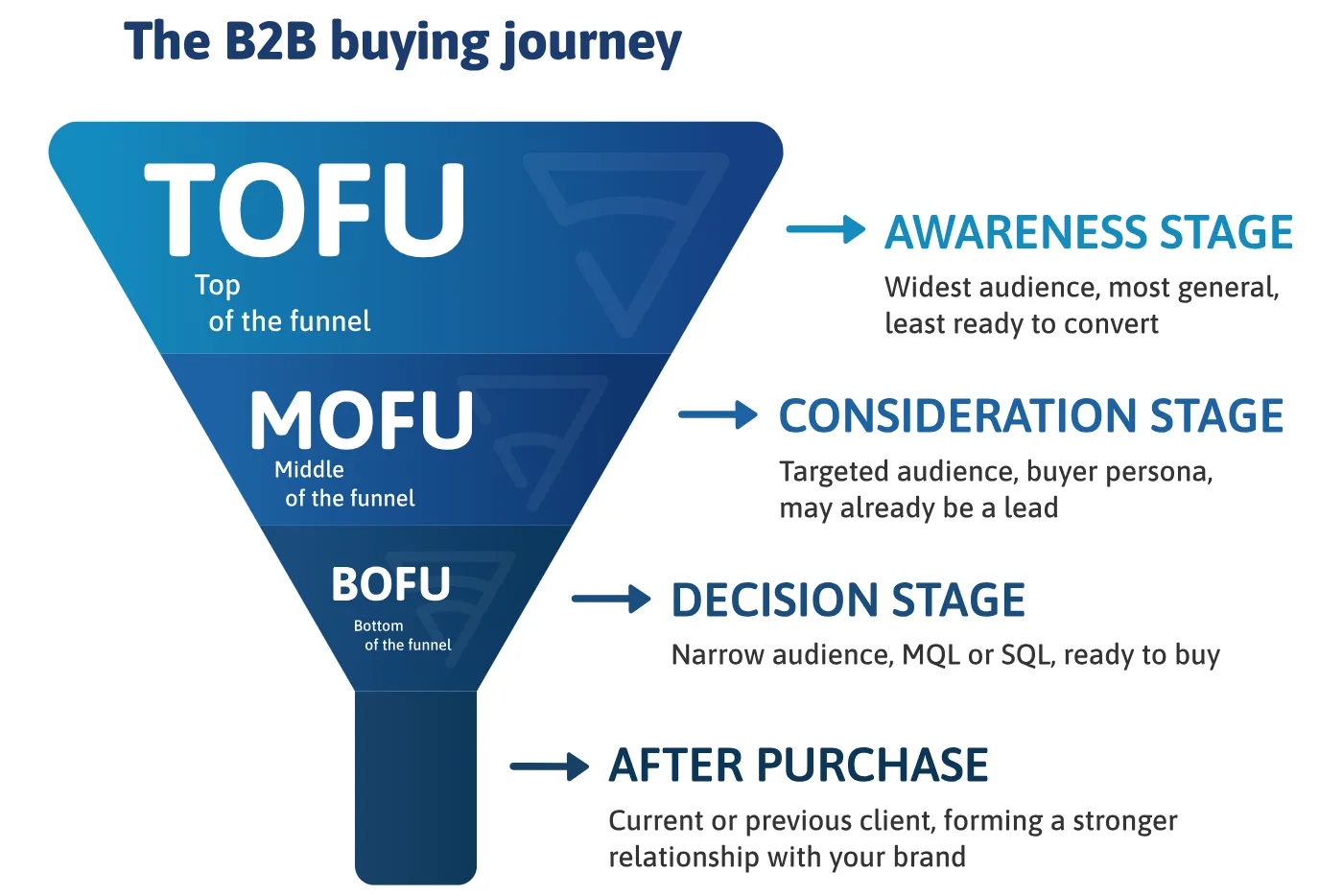
Below is a UX checklist by buying stage:
Awareness
- Make relevance and trust immediately clear
- Ensure visitors can quickly understand what your company does, who it is for, and why it matters
- Use concise positioning to communicate value fast
- Create industry-specific pages to increase relevance
- Include visible proof points to support credibility
- Highlight case studies and product demos for early validation
Consideration
- Enable deeper validation as buyers move into evaluation
- Provide easy access to demos, technical documentation, comparison sheets, and reviews
- Prioritize technical documentation to support fit and feasibility assessments
- Structure content to be easy to scan and navigate
- Make content easy to share across stakeholders
Decision
- Reduce friction and support final checks
- Make pricing, implementation details, security information, and legal requirements easy to find
- Present information clearly to support confident decision making
- Provide clear comparison content
- Set expectations for onboarding and deployment
- Ensure clarity for financial and technical stakeholders
Across all stages, prioritize structured and scannable content to support both human users and AI-driven discovery. INFUSE Voice of the Marketer 2026 confirms that case studies remain one of the most impactful content formats, while technical documentation also plays a key role in influencing decisions. As investment in search and discovery continues to grow, ensuring your UX supports both visibility and validation is essential for improving outcomes.
How to measure UX ROI in B2B
While investing in user experience is essential, understanding the difference between good and bad UX can be tricky, as the outcome of UX should be tied to ROI.
Below are some effective strategies for measuring the commercial impact of UX optimizations:
- Track metrics like conversion rate, sales cycle length, and client retention before and after UX changes
- Quantify efficiency gains (e.g., reduced task time, fewer support tickets) and translate them into cost savings
- Tie UX to revenue by measuring increased deal size or win rate
- Use tools like Google Analytics or Hotjar to gather data, and compare results against implementation costs to calculate ROI
Key takeaways
- UX is an essential part of B2B discovery infrastructure, shaping how buyers form early preferences and influencing brand choice early in the journey.
- Strong UX improves commercial outcomes by increasing shortlist inclusion, accelerating evaluation, and reducing friction across multi-stakeholder buying groups.
- Trust, clarity, and proof are central to effective UX, with buyers relying heavily on verifiable evidence such as case studies, technical documentation, and peer validation.
- Optimizing UX across awareness, consideration, and decision stages helps improve conversion, shorten sales cycles, and increase long-term client value.