Results for “”

Webcast
What enterprise buyers actually think about your AI story & credibility
27 min
•Updated: August 12, 2026
AI adoption has entered a new phase. While 73% of enterprise buyers remain optimistic about AI in the workplace, 61% are actively evaluating or reducing their technology stacks as scrutiny around vendor claims intensifies. Despite positivity surrounding AI, confidence in vendor credibility has become the defining factor in purchasing decisions.
This on-demand session draws on findings from the Voice of the Buyer AI Research Reality Check, INFUSE’s mid-year AI research surveying 310 enterprise technology buyers across North America, EMEA, and APAC.
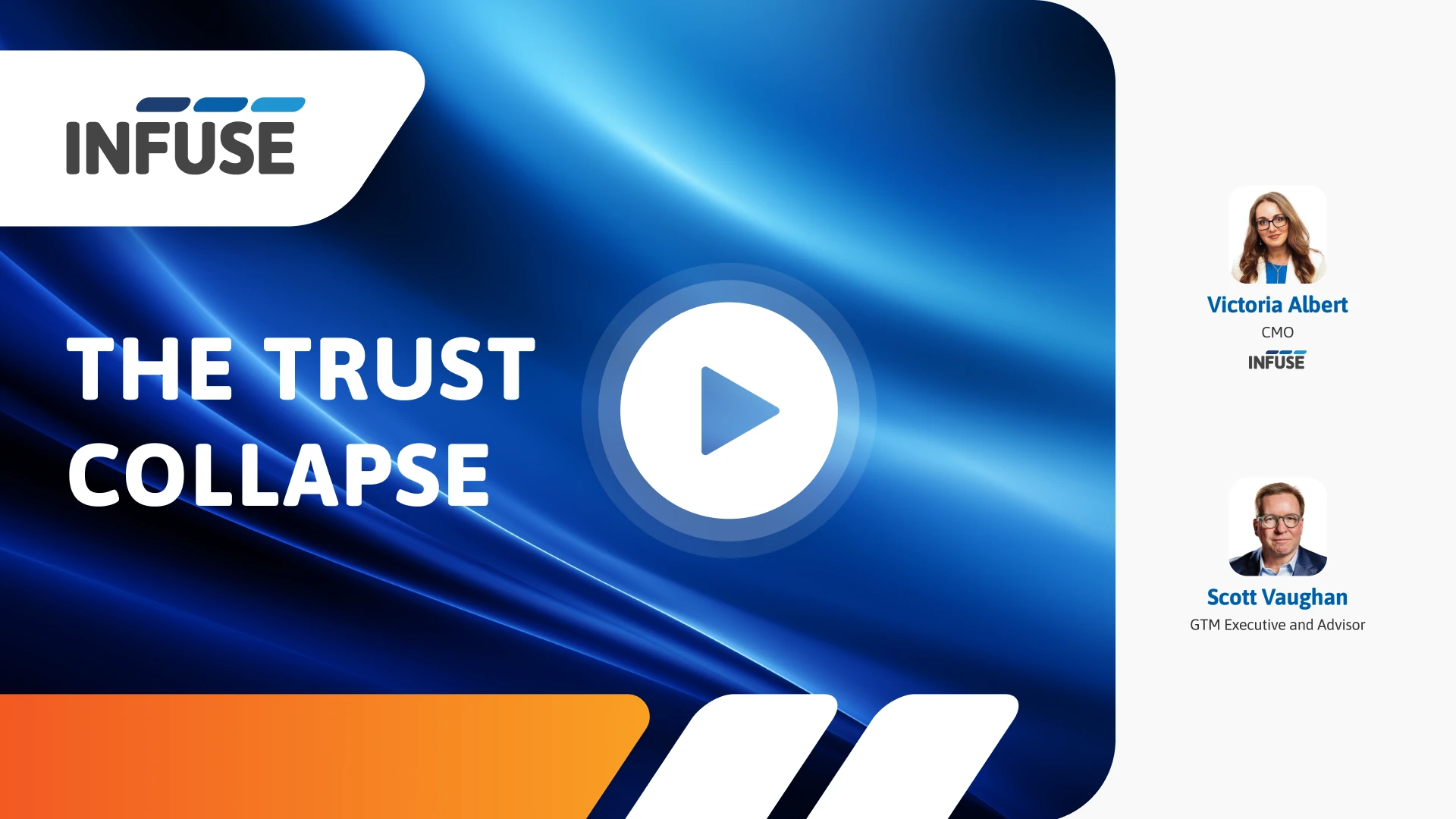
Victoria Albert (INFUSE CMO) and Scott Vaughan (GTM Executive and Advisor) examine how enterprise buying behavior has shifted from AI enthusiasm to proof-based evaluation, and what marketers and revenue teams must do to earn buyer trust.
Watch the webcast to discover how enterprise buyers are evaluating AI vendors today, and how to build the trust needed to win consideration.
In this video
00:05 The trust collapse in enterprise AI
02:57 From AI hype to proof-based buying
04:21 The optimism trap
08:55 Why buying groups need education, not just champions
11:10 Buyers want efficiency, marketers sell transformation
13:53 The enterprise trust advantage
19:00 Building a trust ecosystem with proof
19:42 What enterprise buyers actually evaluate
23:52 Five actions marketers should take now
00:05 Scott Vaughan: Welcome everybody. You are going to love this conversation. Victoria and I are going to talk shop. We both have something very strong in common. The belief that our compass is our business technology buyers, our customers, our prospects, that's going to tell us really what we should be doing and where we should be going. And in this world that is, I don't know, AI-powered, AI-obsessed, AI-fungled up, whatever it is, the session and discussion we're going to have today, I think, is all money. So Victoria, always great to have it with you. What are we going to talk about? What are we going to learn today?
00:48 Victoria Albert: Well, Scott, these conversations with you are always eye-opening. Thank you for another one of our chats. Today, we're going to talk about the trust collapse, which is aptly titled after a mid-year AI research that we just completed. And really, truly, you know, we've been running INFUSE Insights research for the last 6+ years. We simply couldn't wait another year to go and resurvey our buyers. It's moving too fast. So this is our first-ever mid-year survey going back to the same enterprise buyers, but surveying them specifically on how AI is impacting their purchasing, the buying groups, and the technology that they do purchase.
01:37 Scott Vaughan: Well, tell me a little bit about the background. And so for those who haven't seen, you know, INFUSE has a deep business technology buyer audience and pool. What does that look like? Who do we talk to? Just to get the data nerd stuff out of the way so we can get into what we heard.
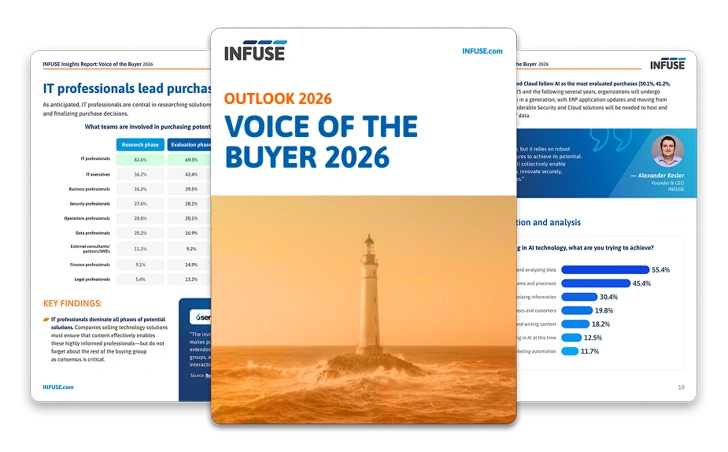
01:53 Victoria Albert: Let's geek out on the data nerd stuff. So we interviewed 310 enterprise buyers. Again, I want to stress these are all enterprise buyers purchasing large chunks, in technical terms, of technology. This is a global research, roughly equally divided between North America, EMEA, and APAC. These are the same buyers we interviewed 6 months ago for our Voice of the Buyer Research 2026, which you can also find on our website. But again, we went back to survey them specifically on AI. In terms of the actual data pieces here, 83% of the 310 came from organizations with over 1,000 employees, 68% from companies generating over a billion in annual revenue. So this is not a startup sample. This is an enterprise buying committee.
02:45 Scott Vaughan: Got it. These are for people that are targeting real business technology buyers.
02:49 Victoria Albert: Got it.
02:50 Scott Vaughan: Organizations. Okay, cool. All right, with that out of the way, give us a perspective.
02:57 Victoria Albert: Yeah, let's run through. So first, I want to give you, sort of three years in a sentence. Of course, for those of us who remember, ChatGPT went online, publicly available about November 2022. 2023 was a year of chaos. 2024 is what we call “AI promises dominate every product roadmap and every vendor pitch.” Buyers became skeptical because the claims from vendors far outpaced the proof. In 2025, those budgets started stabilizing a bit. Buying groups accelerated their evolution, sometimes committing before the proof was even readily available. We all remember that.
03:40 Scott Vaughan: Boards were pushing it. We need to get in and start working with AI. We're not going to get left behind. That was the reality.
03:48 Victoria Albert: That was the reality of last year. The reality today is that the buyers have adjusted, and so have their CFOs and C-suites. Every AI evaluation now anchors on three things, and that's efficiency, integration, and proof that the product is actually delivering what the sales teams are promising it will deliver. So the market has moved. We are now anchored in reality. And now the question is, the big question, of course, is: Is marketing moving along with the market?
04:19 Scott Vaughan: That is the question. Well, let's find out.
04:21 Victoria Albert: I love this sort of dichotomy on this slide. The data comes from the same research. Really eye-opening. 73% of enterprise B2B buyers are really personally optimistic or cautiously optimistic about AI in the workplace. So the majority of the buyers are optimistic about AI. And then yet 61% of those very same buyers are evaluating, planning, or have already cut platforms because of AI. So these numbers, of course, I don't think these numbers are in conflict. I think the numbers are meant to be a conflict in and of itself because the buyer sentiment and buyer behavior really are the most important things that are happening this year. The buyers that we spoke to for this research, they are not skeptical of the technology. They're skeptical of the vendors.
05:23 Scott Vaughan: Yeah, we should double emphasize that. That's why brand credibility, proof as the provider, as a vendor, is so important. Not just that you have a bunch of products. Everybody has AI products.
05:37 Victoria Albert: So, here, I'd like to just point out this one undeniable fact. We're really living the chapter one of this whole research. We're living through the optimism trap because what sounds like good news, when you really look underneath the data, pull the layers of the onion, you sort of start seeing that dichotomy in the numbers. And I'll take you through sort of one more thing here. So again, 73% of the buyers are personally optimistic or cautiously optimistic about AI in the workplace. So that sounds like an open door for vendors. Great, let me get in, right? But when it comes to personal AI readiness, and then more importantly, team readiness, which we should unpack over the next couple of minutes, you and I here, these two numbers are showing two completely different stories. So while I'm optimistic about AI, I don't think that I'm fully ready for the implementation of AI capabilities in my personal life and, more importantly, in my workplace. And I'm even less so, I less so believe that my team is ready for that implementation. Of course, team here means buying group, buying committee, and that's sort of the dichotomy for the vendors who are trying to sell these products into these organizations.
07:06 Scott Vaughan: Yeah, you talked about the gap before of what's happening out there, that the optimism can actually be a trap that you're stuck in. We're enthusiastic about it, but we're not confident or ready or know what to do. And to me, this is a wide-open door for the vendor to show people the path on how to do it. We've learned so much, Victoria, in our past thought leadership and education. Well, this education comes to “I need a blueprint, I need something I can follow, and I will be even, I'll move from optimism to actually buying something and doing something if you are the provider, the vendor that can help me do that”. And that is a big statement, but it's not a me thing, is it? It's a buying committee.
08:03 Victoria Albert: This is a buying group. This is a buying group thing. So you actually said something that's so near and dear to my heart. Thought leadership is fantastic and great, and please keep doing that. This is what you and I are doing right now. But at INFUSE, we, you know, drink our own champagne. We released three really comprehensive playbooks over the last several months, out there into the wild, because the buyers are telling us that they need help. They need to be walked through how to implement trust architecture, AI technologies, and hear from the customers that have implemented similar technologies before in very similar environments, similar solutions. And I think, as marketers, we need to provide that information much earlier in the buying journey.
08:55 Scott Vaughan: Yeah. And if you're doing any kind of target account marketing, also known as ABM or whatever you call it inside your organization, there's no longer a choice to do one or two decision makers or champions. We see so many programs and campaigns with that thinking or selling teams that focus on a couple. You must cover the buying committee. AI, by its very nature, touches so many people. And this is no longer an option.
09:27 Victoria Albert: 100%. If companies are not yet retooling their processes and their capabilities to reach the whole buying committee, then we're really dealing with a 73% versus a 26% scenario in some way in our outreach. We have to reach out to the whole buying group. And here I have a quote. The quote comes anonymously, but I personally spoke to this individual when we were gathering this data. We're sitting outside, and I was interviewing him. This is a senior technical lead at a healthcare technology. Nobody really says it better than him. Individually, your champion is likely ready for implementation, but the champion has to present the business case in front of a very large buying group. And here in this case, in his case, in front of a buying group that may not have ever touched these technologies. So there's a great deal of education here that must happen across the whole buying group.
10:33 Scott Vaughan: Yeah, and I love the phrase you've used before: stop just marketing to the optimists and your fan and your champion and start really making sure you're communicating the value in their language to the committee, to the different players and personas, if we use the marketing term, on the committee. This is a super salient point. We can say it over and over, but the discipline of actually doing it takes work. And that's why it's not always so easy. We stick with the handful of titles or the couple of people we know, including - That's marketing and sales.
11:10 Victoria Albert: Absolutely. So next chapter here is: the market wants efficiency. Our pitch is still transformation. Love this stat. We've been on an efficiency roller coaster.
11:24 Scott Vaughan: By the way, good visual as well.
11:26 Victoria Albert: Thank you, thank you. We've been on an efficiency roller coaster the last few years in our research, right? Ever since, I think, 2023, when the budget got pulled back from these buying groups. Efficiency is not going away. And in fact, what our enterprise buyers are telling us is that 62% of them are still operating on the promise of efficiency. Only 12% of them are purchasing these technologies to specifically answer the claim of innovation, competitive positioning, etc. This really matters when we look at our vendor messaging. The majority of the vendor messaging out there in the wild is what? Transformation, competitive advantage, disruption. All of those are great messaging elements. Their entire category is organized around the 12%.
12:20 Scott Vaughan: Well, when you say we, you're talking to the marketers. We're talking to the sellers, right? The people that are trying to engage.
12:30 Victoria Albert: I'm using the broader we in this context. Yeah. The other members of the buying group want to reduce costs. They want to streamline workflows. They want to do existing work faster, cheaper, and better. That's not exciting. That's not a message that we marketers like to produce and put out in the wild. That doesn't tickle our fancy, but it is a message that is so very much needed when it comes to specifically enterprise buyers. So my call to our marketing community out there: transformation and innovation are fantastic. But in this day and age, in this market, in this environment, we have to lead with operational efficiency when it comes to AI technology specifically.
13:23 Scott Vaughan: And transformation and disruption can happen through efficiency, but you can't lead those words. By getting more efficient, by reimagining how you do business, you can be more efficient. But if efficiency isn't the all-caps word here, isn't the lead story, you're going to have a harder time because all you're going to appeal to is the optimist, maybe.
13:43 Victoria Albert: Yeah.
13:44 Scott Vaughan: You're not going to get the buying committee, nor the budget, nor are you going to replace some of the incumbent vendors or solutions they have in place.
13:53 Victoria Albert: So great segue, Scott. Let's talk about the incumbent vendors because this stat is admittedly not one that I expected to see out of this research. I was quite surprised when the data came in. This is what we call the enterprise effect. When surveying our enterprise buyers, they establish an overwhelming preference for established vendors at a rate of 5-to-1. So again, there are two ways to hear this data. For established vendors out there, this is your window. AI-native entrants are competing against you with a real and palpable trust disadvantage. And for every buyer who's been burned by unproven AI promises, this is really why. And for AI-native vendors out there, a trust ecosystem is probably your number one thing to build. And by the way, we do have a playbook on that on INFUSE.com. Building that trust ecosystem is probably the number one challenge that is needed to really overcome this 5-to-1 disadvantage.
15:11 Scott Vaughan: What the hell is a trust ecosystem, Victoria? Is that a marketing jargon? Did I create that? Who did that?
15:18 Victoria Albert: You may have, I may have. I think that probably matters less, but, as marketers, we need to present our buyers with information that proves that we are delivering value in an honest and transparent way. So, for example, case studies with real people, real headshots, real titles, real companies built around real implementation frameworks. Not the sort of anonymous content that often hits.
15:55 Scott Vaughan: Yeah, the headline bearing, I installed the software, I used this AI app, and I saved $1 million is not deep enough because the buyers and the buying committees are trying to figure out how to actually operationalize AI to do cool things, to do breakthrough things. But also to run their business in different ways. So you've got to show that. And at first when I saw this, when I was looking through the initial research finding. I'm thinking: uh, kind of BS. Anthropic, OpenAI, go down the list. We're just using the big dogs now. They're exploding. But really, it does lead back to “that's for the optimists or the individuals that have been using these tools, so they see it”. But that's not how enterprises buy solutions or choose platforms or vendors. So we have to bring this into the same alignment and orbit. And that's so interesting to me.
16:54 Victoria Albert: Enterprise buyers are not going to just tear away their legacy infrastructure on a whim. Enterprise buyers also want to pick the vendors that they know are going to be there a year, 2, 5, 15 from now when they run into issues. And that runs sort of predominantly here. We look at any enterprise systems, and you can dissect, right? We can dissect it any way we want, but Microsoft AI revenue is up tremendously. Salesforce AI ROI is up tremendously. There's really a reason for that. And I do have another one here. Again, this is an individual I spoke with. He's a CRO of a mid-market to enterprise-level company living in the New England area in the US who chose an AI-native vendor for one of the capabilities that they were running. Chose it intentionally because the sales team wanted to go after those particular capabilities to sell efficiently. But in parallel, this leader is standing up an established vendor platform to de-risk that implementation. Again, a real person I spoke with while we were doing this research, and that sort of, to me, is the pinnacle of what we're talking about.
18:21 Scott Vaughan: It makes complete sense. If you're an established provider, you want to show how they can use their existing platform and exploit all the value and benefits of AI and all its technology. If you are an AI-native company, you want to show how it integrates and complements their existing platforms and enables new ways of doing things or automating things, as we've learned. Yeah, I know that sounds a little bit duh, but that's not really what we're seeing in a lot of the marketing messaging and a lot of the outreach today. So we are incongruent in that.
19:00 Victoria Albert: I was just going to say exactly that, Scott. We're on the same wavelength. If you're a marketer who's listening to this webcast, your solution engineer’s information: bring it up front. Your integration guides: bring it earlier in the buying journey. All of those proof assets, the wins, the badges, the stars, the case studies, the quotes from your customers, the video and Loom videos, and snippets from your customers. Bring them very, very early on in the buying journey because that is what your enterprise buyers are looking for. That is your trust ecosystem.
19:38 Scott Vaughan: So show us that data, and then I want to go a little bit deeper on that.
19:42 Victoria Albert: So let's look at this chart. So we asked the question: what criteria are you actually using to make decisions when it comes to purchasing AI technologies? So look at the data here. 47% need proof of integration. The number one question: does this fit my ecosystem? Yeah, right. 32% show me evidence, show me a client that has implemented this widget in my environment or environment similar to mine with a similar use case. And about 4% want third-party validation. So your number, your two most important assets to a CMO, a content marketer in the room, a demand gen marketer, ABM manager, are assets that prove your integration criteria. So your partner diagrams, all of that solution-engineering content: bring it up front. And then your trust ecosystem, the evidence that you've done this before and will continue to do it.
20:47 Scott Vaughan: Two things I would say to put an exclamation. First of all, the hype, the noise, everything you talked about, what's changed: just answer their damn questions. And it used to be that they're in the awareness phase because that's what's in our marketing automation or CRM, and then they're going to move to the consideration and then evaluation. We all know that doesn't work that way. And what the buyers are telling us: cut the fluff and give me information that answers my questions that I would logically go through. That's why we're moving it up on our websites. That's why we're not just starting with some high-level positioning or thought leadership piece alone. You have to let them go on their journey, and the buying committee, the personas, are going to need different types of information. They're clearly buyers telling us. We need to pay attention. I know we've remade just about everything because of that. Not that we don't do thought leadership. We want to make sure we're really clear. That is clear. You need to do that. Brand credibility and authority are important, but if you can't answer their questions and the meat they need to get the buying committee to move, to get a decision made, and get that shortlist, you're in really big trouble.
22:09 Victoria Albert: I think what's important here, there's a stat that's not on the screen, but it is in our data. Next time you and I record something similar, Scott, I'll put it on the slide. And the stat is 23% of these buyers said that transparency and honesty about what the AI does and its limitations are also extraordinarily important. It's an important criterion. So that to me, right, the era of hyped-up expectations and hype overall is over, done with. Our buyers want real honesty about what AI does, and more importantly for them, most importantly probably, what it doesn't do. And it's okay for the marketers. It feels counterintuitive. It feels raw and wrong for a marketer to sort of think through those, right? Through that messaging. But it's so incredibly important.
23:04 Scott Vaughan: Okay, I have to do an analogy. It may go a little bit off, so bear with me.
23:09 Victoria Albert: Okay.
23:10 Scott Vaughan: It's the same thing that's happening with consumers with the food we consume. They wanted transparency and want to know what's inside. They do not want to know where it came from. I know where it came from on the technology side, but what is it? And that transparency is becoming more and more important because what you started with was the trust trap. And the collapse. And so there's something real here in authenticity and trust, which we covered in our annual Outlook at the beginning of this year, was the theme, and it continues to be running right through buying decisions and how they choose vendors and providers.
23:52 Victoria Albert: But this is a good segue, Scott. Let's wrap up. So what are the 5 things you and I would recommend marketers change on Monday? And these are 5. Number 1:, stop selling transformation as your number 1 pinnacle. Let's sell into efficiency. Number 2: let's prioritize the outcomes. That's sort of the second most important question our buyers are asking. Be honest about…
24:26 Scott Vaughan: Victoria, I was just gonna emphasize what you said before. Prioritize outcomes and then work backwards.
24:32 Victoria Albert: And then work backwards.
24:33 Scott Vaughan: Exactly. Show them how this integrates. Show them what it does. It's okay to start with outcomes, but you need to give them the meat and the proof underneath.
24:43 Victoria Albert: And that's the very next one. Transparency is becoming a competitive position. That is so very important. 23% of buyers explicitly prioritize vendors who are honest about what AI does and doesn't do. And so in the market with inflated claims, and we've lived through that market for a good three full years now, here's what exactly my solution does and doesn't do is becoming that competitive position. Number 4: we talk about this all the time. Bind the committee, not one user, not one champion. And then, finally, renewal must be a part of your AI play because 61% of these buyers are either evaluating or already cutting vendors. So renewal conversations really need to start very early in the cycle.
25:38 Scott Vaughan: Yeah, and it all comes back full circle to number one, which is: You can't lead with transformation. You can talk about transformation, but you’d better get to their outcomes. What a great connected thought. Doing this thing in the spring, just after we had completed the 2026 survey, I think it’s so smart. And to see how the market's moving and what they're doing. I know so many of us out there as go-to-market people are trying to figure out how to really capitalize on the AI movement that's underway. Thank you, Victoria.
26:18 Victoria Albert: You can find all of this research, the entire dataset for the AI segment of the research, on infuse.com/outlook. And Scott, thank you for your time as always.
26:29 Scott Vaughan: Great conversation. Congratulations on the research. I know this will be valuable.
Thank you!
A member of the INFUSE team will contact you soon.
Select your country
North America
Europe
Asia
Africa
Oceania
To provide the best experiences, we use technologies like cookies to store and/or access device information. Consenting to these technologies will allow us to process data such as browsing behavior or unique IDs on this site. Not consenting or withdrawing consent, may adversely affect certain features and functions.