

Executive summary
B2B buying groups conduct most of their research before engaging a single vendor, forming shortlists in channels where sellers lack visibility. In addition, most organizations lack the structure necessary to enable buyers in those channels with the evidence each stakeholder needs to progress through their buyer’s journey.
Trust architecture, a framework developed by INFUSE demand experts for Outlook 2026, addresses this gap directly. It can be implemented via three interconnected layers:
- Build credibility with case studies and benchmarks that show results at comparable organizations (Peer Trust Acceleration)
- Give technical stakeholders access to documentation and test environments so they can verify solution compatibility (Technical Trust Foundation)
- Track and share ongoing solution outcomes, such as roadmap progress, to prove ROI extends beyond the initial purchase (Continuous Value Demonstration)

With buying groups averaging nine stakeholders and buying cycles shrinking to just seven months (INFUSE Voice of the Buyer 2026), this coordination challenge is a critical barrier to revenue.
The trust architecture framework provides a structured path to enable every member of the buying group with the proof they need to reach a confident decision.
What is trust architecture?
Trust architecture is a systematic proof infrastructure that supports buyer enablement, giving B2B buyers the resources they need to build confidence in brands and their solution sets. In other words, it is a system that supports the validation of decision making across buying groups.
Implementing trust architecture is essential for aligning with the B2B buyer reality of 2026. According to INFUSE Voice of the Buyer 2026, buying groups have expanded, now averaging nine stakeholders, yet buying cycles have compressed down to seven months.
During this time, each member of the buying group conducts independent research in parallel with their peers across the dark funnel, seeking a best-fit solution before engaging vendors directly. This process and dynamic is highly pressured, as buyers seek to find the best solution that satisfies the needs of their buying group in the shortest time possible.
Yet, a common pitfall in vendor GTM strategies is structuring content for volume rather than addressing stakeholder-specific objections. This dissonance is the trust gap defining B2B buying: despite consuming more content than ever, buyer confidence in purchase decisions continues to fall.
Trust architecture is designed to address this directly, giving organizations the structure to deliver role-specific evidence that moves every buying group member from uncertainty to informed commitment.

How to start building trust with B2B buyers
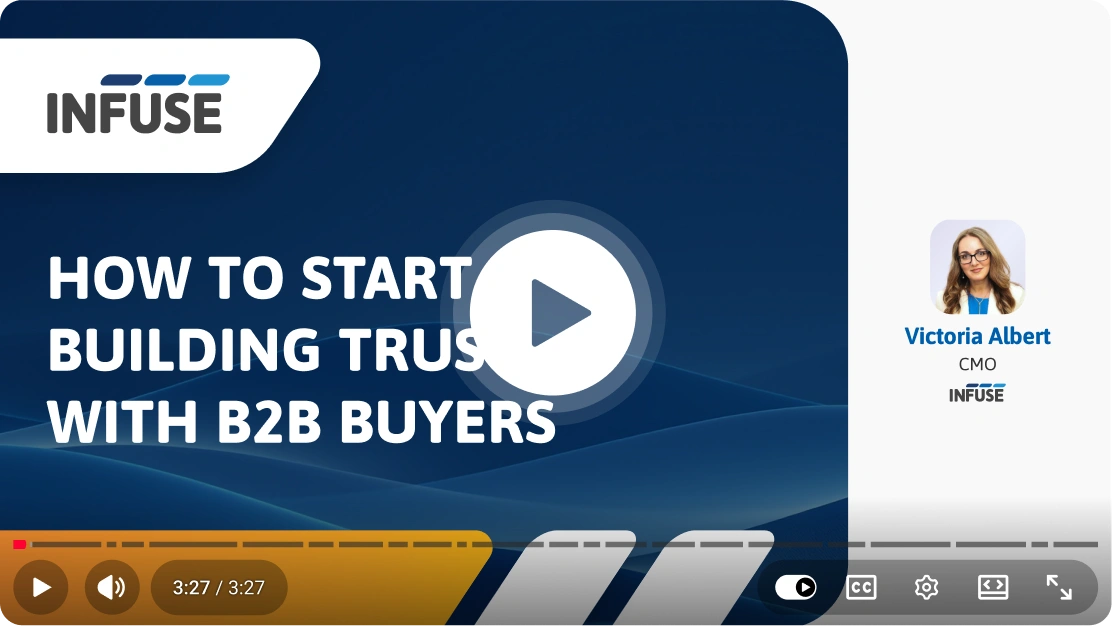
Building trust with buying groups does not always start with creating new content. It starts with understanding what your existing assets already prove, and where the gaps are.
Victoria Albert, CMO at INFUSE, shares the first step most organizations skip when building their trust infrastructure:
How to implement B2B trust architecture: A 3-layer trust-building framework
In order to engage each stakeholder within a buying group with the right evidence, trust architecture must be implemented across three interconnected layers targeting operational, technical, and financial decision makers.
The trust architecture framework below maps each layer to its proof assets, revenue impact, responsible teams, and success metrics:
Peer Trust Acceleration: Provides evidence of the solution’s operational efficiency
Technical Trust Foundation: Demonstrates tech and integration compatibility of the solution
Continuous Value Demonstration: Shows continuous ROI and outcomes from the solution
Industry-specific case studies
Benchmark data
Client reviews
Analyst reports
API documentation
Sandbox environments
Security specifications
Regular business reviews
Product roadmap updates (quarterly releases)
Client Success check-ins
Shortens evaluation by giving buyers credible proof that comparable organizations have successfully implemented the solution
Quantifies the impact on the technology stack and enables self-service compatibility verification, reducing technical risk and eliminating evaluation stalls
Resolves final purchase concerns by demonstrating long-term ROI commitment; reduces churn by proving ongoing innovation and measurable outcomes
Awareness-consideration (top and mid-funnel)
Consideration – decision (mid-funnel)
Consideration – decision (mid and bottom-funnel) and post-sale stage
Operational: Individual contributors, managers, specialists; procurement
Technical: developers, ops, business intelligence, IT security and compliance
Executive and revenue leaders: CEOs, CMOs, CFOs, CROs, VP Sales, VP Customer Success, etc.
Marketing (asset creation)
Sales (nurturing, prospect engagement)
Marketing (distribution and discoverability of technical assets)
Product (asset creation)
Sales (nurturing, prospect engagement)
Product and Marketing (full-funnel)
Sales (decision stage)
Client Success (post-sale stage)
Asset engagement
Review platform ratings
Documentation/sandbox usage rate
Net Revenue Retention (NRR)
NPS/CSAT scores
Referral rate
Expansion revenue rate
Client churn rate
“Trust architecture is not about an abundance of content. It is about building systematic proof that enables buying groups to reach confident decisions independently, on their own terms, through their own research channels, before a vendor ever enters the conversation.”

CMO, INFUSE

How trust architecture works: A buying group scenario
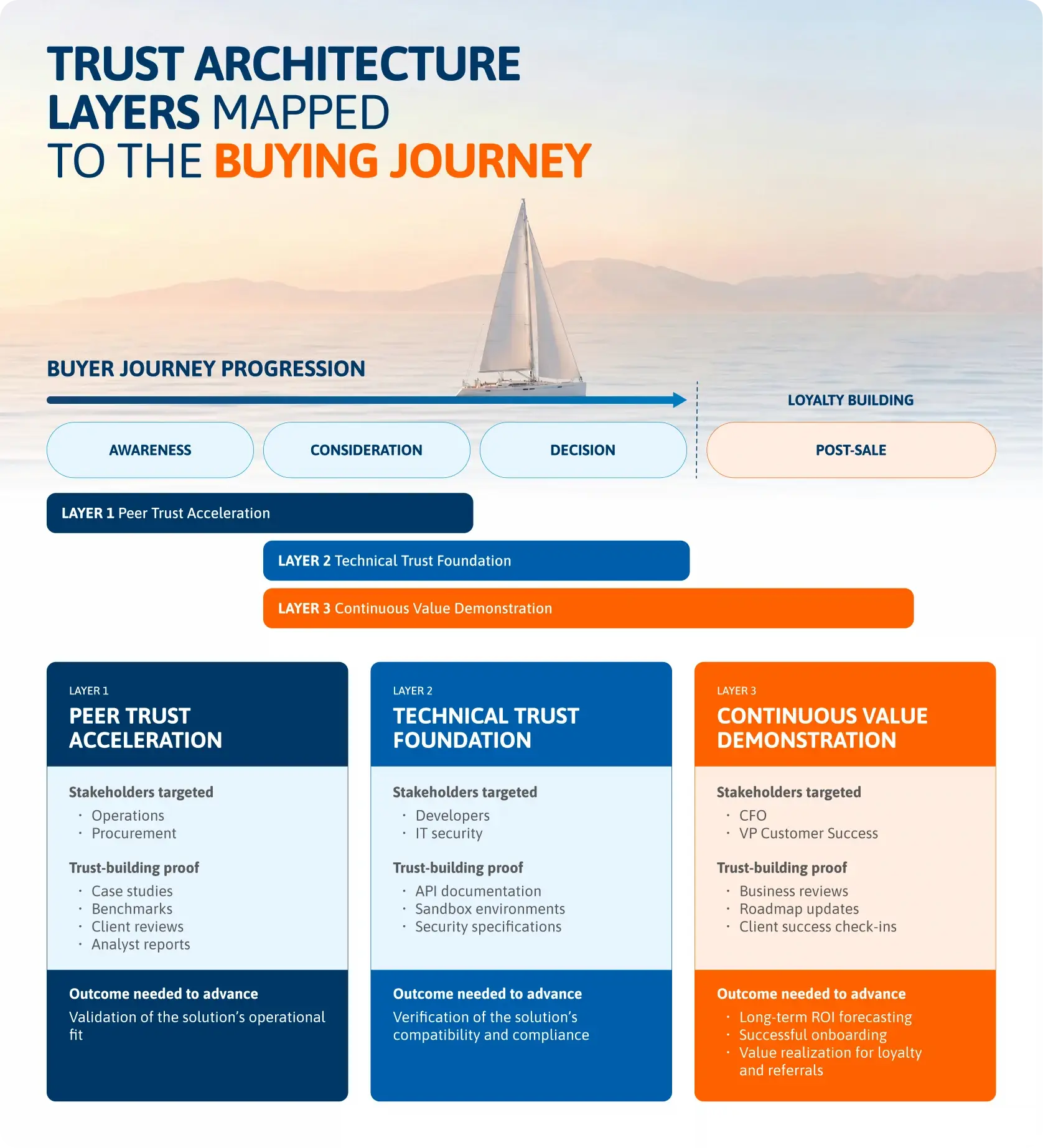
Consider a mid-market technology company evaluating a new operations platform, with a buying group of nine stakeholders spanning operational, technical, and executive roles.
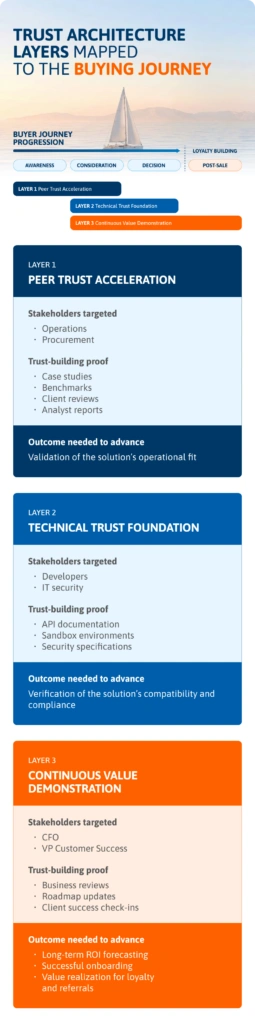
The infographic below maps how each trust layer delivers specific proof to each stakeholder as they progress through the buying journey:
“With trust architecture, each stakeholder finds the evidence their role requires, at the stage where it matters most. This kind of precision only scales when it is systematic. Organizations that build proof infrastructure rather than generic, individual assets are the ones that build trust, consistently compressing evaluation cycles and increasing win rates.”

COO, INFUSE
Simple actions to start building each trust architecture layer


Trust architecture readiness assessment
Complete the following assessment to begin building your organization’s unique trust architecture system.
Use our interactive readiness tool to determine your organization’s trust architecture proficiency score:
Does your organization have content and proof assets that support buyer decision making across operational, technical, and financial dimensions?
Does your organization have a value proposition that clearly articulates how your solution differs from alternatives, and is it consistently communicated across marketing, sales, and client-facing teams?
Is ownership of trust-building content and prospect or client engagement clearly defined across the teams responsible for delivering it?
Can your organization track the buying journey of target accounts and identify the stakeholders involved in purchase decisions?
Does your organization have a structured approach to demonstrating ongoing value and measurable outcomes after the initial sale?
Does your organization measure the effectiveness of its trust-building activities across the buying journey?
Recommended INFUSE solutions and technology

INFUSE Custom Content Solutions

INFUSE Demand Accelerator
Our team of demand experts audits your existing content library, identifies opportunities for creating buyer-led content, and designs an omnichannel strategy to build buyer trust.
Real-time performance insights, AI-powered analytics, and customizable dashboards for your programs.
Complimentary for all INFUSE clients without subscription fees.
“Building trust with clients extends far beyond the initial sale. Organizations that systematically measure outcomes, communicate roadmap innovation, and convert satisfied clients into advocates unlock revenue that exceeds new client acquisition margins.”

VP Global Client Success
and Strategy, INFUSE
Key takeaways
When building your trust architecture strategy, consider these implementation priorities:
- Structure trust-building around three layers: Each layer targets a different stakeholder group within the buying group. Peer Trust Acceleration provides operational stakeholders with proof from comparable organizations, Technical Trust Foundation enables technical stakeholders to verify compatibility independently, and Continuous Value Demonstration shows executive and financial stakeholders that ROI extends beyond the initial purchase.
- Assign cross-functional ownership: Distribute responsibility for each trust layer across Marketing, Sales, Product, and Client Success. Trust architecture requires coordinated evidence delivery across the buying journey, and each layer depends on different teams executing against shared objectives.
- Assess readiness before building: Use the interactive assessment in this article to identify which layers require the most immediate investment. Starting with the Peer Trust Acceleration layer provides the fastest path to building buyer trust during the consideration stage, creating a foundation for the remaining two layers.
BUILD THE TRUST ARCHITECTURE YOUR BUYING GROUPS NEED
INFUSE demand experts work with you to design and implement a proof infrastructure across all three trust architecture layers, ensuring every stakeholder finds the evidence they need to reach a confident decision, turning buyer trust into pipeline growth.
Author


is the Founder and CEO of INFUSE, a global B2B demand generation and revenue marketing company. With over 25 years of experience building and leading performance-driven businesses, Alexander specializes in transforming concepts into scalable, profitable ventures. He is the best-selling author of 250+ Best Practices for B2B Marketing Success and its follow-up, 150+ Best Practices for B2B Marketing Success: Next-Level Strategies.
FAQs

What is trust architecture in B2B marketing?
Trust architecture is a framework that builds buyer confidence by delivering role-specific evidence to every stakeholder in a B2B buying group. It operates across three layers: peer validation through case studies and benchmarks for operational stakeholders, technical proof through documentation and sandbox environments for technical stakeholders, and continuous value demonstration through business reviews and outcome tracking for executive and financial stakeholders. Trust architecture provides the proof infrastructure featured in the Outlook 2026 report, including Buyer-Led GTM, Discoverability-to-Revenue, and the AI Handbook.
Why do B2B buyers lose confidence during the purchasing process?
B2B buyers lose confidence when the evidence available during evaluation does not address the specific concerns of each stakeholder role within the buying group. According to Voice of the Buyer 2026, only 26% of buyers report being very satisfied with their chosen vendor, despite consuming an average of nine pieces of content during evaluation. Content volume does not equal buyer confidence; each buying group member needs different trust-building proof to support their decision.
What are the three layers of trust architecture?
The three layers are peer validation, technical proof, and continuous value demonstration. Peer validation provides operational stakeholders with case studies, benchmarks, and analyst reports during evaluation. Technical proof gives technical stakeholders access to documentation, sandbox environments, and security specifications for self-service compatibility verification. Continuous value demonstration proves long-term ROI to executive stakeholders through business reviews and measurable outcome tracking.
How do you measure trust architecture effectiveness?
Measure effectiveness through stage-specific metrics aligned to each layer: asset engagement and review platform ratings for peer validation, documentation and sandbox usage rates for technical proof, and Net Revenue Retention, referral rates, and expansion revenue for continuous value. These metrics reveal where buyer confidence breaks down and where proof assets need improvement.
How do you get started with trust architecture?
Start by taking the trust architecture readiness assessment in this article. It evaluates your organization across six areas, from content and proof assets to buyer journey tracking and post-sale engagement, and provides a score with tailored recommendations for your level. Organizations at the earliest stages should begin with peer validation, developing case studies that demonstrate results for comparable organizations, as this delivers the fastest impact on buyer confidence.
Why is trust important for business success?
Trust determines whether a purchase decision is made in the B2B buyer journey. Most shortlisting happens before a vendor is contacted directly, as buying group members conduct independent research in parallel. Organizations that build client trust through systematic, role-specific proof shorten evaluation cycles, improve win rates, and generate post-sale revenue through retention and referrals. Without that infrastructure, even well-resourced go-to-market programs fail to convert buyer intent into revenue.
How do you build credibility with enterprise clients through content?
Building credibility with enterprise clients requires matching proof assets to the specific concerns of each stakeholder role. Operational stakeholders need case studies and benchmark data from comparable organizations. Technical stakeholders need documentation and sandbox environments for self-service compatibility verification. Executive stakeholders need business reviews and outcome tracking that demonstrate ROI beyond the initial purchase. The common failure is producing content for volume rather than role specificity: buyers consume an average of nine content pieces per vendor, yet confidence continues to fall because most content does not address the decision each stakeholder needs to make.