Results for “”

Webcast
What the study of 11 cybersecurity programs reveals about using buyer intent to engage demand earlier
29 min
•Updated: August 25, 2026
Evaluation has overtaken research as the longest stage of the B2B buying journey for the first time. But the importance of this stage is not simply about influencing buyers once evaluation begins. By then, many vendors have already been ruled in or out. In fact, 79% of buyers ultimately select a vendor that was on their shortlist at the start of evaluation, making the period before the shortlist is formed critical to earning a place in the final decision.
Those early preferences are shaped during Day Zero, the period before active vendor engagement when buyers build familiarity through brand exposure, peer recommendations, analyst insights, and independent research.
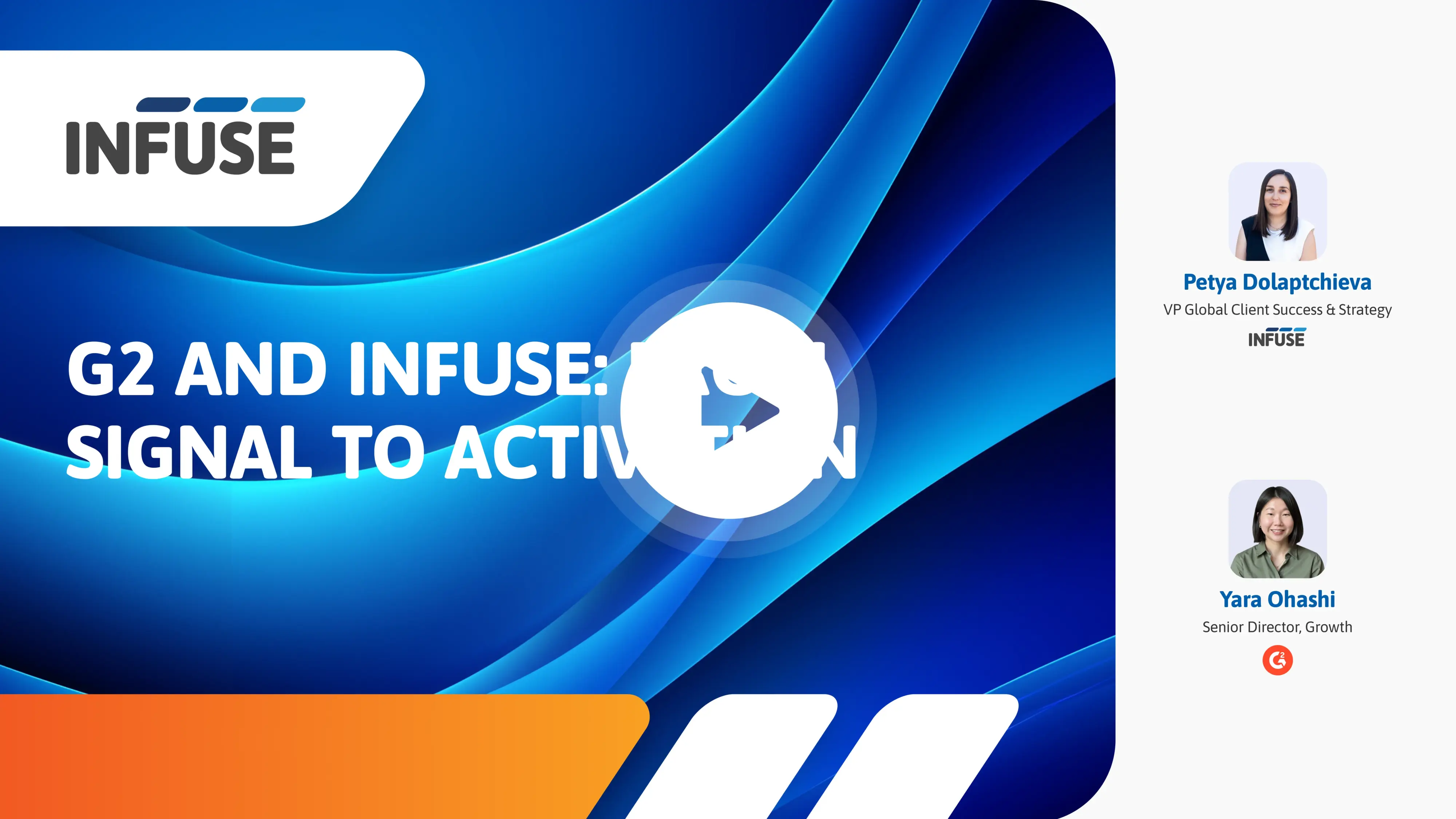
This on-demand session explores findings from a joint INFUSE and G2 study of 11 cybersecurity demand programs spanning more than 130 campaigns, 243,000 G2 Buyer Intent accounts, and 19,200 INFUSE engaged accounts.
Petya Dolaptchieva (INFUSE) and Yara Ohashi (G2) unpack the results of the study, including how accounts present in both datasets generated more leads per account, deeper engagement, stronger nurture engagement, and greater decision stage concentration.
From these insights, they discuss what demand teams should do with signals that arrive before the buying group ever becomes visible.
The conversation reveals how combining independent buyer intent with coordinated demand activation helps vendors engage buying groups more effectively and drive stronger outcomes in one of B2B’s most competitive markets.
Watch the webcast to discover how the combination of buyer intent signals and demand activation reaches in-market accounts earlier, engages the full buying group, and turns activity into pipeline.
In this video
01:31 Why Day Zero matters
03:05 How AI is changing the buying journey
06:18 The four levers of Day Zero influence
11:51 Turning intent signals into activation
13:46 The data: From intent to pipeline opportunity
00:11 Petya Dolaptchieva: Hi everyone and welcome. Thank you for spending the next half an hour with us. I'm Petya Dolaptchieva, and I'm the Vice President of Global Client Success and Strategy at INFUSE. And I'm really glad you're here. And I'm not doing this alone today. I have Yara here. Yara, over to you for an introduction.
00:29 Yara Ohashi: Thank you, Petya. Hi everybody, I'm Yara Ohashi. I lead growth marketing at G2. I've had a career leading acquisition teams and growth teams and B2B tech companies. So I'm very, very excited to be here today. For this conversation, because I bet it is something that almost every B2B marketer out there watching right now is feeling. It is the fact that we have more data, we have more channels, we have more targeting technology, but somehow pipeline still feels very hard. And with that, the answer isn't to just work harder and generate even more activity, right? We have to keep getting smarter about where we focus, which accounts we engage, when we engage them. So hopefully today's conversation will give you a few practical ideas for doing exactly that. How do you identify where real demand is forming and how do you act on it before the opportunity passes?
01:30 Petya Dolaptchieva: Yeah, absolutely.
01:31 Petya Dolaptchieva: So let's put some of these numbers together for cybersecurity. In 2026, buyers are moving through a market with a share of around $240 billion, and the way they buy has changed quite significantly. And there are three main things that we're going to be talking about today. First is the buying committees are getting bigger and the cycle timeframes are changing quite significantly as well. Then research shows that roughly 95% of eventual winners on the vendor list have appeared before Day One. And at INFUSE, we call the period before Day One, that formal search, Day Zero, because there's a lot of research happening, peer conversations, reviews are being looked at, conversations that are being had, thought leadership that is being consumed even before a Day One shortlist is being created.
02:29 Petya Dolaptchieva: So, the list is actually being revealed on Day One when intent signals start to spike even more. But by the time someone raises their hand, the real decision has already been kind of pre-made, or maybe it may have happened already. And I think the third thing is the shift from Day Zero influence that happens to discoverability shift and all of that information that is available to buyers online that they can reach out to, which I think G2 has a lot to share here, especially when it comes to AI discoverability.
03:05 Yara Ohashi: Yes, let's talk about what is driving that Day Zero change and shift. If you think about the buying journey, there's been a big shift in how buyers are finding and evaluating software today. Discovery got faster, but decision making did not. That's one of the most, I think, interesting findings from our latest Buyer Behavior Report. The evaluation has overtaken research as the longest stage of the software buying journey. If you look at the data last year, research was the longest stage for 40% of buyers. This year it flipped, evaluation moved into the top spot, and I think the reason is fairly intuitive. Obviously it's AI, it made finding potential vendors of course that much easier. Our research found that 51% of B2B software buyers now start their research with an AI chatbot more often than with Google. Last year that number was 29%, so now 51% not only grew really fast, but there's that inflection point as well. Buyers can generate a list of potential vendors incredibly quickly. It's just that choosing between those vendors still obviously takes a lot of work. As we all know, you still need to compare, you still need to understand pricing, assess risk, build that internal alignment, prove the ROI, right?
04:43 Yara Ohashi: It makes it incredibly important to reach and influence an account at the right time. It is while that consideration set is still taking shape and you still have an opportunity to become one of the vendors being evaluated. Why is that such a critical insight? It's because once the shortlist is established, it is incredibly decisive. Almost 80% of buyers, ultimately will select a vendor that was on their Day One shortlist. So it is a pretty remarkable number. So evaluation may take time, but you only get to participate if you make the shortlist. It tells you that the shortlist isn't simply an early kind of research exercise. In many cases, it is actually establishing the boundaries of the final decision, is what we've seen in the data so if you organize your marketing and your sales motions around hand raises, right, the demo request, the form fill, the contact us submission, the problem is that by the time the buyer is taking one of those actions, the shortlist may already be established. Again, the Day Zero mentality. The form field may be the evidence that really most of the journey has already happened. So the opportunity is not to wait until buyers announce themselves.
06:09 Yara Ohashi: It is to identify the accounts conducting relevant research and engage them while they're still developing a view of the market.
06:18 Petya Dolaptchieva: Yeah, I couldn't agree more. And I think that here's a trap that I see some teams fall into. They get access to intent data and they get excited and they treat it like a list, and they pull the accounts showing higher intent at the moment, they blast them, and it underperforms because the signal alone is not a strategy. So I think that we have to think about this a little bit differently. And here at INFUSE, we think about this a lot, which is the Day Zero influences for different levers that could be working together, not just one, but implement that signal at the right time. So the first thing, the first lever that I would highly recommend focusing on is the brand authority and brand credibility and what is being built before any buying activity actually happens and any intent signals start to surface. And this is all of the research that buyers could do through LLMs, thought leadership. And it's not just about the volume of content and how much we produce. It's about the quality and how it speaks to the buyer. And actually, 3/4 of the decision makers say that thought leadership actually has led them to research a product or service that they were not even considering.
07:34 Petya Dolaptchieva: So that's basically Day Zero doing its job. And then the second thing is the buying group presence. Oftentimes, go-to-market teams focus on only a couple of personas within the buying group, but the buying group size increases quite significantly. On average, we have nine members of the buying group. With cybersecurity specifically, this could grow to 10 or 12 people depending on the size of the organization. And each one of them consumes, on average, nine content pieces. Here's where we're also talking about the average buying cycle. Our most recent data from the Voice of the Buyer and Voice of the Marketer research shows that this is seven months at the moment. So all of this together is really important to be taken into account, where the content strategy is being created and what content is being served to different buying committee members and at what time. So again, not really talking about the volume of content and how many pieces you send through, but what is the information that you're actually giving to your prospective buyers to help them make that decision. And the third lever is AI discoverability. Not only appearing within LLMs and what information is there is important.
08:53 Petya Dolaptchieva: LLMs hallucinate; they pick up information from different sources that may not always be accurate. So I think it's very important that teams really look at this not just from an SEO perspective, but also what's happening within the LLMs and what information is available there for their companies and for the buyers to find. And the fourth lever is the signal intelligence. And I think this is where G2 comes in very strongly with a lot of different intent signals that could be leveraged to really make a campaign very successful.
09:26 Yara Ohashi: Yes, and I think when I look at all of this data, what it is telling me is the challenge isn't simply just reaching the B2B accounts at scale. You have to know which accounts are actively researching. You have to know how to engage them. You have to do it all before the shortlist is already set, right? So understanding what drives that brand authority and that influence is really important. One of the places where the shortlist is being shaped is off the review sites. Review sites are one of the top sources influencing shortlists, second only to the GenAI chatbots. And I would really think about those two as very closely connected because it is the research, the comparisons, the real customer evidence available on platforms like G2 that will help inform the AI answers. AI may be building the shortlist, but it does need trusted evidence, right, to build it from. So if you look at the G2 ecosystem, that also includes Capterra, GetApp, and Software Advice, that is the most cited B2B source in LLMs for software-related searches and comparisons. We have a 66% citation share across ChatGPT, Perplexity, Google's AI experiences as well, which all means that G2 is really serving two audiences at once.
10:50 Yara Ohashi: You have that human buyer, then you also have the agent, right? You have G2 as part of that trust layer that AI systems use to recommend software. I think the big insight being that buyer behavior is no longer exclusively human. So if you think about it all, it's why waiting for a form fill is so risky, because by the time somebody is requesting the demo, they may have already encountered your competitors and read the customer reviews, and asked AI for a recommendation. So then that form view is really telling you who is ready to talk, but it's really the research behavior that tells you who is deciding whether you're worth talking to in the first place. The opportunity is to identify the activity while it is happening and engage those accounts again before the shortlist becomes fixed, which I think to me is what brings us directly to how G2 and INFUSE really work together.
11:51 Petya Dolaptchieva: Yeah, so we've been partnering for over two years, and we've done quite a few campaigns together. But what's really unique about our Better Together story is how we leverage G2 data and signals into activation. And I think it's going back to what you just mentioned, Yara, it's like looking at the live intent universe, everything that is happening at the moment in terms of signals to then incorporate all of that into activation and orchestrating the right campaigns at the right time. Because G2 provides a lot of buyer intent signals that are very useful for different types of campaigns. And based on the signal type, we recommend different types of programs that we activate at different times to really activate the right audience at the right time with the right content on the INFUSE side as well. And I think that segmenting by signal and strength, it really helps with account depth. It helps with the research, some brand programs to really help accelerate that brand authority and recognition to then move into the activation of these signals and turning them into leads and ultimately pipeline.
13:05 Yara Ohashi: Yes, I think to me the goal here is to really reduce the time between that meaningful research and that meaningful engagement without having your teams repeatedly export lists manually, import, and manually interpret every signal, right? Manually build the specific campaigns. So that timing between research and engagement to me is really the heart of the partnership. Kind of the way that I think about it is G2 shows you where demand is forming, and then INFUSE comes in to really help you act on the demand before it becomes somebody else's pipeline.
13:46 Petya Dolaptchieva: Absolutely. And to reiterate, the integration that we have set up first is extremely secure, but second, it gives the real-time data for the campaigns to be informed and optimized as we go, which is extremely important because no manual work is involved whatsoever. So to me and my teams, that's a very important thing to mention today. And I think that, looking at what we have achieved so far, I think the next slide actually speaks volumes on its own. But to dive deeper into the data, we talked about the theory so far. So now let's, let's show the proof because, you know, everything that we've done together includes analyzing hundreds of thousands of signals across different types of programs. And here what we're looking at is a set of 11 programs that we did. So that's about 130 campaigns that we activated in our cybersecurity segment. So we looked at over 243,000 G2 intent signals, of which about 19,200 were activated through INFUSE accounts and engagement through our first-party data. So what are the results? And we knew that the results are going to be good because we know how strong the G2 buying intent data is.
15:06 Petya Dolaptchieva: And we know the strong engagement and lead quality that INFUSE brings together. But to be honest, I was very pleasantly surprised to see these results. I did not expect such high numbers. Let's start with the lead density. We saw about 20.9% more leads per account. What does that mean? We're doing the same effort, but activating the accounts at the right time has given us the opportunity to expand within the buying group and activate more leads per account than our average campaigns. Then looking at the engagement depth, we're looking at 93.3% higher multi-touch engagement, which is a significant uplift when we look at the non-G2 campaigns where intent signal data is not being used. So this is nearly double. And what we also see is that it doesn't stop there. If the campaign had a nurture component, which the majority of these campaigns did, there's an uplift in the nurture engagement stats as well. So we see about 22.8% additional engagement. So that makes the overall experience more sustained attention across the entire journey for that buying group and that account. Not only that, but I think one thing that is very important, it's very telling for me, is that these accounts are 1.6 times more likely to already be in the decision stage of the buying journey.
16:37 Petya Dolaptchieva: So these are not top of funnel; these are decision stage, and that's 42.6% versus 26.5% on an average campaign. So this is much closer to actually buying. And looking at these signals at the right time is really helping inform the campaign strategy because the intent signals don't just tell you who to target; they predict which accounts will respond, engage deeper, and convert. And that signal activation is very important for the win and the success of the program. And I think the overlap of the accounts and the engagement stats here prove the success of these programs overall.
17:20 Yara Ohashi: It is a very robust data set, which makes me so happy as a performance marketer, as a growth marketer. It really tells the story that when you look at intent and activation, it's not that it simply creates more leads, it really gives you more people within the account, but also more sustained engagement, stronger signs of progression towards that decision, right? We should never look at intent as a guarantee that an account will buy, but when you see something like this, when you see relevant research behavior paired with engagement across multiple people, across multiple touches, that is a much stronger signal of real buying momentum.
18:03 Petya Dolaptchieva: Yeah, absolutely. And actually, one thing I can't stop thinking about is that across the 11 programs, roughly 196,000 G2 buyer intent accounts were never targeted by any campaign at all. They were not deprioritized, they were just not in view. And that's because they just didn't happen to be in the overlap of the accounts or account target account lists that were put together and what the actual live intent universe is. So this is not a rounding error. This is a pretty significant number, and that's a pipeline expansion opportunity. To me, it's just sitting here in plain sight, right? A lot of the accounts that are showing activity should not be overlooked. I think they should be considered as a strong intent signal. I think you're going to talk about this later as well, but really helping to shape up the gaps in the ICP or anything else that is being overlooked when target account lists are being created. So demand isn't something that you can just manufacture. The signals are there, it already exists. So the question is how are you activating it? And to me, that's pretty strong, especially looking at these benchmarks that the vendors we're looking at, right?
19:18 Petya Dolaptchieva: For these accounts, what was overlooked is the competitor page views that were three times more on average. Looking at different competitor pages, the comparison page view goes up to 5.3 times, and then the pricing page views as well. So this is overlap versus no overlap accounts, which tells us that there were a lot of these intent signals within the overall intent universe that were not activated, and they could be considered as a missed opportunity.
19:47 Yara Ohashi: Yes, to me, that number, what it represents is a very substantial pipe opportunity, right? And I think if I think of takeaways from this conversation and hopefully giving people some food for thought, I think there's an opportunity to think about how many of us build campaigns. We often, I think, start with a static account list based on fit, based on company size and industry and geography. There's a propensity model in place, which are all very valuable inputs. But the accounts on the list, one, don't all go into market and become interested. Interested at the same time. And then meanwhile, you have companies outside of the active campaign audience that may be researching, that may be comparing, looking at pricing. So if your audience never changes, you may continue to spend against accounts with no current need while you're completely missing out on accounts that are actively in that Day Zero period, right? They're actively forming a shortlist right now. So I definitely would encourage everyone to compare the accounts demonstrating intent with the accounts you're currently targeting, because that gap may represent demand that is already in motion, but not receiving engagement. I think to me, when I saw this data point, the biggest insight to me was that the biggest leak in your funnel may happen before anybody actually enters the funnel, right?
21:25 Yara Ohashi: That is to me what the 196,000 accounts represent. It's not a theoretical audience. It's not demand that still needs to be created. It is opportunity that is already in motion.
21:38 Petya Dolaptchieva: Yeah, and I think if folks don't take anything else from today, but these three things, right? Audit your target account list against your G2 buyer intent universe and just really quantify the gap. Then the second one is to segment your active programs by intent signal. So there are different things that we can be looking at when activating your programs, whether that's competitor page views, comparison page views, pricing page views, or just learning from the overall G2 reviews is extremely helpful when we build the strategy for a campaign. And then, as Yara mentioned, just expand beyond the accounts that you already know, because the signal is already there. Activate the accounts you know and the ones that you don't. You can have two completely different motions, but part of the real full funnel coverage is then, instead of just working with your existing list, when you have these active signals and accounts available to you.
22:36 Petya Dolaptchieva: Alright, I think we're going to close with a couple of questions that we hear the most, and I think chances are a lot of folks are thinking about these right now as well. So, Yara, I think the first one is for you.
22:49 Petya Dolaptchieva: How do we reconcile G2 Intent signals with our existing ICP and target account lists in the near term?
22:56 Yara Ohashi: Yes, so how I'd see it is essentially using G2 Intent as the really dynamic economic prioritization layer on top of your ICP and your target account list. Your ICP is telling you which accounts are most likely to be good customers, right, based on fit. Then you have the target account list that's basically operationalizing that strategy. The G2 data is basically adding the missing timing signal. It's telling you which of those accounts appear to be actively researching right now. So if you put fit and intent together, to me it really is a framework that you can use to prioritize accounts, understand what truly should be in your ICP, your target account list. You think about high-fit, high-intent accounts, you should definitely prioritize those and activate them now. You have high-fit accounts without intent, you should not abandon those, you should continue to nurture until that behavior changes. You have high-intent accounts outside of your target account list. Again, that immediate pipe opportunity, as well as to me, how I see it is really a test and learn opportunity, right? It may expose gaps in your ICP, your propensity modeling, the way that the target account list was built originally.
24:18 Yara Ohashi: So what I would do is over time, as you get this data, you compare the conversion, the pipe performance of each of the groups, and you use those findings to improve the next version of your target account model. You just don't have to wait for the full modeling exercise or refresh to begin acting on those signals today. So the goal really is not to choose between your target account list and your buyer intent. It is to make a relatively static account strategy more responsive to what buyers are doing right now.
24:58 Petya Dolaptchieva: Yeah, and just to add to that, from the activation side, you don't have to rebuild this overnight. This could be just layering in some intent into your programs that are currently in flight and using the strength of these signals for activation, and let the results tell you where to expand, or it's an evolution. It's not just a rip and replace. But then I think having that integration really helps with the flow of these signals automatically in real time, which helps with the monitoring optimization of programs. And I think we have one more question here. How does this apply if we're not in cybersecurity at all? And I'll take this, but Yara, feel free to jump in as well. We focused on this. We studied the cybersecurity space because it's the one of the hardest cases. Not only do they have one of the biggest buying committee groups, they have long sales cycles, but also it's one of the most crowded markets. But nothing in the four levers that we mentioned and all the insights that we've shared today is specific to just security. So every B2B category has a Day Zero. Every category is forming shortlists, and they are researching using AI, using peer reviews. And so the principle is the same for any industry that you might be in, and the signal source and activation change by market, but the underlying shift doesn't.
26:28 Yara Ohashi: Yes, the framework I think remains the same, right? You identify the accounts that are researching right now, you interpret what that behavior suggests, you engage them before the decision, the shortlist has already been made.
26:42 Petya Dolaptchieva: Yeah.
26:44 Petya Dolaptchieva: And let's come back to where we started. I think the reason pipeline feels harder isn't because your team is not trying their best. It's just that the decision moved, and it moved earlier. It moved into AI. It moved into places that the old funnel couldn't see. So the good news is it didn't disappear. It's visible again, you know, leveraging the data from G2. And really having the right signals you can act on fast would be the key to success.
27:13 Petya Dolaptchieva: So that's the whole story of what G2 and INFUSE have built together to really activate the intent signals to see who's in-market, reach the full committee, and then really close the distance between intent signals and activation with our real-time integration.
27:33 Yara Ohashi: Yes, and because we want everybody watching to experience all of this firsthand, I'll also mention that there is a joint offer going on right now. New and current G2 buyer intent customers that are not currently working with INFUSE may be eligible to receive 100 complimentary leads. The goal being really to give you a practical way to begin operationalizing your G2 intent data so you can see how signal-informed activation performs in a live campaign.
28:07 Yara Ohashi: So we definitely encourage everybody to book a strategy consultation to learn more about G2 and learn more about INFUSE and what happens when signal meets activation, and you can learn more about the offer there as well.
28:21 Petya Dolaptchieva: Awesome. We look forward to it. Yara, thank you so much. I appreciate your time today, and thanks everyone for being here.
28:29 Yara Ohashi: Thank you so much, Petya. Thank you everybody for watching. Wishing everybody a record-breaking pipe quarter.
Thank you!
A member of the INFUSE team will contact you soon.
Select your country
North America
Europe
Asia
Africa
Oceania
To provide the best experiences, we use technologies like cookies to store and/or access device information. Consenting to these technologies will allow us to process data such as browsing behavior or unique IDs on this site. Not consenting or withdrawing consent, may adversely affect certain features and functions.