Results for “”

Webcast
What APAC marketing and GTM leaders are doing to close the trust gap
35 min
•Updated: July 15, 2026
Your requested content is now available.
We hope you find it helpful and insightful.
WATCH NOW

Sameer Thakkar
VP Marketing, Asia Pacific

Fiona Lam
VP Marketing, Asia Pacific

Mukesh Rajpurohit
Vice President APAC

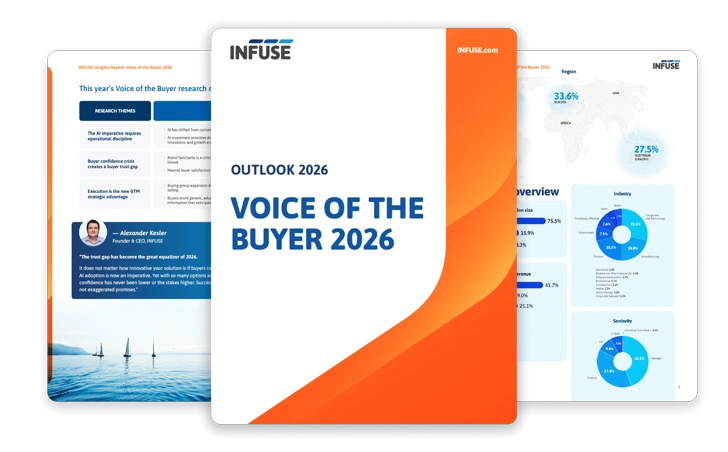
Two forces are redefining B2B growth: AI-powered decision making and the rise of discoverability as a direct path to revenue. Only one in four B2B buyers report deep satisfaction with their current vendors, even as content consumption per deal climbs to nine pieces and buying groups expand to nine stakeholders (Voice of the Buyer 2026). An abundance of information is not producing confidence.
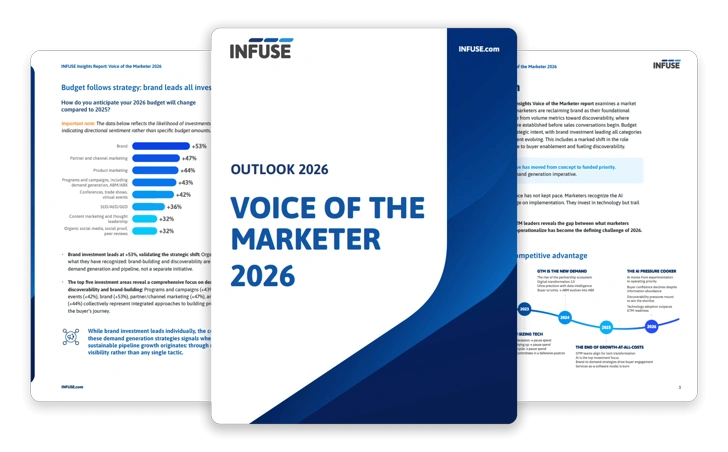
The same pattern appears on the marketing side. Predictive analytics now leads AI deployment at 58%, yet AI-driven segmentation and personalization sit at just 3% deployment (Voice of the Marketer 2026). Marketers are investing in the infrastructure of intelligence without scaling the buyer-facing experience that infrastructure is meant to power.
This on-demand session examines how AI is simultaneously accelerating insight and eroding buyer trust, and why confidence in data, content, and vendors has become an executive-level priority. Sameer Thakkar (SAS), Fiona Lam (Equinix), and Mukesh Rajpurohit (INFUSE) bring this market reality into focus through the lens of APAC marketing and GTM leadership. The discussion also explores how growth is shifting toward being found first, not just being better, in an era of AI-powered search, generative tools, and dark funnel activity. The session draws on findings from INFUSE Voice of the Buyer and Marketer 2026, a survey of 2,300+ GTM leaders.
This webinar explores:
Watch the webcast to explore the latest insights on AI, trust, and discoverability in B2B.
Watch now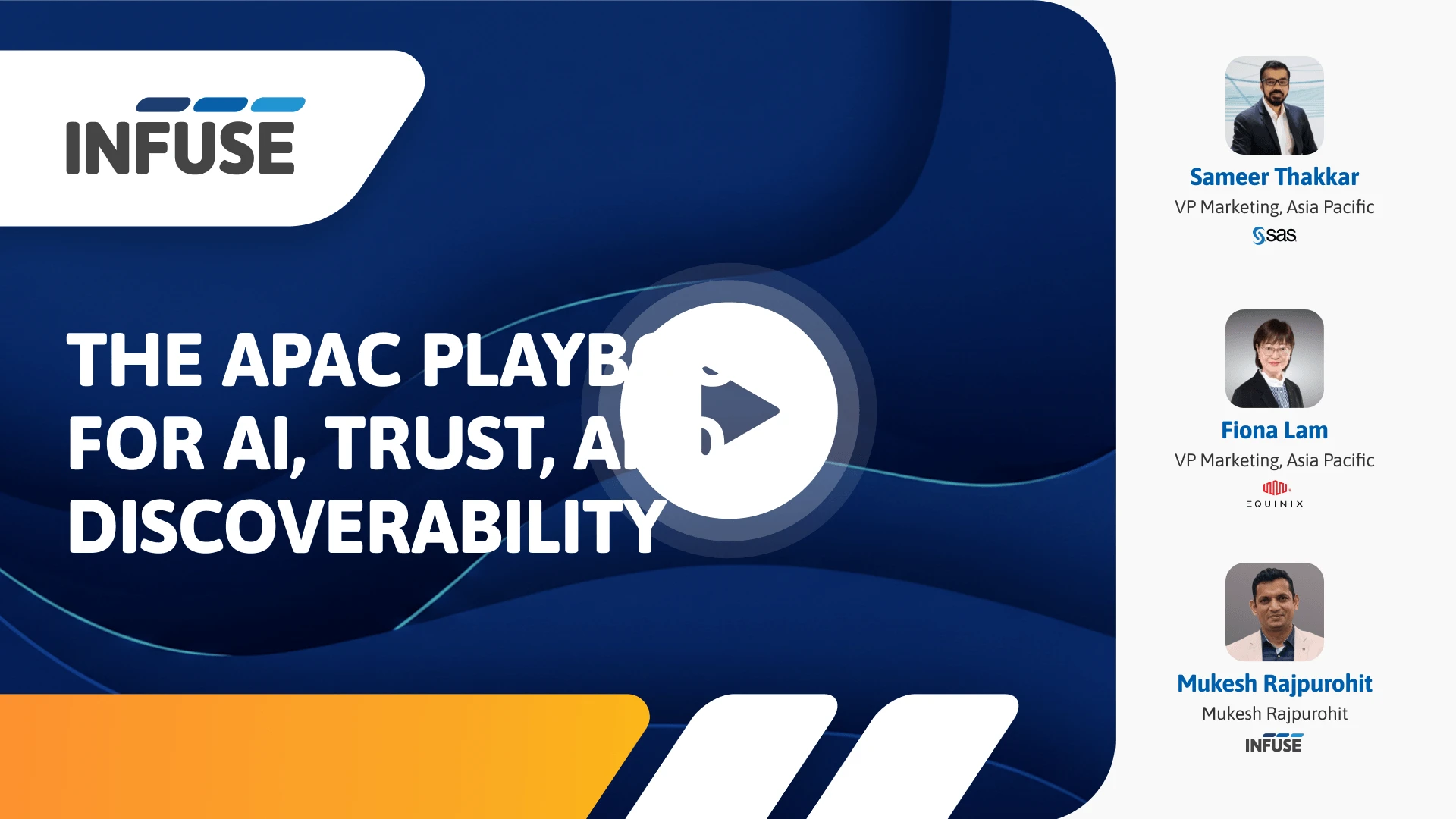
In this video
02:42 Introduction and the evolving realities of B2B marketing
02:47 How B2B buyer behavior is shifting across APAC
07:42 Lighting up the dark funnel and influencing invisible buyers
14:40 The growing trust gap in AI-driven content and buyer engagement
22:31 AI-powered personalization, segmentation, and discoverability
29:36 Data-driven marketing and the future mindset for APAC marketers
33:53 Key takeaways
00:09 Mukesh Rajpurohit: Hi, hello everyone. My name is Mukesh Rajpurohit. I head the Asia Pacific business for INFUSE. I've been in the demand gen space for a little over 25 years now. And one of the interesting things that we are doing this year is talking about the new realities faced by marketers. There was a time that they said it took a decade for a new technology to come in and disrupt something. But one of the things that we are noticing is that I think it's more like 6 months now. It takes six months for a new technology to come in and disrupt. And there are a few interesting things that are changing our realities. One of them is, of course, AI. We have some trust issues when it comes to our content. And, you know, SEO has now moved to discoverability. It's all about making sure that you're available on your AEO and GEO platform. Now, in order to decode this, I have a fantastic panel with me. This panel, of course, between Fiona and Sameer, they are not only leaders in their respective roles, but also amazing practitioners.
So let me first introduce Sameer Trakkar, who's the Vice President, Marketing, Asia Pacific for SAS. Sameer is an experienced marketing executive with over two decades of expertise in leading international marketing teams and leveraging strategic marketing to drive business growth, both on B2B, as well as the B2C side of the business. Prior to SAS. He led marketing for Meta, popularly known as Facebook, HERE Technologies across APAC, EMEA, as well as North America. Along with this, he's facilitated more than 75 workshops, accumulated more than 25,000 hours of training for mid to senior-level professionals. Sameer, excited to have you on this panel.
02:03 Sameer Thakkar: Thank you very much, Mukesh, for having me. It's wonderful to be here. Thanks.
02:06 Mukesh Rajpurohit: Fantastic. And of course, we also have Fiona Lam, Vice President Asia Pacific Marketing for Equinix. First of all, thank you so much, Fiona, for joining this one. Fiona leads the regional marketing strategy and field marketing operations, driving segmented value proposition, generating demand, supporting revenue growth across Asia Pacific. With nearly 3 decades of experience in the technology sector, she has held senior marketing leadership roles with popular brands like Brocade Communications, Riverbed Technology, Monster.com, and Juniper Networks. Fiona, excited to have you.
02:42 Fiona Lam: I'm pleasured, it's my honor to be with the team and meet with everyone today.
02:47 Mukesh Rajpurohit: Fantastic. You know what, let me start off with an interesting question to both of you. What is the biggest shift that you've seen in the B2B buyer behavior in APAC over the last 12 months? It's been very, very interesting. So many new technologies coming in, so many new strategies coming in. Almost every marketer that I met this week at an event spoke about building their own agents. So how different is this overall buying environment in APAC? And when I reached out to you, I said, we want to make this very specific to APAC. So, how is it different in APAC compared to your global counterparts? So Fiona, do you want to get started with this one? So, how has the overall environment changed in the last 12 months?
What is the biggest shift you've seen in B2B buyer behavior in APAC over the last 12 months, and how is APAC different from global markets?
03:37 Fiona Lam: Wow, this is really a great question. So, we saw quite a big shift in the past 12 months. So the most significant shift is the rise of enormous self-directed buying across large distributed buying groups in our space. So, you know, in APAC, many buyers tend to research quietly and also engage late with marketing by our marketing efforts, right? So in our category, we are seeing around 8 to 12 stakeholders involved. Simply speaking, like maybe cloud architect or network infrastructure buyer, AI leaders, and so on. And most of their journey happens before they even engage us. So therefore, what's changed is that they arrive highly informed. So, often, maybe 60% - 70% through their decision journey, having already benchmarked some architecture. For example, they already know the pricing model and ecosystem options. And by far, we are seeing AI influencing their discovery. So buyers are usually using GenAI tools to shortlist vendors or validate some architecture, and so on. So this changes how early inference happens.
04:55 Mukesh Rajpurohit: Interesting. Yeah, of course, the buyers are way more well-informed today than they were before a lot of this technology was made available to them. Sameer, what about you? What are the changes you've noticed in the last 12 months?
What is the biggest shift you've seen in B2B buyer behavior in APAC over the last 12 months, and how is APAC different from global markets?
05:09 Sameer Thakkar: I think Fiona covered a couple of very, very useful and important ones, right? The research that we have done, especially in the last two years, more significantly in the last year, shows that roughly about 70 to 80% of the buying journey has been completed even before the first conversation begins with the partners. That means that there is a lot of independent research and internal alignment that is happening within organizations, within the buyer groups, fundamentally in terms of understanding what their priorities are, who the partners are that are aligning with those requirements across the key parameters that they're looking for. And therefore, it is more critical than ever that the brands remain visible and relevant even when the buyers are not active in the market. I think there are two factors, right? The buyers who are currently active in the market are roughly about 15% at any given moment in time. The buyers who are not active in the market, the remaining large chunk of 85%. Constant engagement with them becomes extremely critical. The second element is the role that AI and LLMs, basically, or AI research tools and LLMs, are playing more importantly in the market.
Buyers are now increasingly using AI-driven tools to research vendors. They're looking at it to compare options. They're generating shortlists based on factors like cost, integration capabilities, the tech stack, and the business outcomes as well. So the organizations that are looking at areas beyond the traditional SEO and digital visibility are a key shift that we're seeing, especially in the last 6 to 8 months. Let me highlight that with a very relevant and a very recent example that has happened within our company as well. Our team, our sales team, was presenting to one of the groups, our buyer groups, within a large organization recently. This was just a couple of months ago, and roughly about 30 minutes into the pitch discussion, the senior, the CXO, basically just said, “Hey, the idea is not about starting the conversation today. In fact, we just wanted to validate that the research that we have done on selecting your organization to be our partner is the right one.” So the conversation is more about the closing rather than the pitch part of it. And that is the shift that we are drastically seeing, that the companies have already done a large part of their research, including estimation, and then starting the conversations to evaluate whether these one or two partners that they have evaluated or shortlisted are the right ones to move ahead with.
07:38 Mukesh Rajpurohit: Fantastic. And in fact, you know, yes, dark funnel is real. Sameer, you mentioned that 70% research is happening before someone even puts their hand up or makes himself or herself available. And that's my next interesting question for you. You know, today we are in a very interesting situation where we want to build the brand preference. And Sameer, what an example. Kudos to your team. You guys were able to build that brand preference with the larger, as Fiona said, it's not one or two people. We're talking to a larger community of people. And this has to happen at a record speed. You cannot do it at your own convenience, we've seen, you know, the overall buying cycle is actually reduced. And, to make our lives easy, most of this is happening in the dark, and most of this is happening without our notice. And this is something which is, I think, one of the most interesting challenges as well as an opportunity. So, how are you going about it? Sameer, I'm going to come to you first. How are you going about lighting up this dark funnel to make sure that the recent example that you spoke about is an example which repeats itself.
And, I think that's also one of the best ways for sales and marketing to be joined at the hip and have that confidence that we are talking to these buyers or making ourselves visible even while they've not come out, put up a hand, or filled out a form. So Sameer, how are you going about, I keep calling this lighting up the dark funnel. So how are you lighting up this dark funnel?
How are you lighting up the dark funnel and building brand preference before buyers engage directly?
09:16 Sameer Thakkar: Absolutely. I think it is more critical than ever in terms of understanding or trying to light up, like you mentioned, the dark funnel part of the invisible buyer group journey as well. And this is where the entire idea, basically of influence, Mukesh, becomes more important than ever. We're looking at influence that needs to be established well before any direct engagement even starts with the vendor, right? Like we spoke about, and we have it here on the slide as well. That they are already 70% through their journey even before the conversations first start. And therefore, looking at a holistic perspective, and we call it the "3 R" framework, the first one is the "reach", the second one is "relationship", and the third one is "revenue". Now, it is not necessarily linear in terms of me starting with reach and then going into relationship and then going into revenue. In many cases, these are existing customers. So we have already revenue which is coming up, but strengthening relationship, or increasing our reach in these dark funnel areas or the invisible buying groups becomes more critical than ever. The entire second idea is showing up consistently at the right forums, at the right conversations, and digital environments where these evaluations are happening.
Even though there is a possibility that we do not know or we are not aware of where these conversations are happening within and what stage of funnel the buyer is in currently, or the enterprise is in currently. The brand's ability or an organization's ability to feature and remain relevant in a very consistent way is extremely critical so that they are top of mind both in terms of recall and in terms of visibility for these enterprises, which are currently driven and they're in the market as well. So fundamentally, and lastly, I already highlighted the need for everybody to get ready for an AI-driven discovery and evaluation model. If you are still not thinking about it in terms of how we are looking at AI-driven marketing or AI-driven discovery and evaluation models, already too late in the market. So the idea is not to wait for demand to come to you, but to show up absolutely consistently, number one. Second, ensure that you're looking at an integrated full funnel buying journey with, regards to where the customers, irrespective of where the customers are. And lastly, having an AI-first mindset is more critical than ever. So those are, I think, the areas that we are focusing on to ensure that we address that gap that you just spoke about.
11:44 Mukesh Rajpurohit: Absolutely, Sameer. I'm going to steal the "Triple R" framework. I'm going to use that whenever I'm talking to my customers. That's such an intelligent way of going about making sure that you build that relationship, be relevant before you even discuss revenue with someone. Thank you. Thank you so much. Fiona, how about you? I know you cast a wider net. How are you going about lighting up this dark funnel?
How are you lighting up the dark funnel and building brand preference before buyers engage directly?
12:10 Fiona Lam: Thank you, Mukesh. Actually, I try to take the question in a different way, which is really talking about the practical scenario that we have at Equinix. So I believe there has an echo to both of you as a matter of fact. A large portion of the journey is invisible in this sense. But it is not unobservable anymore, right? So like in our company, we shift from lead-based marketing to intent-led orchestration on our MarTech platform. And it plays a very significant role in a couple of ways in helping us to navigate and observe the journey of the buyer, even when we don't see them engage with us. So, we start with how to identify in-market accounts early. It helps us to detect buying stage and keyword-level intent. Wherever an account is already starting researching, like in our space, right, interconnection, AI-ready infrastructure, or hybrid multi-cloud, we already know it through our platform. That allows us to prioritize real-time demand and not just waiting for inbound leads. So at the same time, on the search and discoverability dominance side, we also invest heavily in ensuring our expertise shows up where the buyers start in researching the information, whether it's traditional search, anonymous platforms, or increasingly AI-generated summaries.
That means structured, high-quality content is required in this day, and also around all the real use cases that our company offers to the customer. Like hybrid multi-cloud, data sovereignty, AI workload, and so on. Lastly is activating across channel before engagement. So once we see the intent, the next step is so important. We need to be very smart and to organize targeted digital campaigns and personalize the content and sales outreach. So I think to date, the topic is about trust. The more you use AI in your GTM, the less the trust factor will be seen. So therefore, content is also the king. How can we make sure to make ourselves be consistent and be relevant, and also trust-led, is equally important in our orchestration.
14:34 Mukesh Rajpurohit: Totally. It's so important. I love how smartly you're looking at intent and then following it up with very targeted, very focused digital campaigns. Now, INFUSE sits in a very interesting marketplace where I talk to marketers, of course, for a living. I talk to marketers as well as we also talk to your audience, the IT decision makers, the whole buying committee. Every year we come up with this very interesting research called the Voice of the Marketer and the Voice of the Buyer, where we understand the challenges faced by marketers as well as the audience that they want to sell into. And one of the things, one of the themes that came out very strong and Fiona, you just touched upon them, is that I don't like to see the slide, but the fact is, we've got a serious trust gap. And I agree with you. Yes, a lot of our audiences came back, and they said we live in a very interesting day and age where content is available. There's in fact too much content that is available. Getting access to content has become easy. There's so much.
So while AI has kind of accelerated the whole process, it has also broken trust. When we spoke to our buyers, there are only 20% of people, and these are the people you're interested in selling to, 20% of people actually have come back and said, yeah, you know, we trust, trust this content that we get from the vendor. So my question to you, Fiona, is how do you bridge this trust gap? How do you go about making sure that the content that you put out there is something which is loved and respected. And more importantly, as I said, it's so important because after this content consumption is when they're going to come out of the dark and put up their hand and want to talk, have a conversation with you. So Fiona, how's your team tackling the whole bridging of the trust gap?
How are you bridging the trust gap and ensuring buyers trust your content and brand?
16:33 Fiona Lam: Yeah, trust is very important in our domain because our buyer is making important infrastructure decisions with long-term implications, right? So, trust to us is the primary differentiator. So therefore we, we focus on a few trust levers. Firstly, the transparency and proof. So buyer trust evidence over messaging. You can have great messaging, but they look for evidence as well. So therefore we need our content to show performance benchmarks, SLAs of our servers, sustainability matrix that we deliver, and also we build customer case outcomes, right? Particularly important in APAC, where buyers usually, their risk sensitivity is high. They want the proof points. At the same time, we always believe human plus digital trust blend together. So therefore, digital research creates digital trust, right? But at the same time, we will make sure that human validation close the gap as well. So we also invest in executive face-to-face engagement, customer communities, and other peer references. Especially critical for our space is large and multimedia infrastructure investment. So ultimately, trust is built when what you say, what your ecosystem is also saying, and also what customer experience are aligned. This is how we address this.
18:01 Mukesh Rajpurohit: I so agree. And then, of course, we see that buyers are actually drowning in AI. They consume more, trust less. And then, even the vendor selection, of course, brand has its own importance. But what is also very important is that instead of brand, people are now focusing more on technical fit. Sameer, how are you tackling this? As we know, you go with so many solutions to the buyers. And then of course, the whole buying committee is very, very large for you. And then while it's large, it also magnifies the problem for you because, you know, to every buyer you have to say the same thing but in a different tone with a different messaging. So, how are you going about building or bridging the trust gap?
How are you bridging the trust gap and ensuring buyers trust your content and brand?
18:46 Sameer Thakkar: Very, very critical, Mukesh, that you mentioned in terms of the spectrum of solutions and products that we order to an even wider spectrum of industries and use cases that SAS works with, right? Let me give you a couple of examples, basically, and then ask the panel a question with regard to where you see or how critical you see trust within the use cases that I'm going to just share with you. Let's take an example about vaccines, new vaccines that are being developed to address the diseases that the world is going through today, and ensuring that people remain healthy for the future. There is a rigorous regulatory framework that needs to be addressed. SAS today is at the forefront of working with the health and life sciences industries for providing solutions that give the rigorous testing and regulatory requirement fulfillment that is required for this vaccine development. The second use case would be avoiding and ensuring that you're detecting fraudulent cases that are happening, especially with a digital-first or a digital-only banking and insurance infrastructure that is shaping up around the world. Billions of transactions are happening every day, and the ability, how each one of the customers within the banking and insurance sectors, people like you and me, are able to trust the banks is that they ensure that the number of fraud and the transactions are basically are reduced to a minimum or not there at all. And therefore, the entire element of trusting the entire system that SAS provides these banking and insurance companies becomes more critical than ever. Welfare mechanisms that are currently deployed by the government in terms of ensuring that people get benefits out of the taxes that they're paying in a right, in a fair, in a distributed way is extremely critical. How would we feel as individuals, as citizens in whatever countries we are living in, if we are not getting the welfare schemes for the taxes that all of us are contributing to? And therefore, I think trust becomes, using these examples, trust becomes the cornerstone of everything that we have been doing for the last 50 years. SAS turned 50 this year. And the fact that we still continue to work with all these organizations with a high level of trust or high level of credibility is fundamentally because we do not see trust as an experiment. We do not see trust as a moment. We do not see trust as a point of time. Trust is something that we have built consistently over the last 5 decades and still remains one of the key considerations as we approach and work with our customers, with our partners, and not just the customers, but the billions of people who are end customers of these banks, of these insurance companies, of the government bodies that we work with, of the pharmaceutical manufacturers that we are working with.
So I think this entire idea of looking at it not in a transactional way, but very consistently in terms of investments around reputation and brand building, that is then supported with whatever we are doing in terms of our deliverables as well, becomes extremely important. So it is not just looking at an immediate deal or some work that you're doing within the year, but a longer-term relationship-building exercise, which is mutually beneficial and anchored in trust, becomes very critical. And this is not just for SAS. Take an example of anybody who's there currently in the market today, especially with the fast-evolving situation, it becomes increasingly important.
22:18 Mukesh Rajpurohit: This is so interesting how you both put this forward, Fiona, you gave us the clear tool in terms of you've got to validate your claims. And Sameer, you've taken this to a very, very fundamental level where, say trust is one of the co re fundamental values that we remember before we even design a single campaign, so thank you so much. I think you both have really touched upon this topic from two different lenses, which eventually actually gets you, gets you that trust and helps you build that relationship, one of the core pillars of the Three R strategy that you mentioned, Sameer. You know, what's also happening within our industry, and this is Asia-Pacific relevant data, is we've seen overall, with the advent of AI, our buying has moved faster. The buying committee used to be 10, and has come to about 9. People are consuming more data. And then, you know, we also see a lot of our audiences is more, either they don't trust the current vendor or they're looking for a switch, or at least they're in neutral. Neutral is also not good these days.
We want to make sure that our customers really, really love us. And while it has accelerated, the overall, I don't call it a challenge. I call it an opportunity. You know, one of the things that we've seen is the overall AI adoption is something which is very, very interesting in Asia-Pacific. 50% of our audiences we spoke to, marketers we spoke to, came back and said, yeah, we're using AI, but more for predictive analysis and modeling, rather than for segmentation and personalization. This is another big opportunity area. And I'm sure this number as we talk is going up. Sameer, I'm going to come to you as first to respond to this. Everyone is investing in AI right now, but within SAS, what are the AI applications that you're evaluating deploying as part of your marketing strategy? How are you leveraging AI, not only for data breakdown, data analysis, but more for personalization, that segmentation, which really, really means a lot. And personalization at scale now.
How are you applying AI in your marketing strategy for personalization, segmentation, and customer engagement at scale?
24:42 Sameer Thakkar: Absolutely. I think you brought up a very important point, Mukesh, which is Asia-Pacific and the diversity that we bring in, right? Asia-Pacific is not one market. It is not one buying behavior. It is not one buying approach. The entire idea around the diversity that we see across regulatory, linguistic, cultural elements is so diverse. However, I fundamentally believe that we have a great opportunity of using and leveraging that diversity to our advantage in terms of it becoming a sandbox of how new technology, how new changes, how new technology advancements can be adopted first. And specifically, now coming to the AI part of it, the way we are looking at it is across 3 core areas. The first one is content and digital assets that are AI-ready. Especially for customers, increasingly, the discoverability area that we spoke about, it is important that the content and the digital assets are ready to be discovered through these LLMs and AI-driven search experiences. The second one is using AI internally to better segment our audiences, identify the right personas, and build ongoing engagement strategies with scalable customization at the heart of it. I think the entire idea is we have two spectrums, right?
On one side, we are looking at one-size-fits-all. There is a campaign that is deployed the same way across the market. It is not going to work. On the other side, there is extreme customization where we try to customize and localize everything for every single market, every single segment. That is not going to scale, and given the pressures that we are seeing around resources, that is not going to continue as well. So how do we find and leverage AI for that scalable customization element, I think, is an area that we are double-clicking on. And the third one is now bringing visibility or increased visibility to the hidden or the dark buying funnel or the discoverability phase that we have spoken about at the beginning as well. AI now and the tools, have increasing capability of building campaign reporting and tracking that delivers a connected view of the full customer journey. Including sharing insights about that dark funnel that we spoke about. How can we bring in and use AI to our advantage to throw more light in terms of gathering customer insights even before they come into the market for that first conversation that we spoke about? We are using a bunch of tools, including our internal tools as well, which we have been developing over the last couple of decades. SAS has been doing data analytics even before it was called AI, but also, again, equally important, leveraging external tools to be able to complement the work that we already, or the tech stack that we already have internally. So those are the three core focus areas that we are focusing on this year and potentially into next year as well.
27:26 Mukesh Rajpurohit: Thank you. Thank you for sharing that, Sameer. What about you, Fiona? What sort of AI investments are you looking at and how are you evaluating and deploying it into your marketing strategy?
How are you applying AI in your marketing strategy for personalization, segmentation, and customer engagement at scale?
27:36 Fiona Lam: Yeah, so I'm very lucky. I work for a company that really supports a data-driven, AI-empowered go-to-market marketing approach. So since 10 years ago, we have already been heavily data-driven. We build modeling in order to support us in segmentizing and also targeting the right personas and segments that we need to go after for our sales team. So with the past 10 years journey, we are pretty much evolving to be fully AI empowered today. So we already apply a couple of AI empowered platforms in helping us on predictive demand generation to precisely target and personalize, and to orchestrate our campaigns, as well as most importantly, through the platform, we are also able to indicate to our sales rep how to prioritize outreach and tailor-made conversations, and even help them to engage earlier before the buyer really understands what need they have. So I think particularly in our domain, it involves complex infrastructure deals. So timing and context are everything. So, every day for me as a marketing leader, once I'm back in the office, I turn on my inbox. Actually, I also turn on my MarTech platform, because it immediately tells me all of my customers and what they did in the past 24 hours, what their online behavior is, and what is their intent in the past 24 hours.
That is very, very inspiring, and it is also helping us to make, you know, very advanced, proactive decisions on how to engage with them early in their buying journey.
29:14 Mukesh Rajpurohit: This is so interesting. Yeah, of course, these days when we log into our machines, I'm sure the second or the third interaction is within an AI platform when we get started. Thank you. Thank you for sharing that, Fiona. We are at the very end of this particular discussion, but of course, I'm not going to let you guys go without you guys telling me what your take is on this. If you were to pick one investment, one capability, or a mindset shift which will define marketers, which will help marketers win in the Asia-Pacific region, what would that be? Fiona, what's that one thing? It could be investment capability, mindset, which will help marketers in the Asia-Pacific region?
What is the one investment, capability, or mindset shift that will help marketers win in APAC?
30:03 Fiona Lam: Oh, you know, this is a very good question, Mukesh, because this is a very popular topic within our team. We have been discussing this, right? How we can move today's marketer to be future-proof. Okay, so my experience told me that one important capability is how we make sure that we are a data-driven marketer who is able to really deliver data-driven orchestration in our marketing deliverables. Because in APAC particularly, to echo what Sameer mentioned, it is a very diverse region. So people come from different backgrounds, different buying intent, different maturity of the market. So therefore, only data can tell you that deep visibility into buying journey and intent. So as a marketer, we have to, at least our top of mind, that is a must. We want to make ourselves data-driven and embed it into our marketing approach. At the same time, don't be afraid to start everything from data in your marketing planning. So I still come across lots of marketers, that when they have a budget, they think about, okay, sales team asked me to generate more pipeline, and then they think about what kind of event that we need to do.
No, stop doing that. Really understand from the data what are the next big opportunities, what is the customer behavior intent before you figure out what are the right channels in order to engage with them early in their buying journey. So therefore, data-driven orchestration is one capability that I suggest to the team.
31:43 Mukesh Rajpurohit: Totally. I mean, someone early on in my career told me, Mukesh, data is always going to be your best friend and a friend that never lies to you. So I agree. Of course, you have to be data-driven. Sameer, what's your outlook? It could be capability, investment, or mindset. What's your recommendation to a lot of marketers out there in this region?
What is the one investment, capability, or mindset shift that will help marketers win in APAC?
32:03 Sameer Thakkar: Mukesh, at the cost of sounding a bit old-fashioned and a little too fundamentalist, we are currently focused, and our global CMO has highlighted the need for us to be customer-obsessed with an organization-first mindset. Our ability to adapt basically and adopt new technologies that are coming into the market, which are extremely critical, is also the North Star that we are evaluating the new technologies, the new evolution, the new way of doing things, to ensure that customer obsession remains at the center of it, number one. And second, like I mentioned, it is not just looking at one team first or another team first, marketing coming first or the sales team coming first, or any other teams as a matter of fact, it is looking at an organization-first mindset in terms of understanding how can we have the entire organization leverage the new technologies, the data insights that Fiona spoke about, and our new GTMs basically in terms of ensuring that we fulfill and successfully deliver on the customer obsession that we're looking at. Everything that we have spoken about can be a very wonderful and a very complementary part of this entire journey as soon as we have that mindset shift fundamentally activated across the company as well.
So I think those are two areas that we are focusing on bringing together to ensure success.
33:25 Mukesh Rajpurohit: Fantastic. Customer focus and one team. I love that. I love the theme. So, we said we are at the end of our discussion. Of course, we'd love to talk more, but I have to respect time. In case you want more information about this research, you could go to infuse.com/outlook, scan this QR code, and download a lot of this content. But you know what, Fiona, Sameer, thank you so much. I mean, of course, as always, it's great to talk to you. More importantly, getting this practical advice. When I go back to my desk, I'm going to take up some of these snippets and say, okay, this is what I want to implement. Thank you so much for keeping it so relevant, so practical, and I sincerely appreciate you finding time out of your busy schedule to do this, not only for me, but for the industry at large. Thank you so much.
34:17 Fiona Lam: Thank you. Thank you.
34:18 Sameer Thakkar: Thank you, Fiona.
34:19 Fiona Lam: Thank you.
Thank you!
A member of the INFUSE team will contact you soon.
Select your country
North America
Europe
Asia
Africa
Oceania
To provide the best experiences, we use technologies like cookies to store and/or access device information. Consenting to these technologies will allow us to process data such as browsing behavior or unique IDs on this site. Not consenting or withdrawing consent, may adversely affect certain features and functions.