

Visit your local INFUSE site

Contact

Results for “”

Hero background

Discoverability-to-Revenue:

Building Trust in an AI-Enabled Era

Navigate
executive summary

Executive Summary

B2B go-to-market (GTM) teams must transform their brand and demand orchestration to reach buyers as they navigate self-directed, AI-assisted research journeys. Establishing a systematic presence across discovery channels while building trust is critical to all elements of the B2B buying process: making the consideration list, affirming purchase decisions, and securing renewals and expansions.

This article presents a 4-step discoverability-to-revenue framework: discovery infrastructure to capture invisible journeys, trust systems to enable group consensus, strategies to compress decision cycles, and methods to attribute revenue to demonstrate impact.

Critical insights:

Create discovery infrastructure: Establish presence across core marketing channels, including AI platforms and peer communities, to influence the 61% of B2B buyer research that occurs pre-vendor contact (6sense, 2025)

Integrate trust mechanisms: Provide proof of technical alignment and business value to build confidence across expanding buying groups. Indeed, 27% of buying groups now comprise 7-10 stakeholders (INFUSE Voice of the Buyer 2026)

Drive buyer-led revenue growth: Deploy systematic buyer enablement to improve pipeline velocity and allow buyers to quickly perform technical validation

WHY TRADITIONAL MARKETING APPROACHES FAIL IN THE TRUST ECONOMY

GTM teams face an implementation challenge: rapid adoption of AI solutions has not translated into clear, quantifiable outcomes.

According to INFUSE Voice of the Buyer 2026 research, 58% of buyers prioritize “strong alignment” with their use case or technical requirements when creating vendor shortlists, while 36% cite “demonstrated ROI.”

In other words, buyers mitigate risk in their purchase decisions, prioritizing applications that seamlessly integrate with their tech stack and deliver proven performance. Vague or aspirational promises damage buyer confidence, stalling decisions, and can even result in solutions being removed from consideration.

Buyers seek vendors they can trust not only to solve their current problems but also to mitigate future challenges as they arise.


The B2B buyer confidence paradox

The same pressure driving high AI adoption has also resulted in low trust in outcomes, creating a confidence paradox. Organizations navigate the challenges of discerning AI value from hype and identifying strategic applications, all during an unprecedented pace of change.

This confidence paradox manifests through two disconnects:

  1. The verification gap, where AI adoption reaches 63% of organizations, yet 51% are unable to measure ROI or see business impact from their implementations (Jasper, 2025). In addition, while 94% of buyers use LLMs during their journey, the reliance on vendor content or third-party experts has not diminished, as buyers feel the need to verify AI outputs (6sense, 2025)
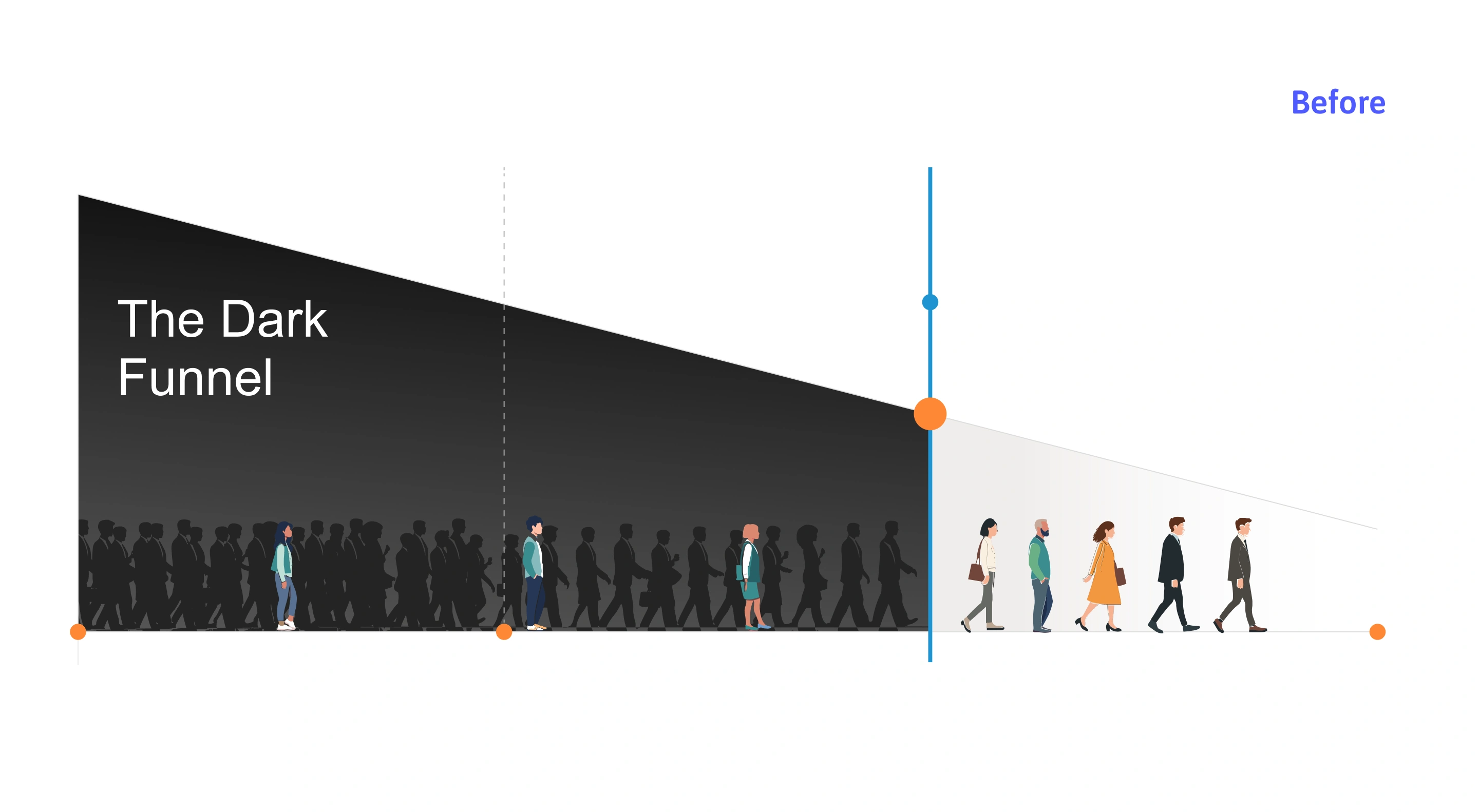
  2. Outdated buyer engagement approaches, which do not align with the dark funnel reality. Buyers complete 61% of their journey before engaging sellers, with 95% already having a preferred vendor at first contact (6sense, 2025). Discoverability is critically important to influence shortlist consideration early in the buyer’s journey. Meanwhile, buying group complexity has intensified, with 20% of all buying groups now including 15+ members (INFUSE Voice of the Buyer 2026). Despite this, many organizations still leverage individual, lead-based strategies that fail to enable collective decision making

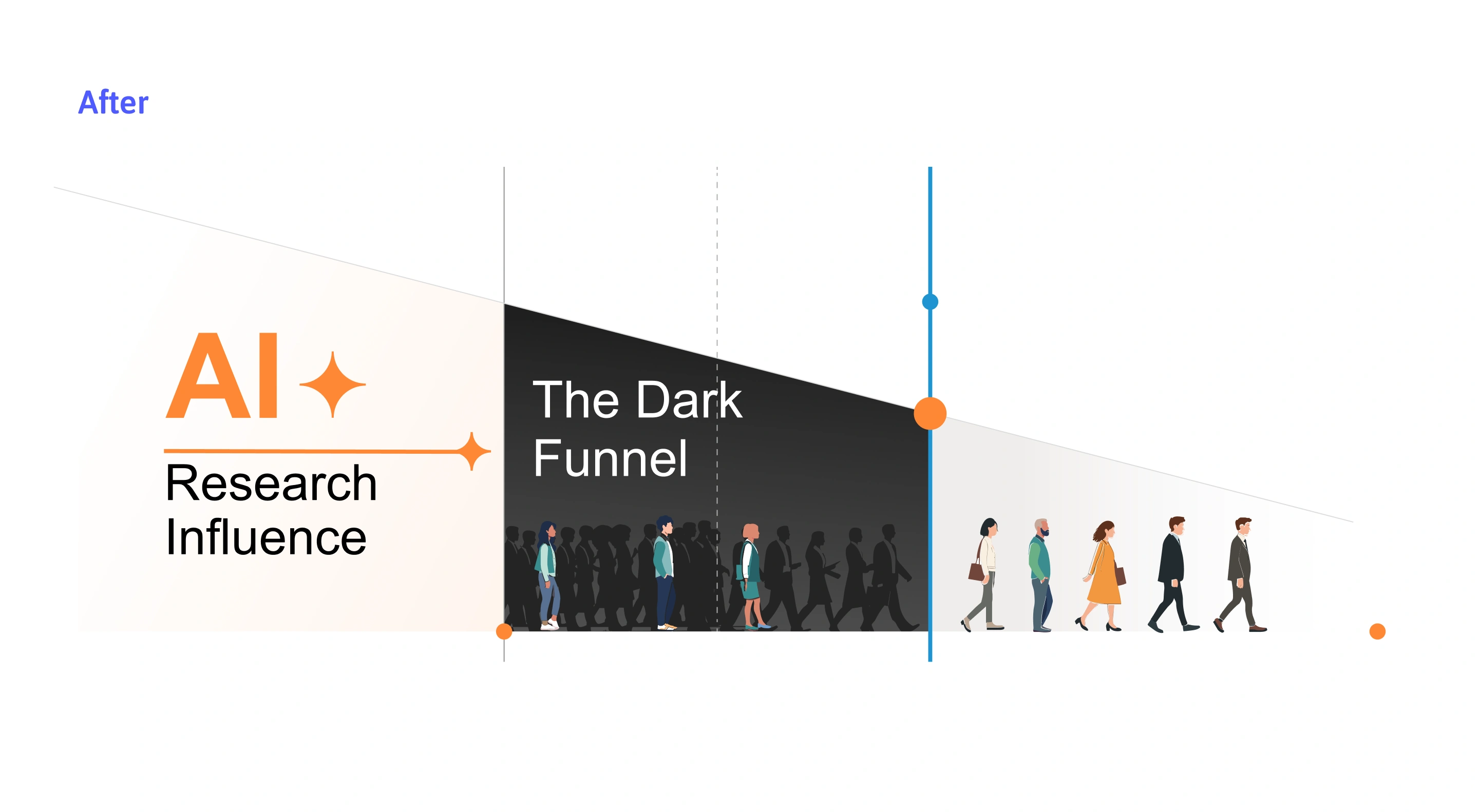
    These disconnects intensify as AI-assisted buyer research condenses the discovery phase of buyers’ research journey, impacting organizations’ ability to curate traditional brand and demand experiences.
Before
After

Drag to reveal the new buyer's journey

Copyright Alexander Kesler © 2026 All Rights Reserved

The discoverability era demands omnipresence wherever AI directs buyer attention, including peer communities, review platforms, and technical forums where anonymous research shapes vendor selection.

Ensuring brand presence across all core channels is essential to generating the trust signals that both AI search engines and buying groups require for validation.

Essentially, GTM teams ought to implement a "search everywhere" strategy, enabling buyers who navigate the dark funnel to seamlessly discover evidence to validate their decisions.

However, there is a trust deficit in the B2B market, fueling the confidence paradox. Most GTM teams are unable to supply custom-tailored evidence that resonates deeply with buyer needs, with only 20% of buyers trusting company-generated content (Insight Revenue, 2025).

Discovery channelTrust signal
Public peer communities like Reddit prioritizing authentic discussions (Search Engine Journal, 2025)Community-verified insights
Professional B2B networks like LinkedIn, with posts recommending solutionsExpert endorsements
Review platforms (G2, TrustRadius) validating capabilities and outcomesThird-party verification
Private channels (Slack, technical boards) exchanging implementation insights and challengesPeer validation

The solution requires two integrated components:

1

Trust architecture that defines the validation buyers need to confirm their choice

2

Discoverability-to-revenue frameworks that ensure buyers find this proof throughout the entirety of their journey

Discoverability-to-revenue vs brand-to-demand

Brand-to-demand, a cornerstone of our INFUSE Outlook 2025 report, established the foundation for modern demand strategies by connecting branding efforts to a measurable pipeline.

Discoverability-to-revenue evolves this approach for the AI-led buying era. The premise: demand already exists, and buyers actively research solutions before vendors can detect intent.

The focus shifts from generating demand through brand awareness to establishing visibility for your brand, content, and solutions across platforms where buyers engage anonymously.

Discoverability-to-revenue explores:

  • How buyers discover solutions in the AI-assisted buying era
  • How to drive velocity when buyers navigate the dark funnel independently
  • How to connect the discovery phase with attributable revenue outcomes

How does trust architecture support discoverability-to-revenue?

Trust architecture provides a systematic framework for building buyer confidence throughout their journey. As a comprehensive blueprint, it defines the layers of validation buying groups require before making purchase decisions, addressing their fundamental need for proof across peer, technical, and continuous value dimensions.

Trust has become the primary driver of early buyer preference, impacted significantly by buyer skepticism. Buyers prioritize three forms of validation before shortlisting vendors: direct information from vendors (24%), internal peers (22%), and independent SMEs (20%) (Voice of the Buyer 2026).

Additionally, 97% of buyers have prior experience with at least one vendor they consider (6sense, 2025), underscoring that building trust must be sustained to overcome old associations and establish new, positive brand connections with buyers.

The three layers of trust architecture systematically address buyer needs across their journey:

Trust layer

Buyer need

Implementation requirements

Revenue impact

Journey stage

Peer trust acceleration

Evidence of successful implementations

  • Industry-specific case studies /success stories
  • Analyst validation reports
  • Third-party benchmark data

Shortened consideration phase through credible proof

Awareness → consideration

Technical trust foundation

Integration compatibility

  • Comprehensive API documentation
  • Sandbox environments
  • Security specifications

Shortened evaluation cycles through self-service validation

Consideration

Continuous value demonstration *Investing in continuous value demonstration is of particular importance as 80% of buyers state dissatisfaction with their providers (Forrester, 2024). GTM teams must incorporate this motion as a critical growth and efficiency layer to counter high Client Acquisition Cost (CAC) and churn.

Ongoing innovation and value for investment

  • Quarterly capability releases
  • Proactive roadmap communication
  • Regular business reviews

Reduced churn through demonstrated commitment

Decision → post-purchase

Developing a sophisticated trust architecture defines the three validation layers buyers seek, setting the foundation for operationalizing the discoverability-to-revenue framework within your organization.

Fueling discoverability-to-revenue for each buying group stakeholder

By multi-threading engagement across buying groups, GTM teams can accelerate consensus and compress decision cycles. Content is a central component of this strategy as stakeholders prefer to engage on their own time:

Buying group engagement framework by stakeholder role

Stakeholder type

Content requirements

Discovery channels

Engagement metrics

Technical decision makers

API documentation, integration guides, security papers

Developer communities, technical documentation sites

Documentation downloads, sandbox activations

Business leaders

ROI calculators, peer benchmarks, case studies, analyst reports

LinkedIn, executive forums, closed business groups, industry publications

Business case engagement, social listening brand mentions

End users

Product tours, workflow demonstrations, feature comparisons, implementation examples

Review sites, user communities, social platforms, vendor comparison sites

Demo requests, trial activations, strategic content engagement (i.e., feature, case study pages)

Procurement

Contract templates, compliance certifications, pricing frameworks, joint execution plan templates

RFP databases, comparison platforms

Contract template downloads, compliance documentation requests, pricing page engagement, implementation timeliness

quiz

Discoverability-to-revenue readiness assessment

After implementing the discoverability-to-revenue infrastructure across your organization, evaluate your GTM team’s readiness with our comprehensive assessment tool.

Use our interactive readiness tool to determine your GTM team's discoverability-to-revenue proficiency score:

Category 1:
Discovery Infrastructure

Select all that apply (0-25 Points)

10 points
8 points
7 points
Skip this category

KPIs:

  • AI discovery metrics: Answer engine citation rate, appearance in AI-generated summaries
  • Peer community presence: Brand mention volume and sentiment
  • Proof points and client voice: Customer testimonial reach, client-contributed content volume, CX validation metrics
  • Technical documentation performance: Resource utilization rates, self-service resolution metrics
Step 1 of 4
Category 2:
Validation Systems
Select all that apply (0-25 Points)
10 points
8 points
7 points
Skip this category

KPIs:

  • Stakeholder content alignment: Role-specific engagement depth, persona journey completion rates, internal sharing metrics
  • Technical proof metrics: Validation environment conversion rates, POC success ratios, autonomous evaluation completion percentage
  • Peer influence tracking: Referral program activation rate, peer validation impact on win rate, reference-driven deal ROI average
Step 2 of 4
Category 3:
Decision Acceleration
Select all that apply (0-25 Points)
10 points
8 points
7 points
Skip this category

KPIs:

  • Buying group coverage: Stakeholder identification completeness (% mapped), multi-threading depth per account, speed to full group visibility
  • Demand intelligence effectiveness: Intent signal accuracy rate, behavioral trigger response time, and anonymous-to-known visitor conversion
  • Champion success metrics: Champion win rate differential, enablement resource adoption, stakeholder expansion rate through champions, buying group consensus acceleration timeline
Step 3 of 4
Category 4:
Revenue Attribution
Select all that apply (0-25 Points)
10 points
8 points
7 points
Skip this category

KPIs:

  • Pipeline velocity: Average deal cycle, buyer journey stage duration, opportunity identification accuracy, funnel drop-off rate
  • Attribution intelligence: Revenue contribution per channel, touchpoint influence mapping, predictive revenue modeling accuracy
Step 4 of 4
Your Readiness Score
0
/ 100
Score breakdown by category
Discovery Infrastructure 0/25
Validation Systems 0/25
Decision Acceleration 0/25
Revenue Attribution 0/25

Key Takeaways

When building your discoverability-to-revenue strategy, consider these implementation priorities:

  • Develop a robust discoverability strategy to win the buyer consideration window: GTM teams must invest in answer engine visibility, review platform optimization, and peer community engagement to capture the invisible buyer journey. Success requires reallocation from brand awareness campaigns to sophisticated buyer discovery infrastructure
  • Enable entire buying groups with persona-specific or 1to1 engagement tracks: With buying groups averaging 11 stakeholders (6sense, 2025), GTM teams must provide role-specific content addressing technical, business, and operational concerns concurrently through a comprehensive trust architecture
  • Demonstrate continuous value through post-purchase engagement: Organizations must establish client success partnerships that build trust through demonstrated outcomes, transforming relationships from transactional to strategic for sustainable revenue growth
Key Takeaways

Transform Your GTM with Trust Architecture and Discoverability

INFUSE demand experts leverage proprietary buyer intelligence and proven trust architecture frameworks to build your discoverability-to-revenue engine.

We enable organizations to establish systematic presence across the dark funnel while delivering the peer proof, technical validation, and continuous innovation that today’s buyers expect.

Chat with the team to implement your discoverability-to-revenue strategy