









Visit your local INFUSE site

Contact

Results for “”

The Buyer-Led GTM Framework

The Buyer-Led GTM Framework: How to Accelerate Buyer Confidence

Navigate
executive summary

Executive Summary

Although 61% of B2B buyer research occurs in the dark funnel before vendor contact (6sense, 2025), organizations continue to operate as if they control the buying journey. This playbook provides the complete framework for implementing buyer-led GTM: a model that truly enables B2B buying teams throughout their entire journey, from initial research through post-purchase expansion.

Critical insights:

Buyer-led go-to-market addresses buyer confidence, ensuring your brand, content, and solutions are discoverable, increasing your ability to make the consideration list

Buyer journey audits and friction elimination enable autonomous evaluation and build purchase confidence

Success requires orchestrated strategies from marketing, sales, and client success at each journey stage

Understanding buyer-led GTM

The new reality of B2B buying

B2B buyers control their journey, conducting 61% of evaluation before vendor contact (6sense, 2025). Yet 80% remain dissatisfied with their chosen providers (Forrester, 2024).

This paradox exposes the flaw in traditional GTM: organizations still operate as if they control a buying process they no longer own.

There is a crisis of confidence on both sides. Sellers oscillate between overconfidence in assuming they understand buyers and under confidence when facing diminishing influence. Meanwhile, buyers struggle with decision paralysis.

This is driven by the acceleration of vendor comparisons via AI assistants. Buyers have access to instantly generated and synthesized insights, effectively collapsing the discovery stage. This trend continues throughout the buyer’s journey as 94% of buyers use LLMs as a reference in combination with peer networks, industry sources, and their past experiences (6sense, 2025).

Yet this overwhelming abundance of information and remaining complexity fuels uncertainty resulting in conservative decisions or no purchase.

Two necessities to winning the AI-assisted buyer:

  1. Securing competitive positioning early: Ensuring your brand is top of mind when buyers leverage AI for their research is essential to shaping preference
  2. Evolving to buyer confidence building: Organizations must build trust and decision making confidence through proof of value, rather than purely focusing on vendor capabilities

The strategic imperative is clear: adopt buyer-led GTM. This model represents a shift from interruption to enablement, from control to support, and from acquisition focus to lifetime value optimization.

Buyer-led GTM does not just acknowledge the dark funnel; it illuminates it through comprehensive enablement at every stage.

This playbook presents the complete framework for buyer-led GTM, enabling organizations to support buyers throughout their journey to maximize conversions and long-term value.

Understanding buyer-led GTM
Alexander Kesler

Alexander Kesler

Founder & CEO

"Organizations still architect selling motions for a buying process that no longer exists."

4 critical realities shaping modern buying behavior

1

The invisible journey dominates the decision making process

Research shows 61% of evaluation happens before vendor contact with 95% of buyers having already selected their preferred vendor (6sense, 2025). Younger buyers demonstrate particular independence: 83% of Gen Z consult user reviews versus 77% of all buyers (TrustRadius, 2025).

The dark funnel extends beyond vendor awareness. While vendors believe only 38% of buyers speak with product users, the reality exceeds 49% (Insight Revenue, 2025).

Important note: AI significantly impacts hidden evaluation. Buyers use AI tools to synthesize reviews and data into insights, compressing discoverability instantaneously.

2

Technical requirements outweigh traditional selection criteria

57% of buying groups prioritize alignment with technical requirements when evaluating solutions, followed by ROI and AI-native capabilities at 36% (Voice of the Buyer 2026). Buying groups value integration proof and compatibility over other vendor features.

This is likely due to the extreme skepticism buyers show toward ROI promises versus functionality claims, combined with the pressure to increase efficiency. Realistic technical proof proves more persuasive than unvalidated promises.

3

Complexity overwhelms buyer confidence

According to Gartner, 77% of B2B buyers rate recent purchases as extremely complex. Accelerating innovation cycles compound paralysis as buyers question investment timing while AI deployment pressure continues to mount.

Meanwhile, buying groups expand and become fragmented as AI democratizes evaluation tools, resulting in more stakeholders joining the process. Buying cycles that do result in purchases average seven months, down from eight in the previous year (Voice of the Buyer 2026).

Yet, despite compressed cycles, 86% of B2B purchases still stall during the buying process and result in no decision (Forrester, 2024). This combination of innovation overload, fragmenting consensus requirements, and compressed research timelines generates a crisis of confidence.

Buyer-led GTM must address this confidence gap to reduce lost value from failed buying processes.

4

Post-purchase success determines competitive advantage

According to Voice of the Buyer 2026, 48% of buyers are "somewhat satisfied" with current vendors, reflecting an openness to change. The enduring challenges of purchase decisions, combined with the rapid pace of AI development, create higher innovation expectations.

Innovation gaps and vendor dissatisfaction create unprecedented switching readiness, eroding confidence in long-term vendor relationships and damaging recurring revenue streams.

Larysa Zakirova

Larysa Zakirova

COO

"Retention is the new acquisition: buyers expect continuous innovation or they'll find it elsewhere."

Delivering expectations demands a buyer-led approach anchored by a robust understanding of how buyers make decisions.

4 critical realities shaping modern buying behavior

4-step buyer-led GTM implementation framework

How to map your buying group and individual buyer’s journey

Creating an effective buyer-led GTM starts with understanding buyer navigation patterns. This requires systematic discovery and documentation of authentic buyer behavior.

Step 1: Mine your dark funnel signals
Important note: Brand discoverability is essential for reaching dark funnel buyers and collecting buyer intent signals through content anticipating buyer questions.

Before direct engagement, buyers conduct research across the dark funnel: peer networks, review sites, and industry communities where vendor visibility remains minimal.

This independence proves especially pronounced among Gen Z as 57% seek product users independently versus only 28% engaging vendor references (TrustRadius, 2025). These interactions generate behavioral signals that can be combined to create target buyer insights.

Several practical approaches to analyze buyer behavior:
  • First-party data collection: Capture owned channel engagement, website behavior, submissions, downloads. Use marketing automation to aggregate activity at the account level
  • Third-party intelligence: Monitor review sites and communities for evaluation criteria. Track competitive mentions to identify when accounts enter active evaluation phases
  • Content consumption patterns: Analyze content correlation with opportunities via dwell time and sharing, not just downloads. Track cross-channel engagement to map content influence across the buyer journey
  • Technographic triggers: Analyze technology stack changes through intent and install-base platforms to identify changes signaling needs. Companies implementing certain tools often evaluate adjacent solutions within predictable timeframes

In combination, these data sources reveal buyer signals. When accumulated across buying group members, activities can indicate purchase intent for target accounts. This deep intelligence fuels the prioritization of buyer enablement strategies which aligns with actual, observable buyer behavior.

Larysa Zakirova

Larysa Zakirova

COO

"Buyers complete the majority of their research before contacting vendors. Organizations collecting dark funnel signals across peer networks, review sites, and communities gain early visibility into intent and can shape consideration strategically."
Step 2: Identify stakeholder entry points and requirements

Build on these signals by mapping common behavior patterns of stakeholders in your buying groups. While buying group structure, needs, and challenges vary per account, these findings will serve as the foundation for your buyer-led GTM strategy.

Important note: AI reshapes buying dynamics by compressing research while increasing informed stakeholders, creating broader consensus requirements with faster decisions.
Stakeholder journey entry point framework:
Stakeholder typeTypical entry pointEntry triggersRequirementsHow AI augments evaluation
End user & business leadersEarly awareness to consideration Operational inefficiencies, strategic initiatives, competitive pressure Ease of use, ROI models, peer validation Accelerated shortlisting: Synthesized peer reviews and performance comparisons
Technical evaluatorsConsideration/
decision
Integration challenges, technical debt Architecture
diagrams, API documentation
Shorter validation cycles: Integration assessments and technical alignment
ProcurementDecision/purchase Budget planning,
procurement process
Contract terms, payment flexibility Streamlined procurement:
Contract analysis, risk assessment and budget optimization modeling
Executive sponsorsDecision/purchase Strategic gaps, transformation initiatives Strategic gaps, transformation initiatives Compressed strategic decision making cycles: AI-generated market intelligence and competitive positioning analysis

When you have established your buyer-led GTM model, consider expanding it to include variations by segment, company size, vertical, and geographic region.

Alexander Kesler

Alexander Kesler

Founder & CEO

"AI has democratized buying research. More stakeholders arrive informed, earlier. Organizations that map entry points, triggers, and requirements for each role can orchestrate consensus rather than chase it."
Step 3: Conduct a comprehensive buying journey audit

Only 12% of organizations rate their discovery process as highly effective (Insight Revenue, 2025). Auditing your buying journey becomes essential for building buyer confidence, in the face of information overload.

Important note: Buying journey audits must evolve continuously as AI reshapes research and evaluation.

Leverage your buyer understanding to audit gaps between your current strategy and buyer consideration needs.

Three-step buying journey audit process:
Audit stepFocusKey activities
1. Self-service assessmentInformation accessibility across all channels
  • Evaluate ability for target buyers to understand value propositions and solutions without human guidance
  • Assess decision-critical information availability (pricing, implementation timelines, integration details)
2. Friction point analysisBarriers to buyer progression
  • Map abandonment points by stakeholder and buying stage
  • Document potential buyer questions requiring intervention
  • Assess impact of friction points on deal progression
3. Enablement gap prioritizationCritical missing content and validation tools
  • Identify unanswered questions in materials by stakeholder and buying journey stage
  • Document validation requirements that cannot be completed independently
  • Flag consensus blockers and unaddressed risk factors

Utilize this audit to transform assumptions about buyer needs into evidence-based priorities, to address buyer progression friction.

Step 4: Build and activate your buying group enablement architecture

With buyer journey understanding established, create the content and tool architecture to support progression across all buying stages. To the right is an example:

Andrew Sambrook

Andrew Sambrook

Sr. VP Global Demand Generation

"Enablement architecture is about delivering the right resources at precise moments when stakeholders need them. Strategic content alignment across journey stages transforms how buying groups progress."
Stakeholder journey entry point framework:
Journey stageContent typesDistribution channelsSuccess metrics
TargetThought leadership,
industry research
Organic search, social
media
Traffic sources, engagement time
AwarenessProblem diagnostics, maturity assessmentsEmail nurture, paid mediaEmail engagement, return rates
ConsiderationTechnical guides, ROI calculatorsWebsite resources, sales materialsCalculator usage, repeat engagement
DecisionCompetitive comparisons, implementation guidesSales-shared resources, proof-of-conceptStakeholder coverage, reference completion
PurchaseContract templates, security documentationSales support, procurement systemsContract cycle time, review duration
Post-purchaseSuccess playbooks, optimization guidesClient knowledge base, user communitiesAdoption velocity,
expansion readiness

How to operationalize
buyer-led GTM

Team Roles in Buyer-Led GTM:

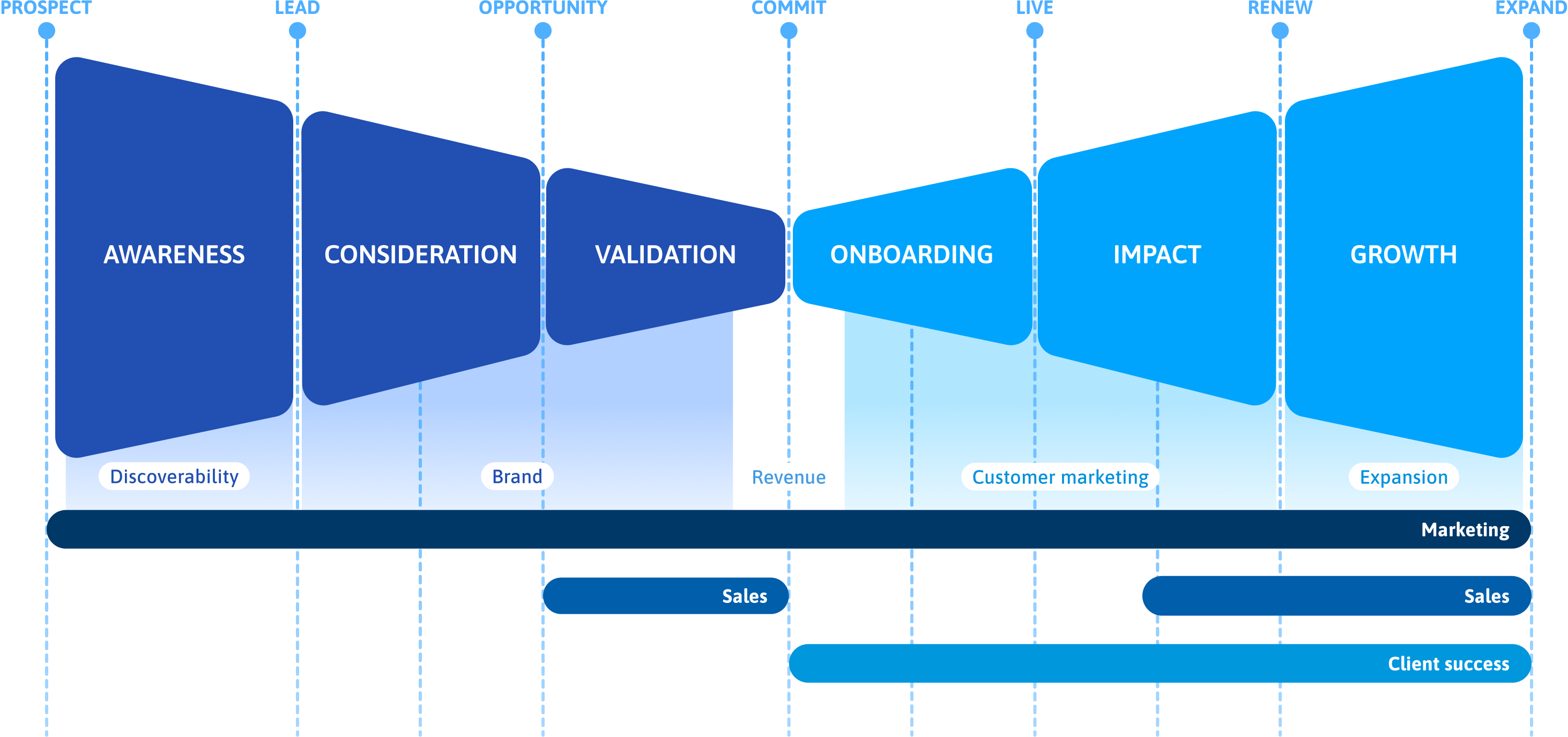
Successfully operationalizing a buyer-led GTM model requires role clarity. Each team must understand and align with their role in supporting buyer progression. This coordination allows teams to create and orchestrate sophisticated and compelling buyer experiences.

Marketing: Sets the foundation for buyer enablement by creating resources and experiences empowering autonomous research and evaluation. Marketing equips buyers with information to progress through their journey independently before requesting sales engagement

Sales: Transforms from a pitch-focused to consultation-oriented engaging only when buyers signal readiness, adding value through expertise. This shift challenges seller confidence as they add value beyond AI and self-service capabilities

Client success: Drives retention, expansion, and advocacy outcomes. Creates competitive advantages to challenge switching readiness and high innovation expectations

Alexander Kesler

Alexander Kesler

Founder & CEO

"Buyer-led GTM means orchestrating confidence, not controlling information flow."
Buyer journey diagram

Framework to operationalize buyer-led GTM per role

The table below shows the unique roles each team plays in supporting compelling buyer experiences.

Journey stageMarketing responsibilitiesSales responsibilitiesClient success responsibilities
Target
  • Craft thought leadership
  • Build category awareness
  • Monitor dark funnel indicators
  • Identify and connect with early influencers
  • Create advocacy content
Awareness
  • Deploy problem-focused content
  • Create diagnostic tools
  • Build segmented experiences
Consideration
  • Provide technical content
  • Devise self-service tools
  • Generate social proof
  • Map buying groups
  • Provide consultative insights
  • Enable champion development
  • Provide implementation evidence
Decision
  • Create competitive content
  • Develop case studies
  • Navigate procurement
  • Align stakeholders
  • Secure commitment
  • Confirm implementation readiness
Purchase
  • Create success stories
  • Expedite contracting
  • Coordinate implementation
  • Begin relationship building
Post-purchase
  • Create product/solution adoption content
  • Support community building
  • Monitor account health
  • Identify expansion opportunities
  • Drive adoption
  • Accelerate value realization
  • Facilitate expansion
David Verwey

David Verwey

CCO

"Success requires each team to enable buyer autonomy while maintaining strategic coordination."
Critical requirement: All teams must share data insights on buying groups and accounts through a single source of truth.
Waves

Role-specific frameworks

Buyer-led GTM requires precise orchestration across marketing, sales, and customer success. Each function must understand how their actions enable buyer progression.

Marketing framework:

Illuminating the dark funnel

Marketing supports buyer-led GTM by building and maintaining the content architecture that enables autonomous research and progression across stages.

5 strategies for reaching dark funnel buyers:
  1. Buyer signal intelligence: Combine first-party data with intent signals to build demand intelligence frameworks. Individual signals (downloads, visits) lack meaning in isolation. Map account activity to identify buying group members and progression. Weight activities by purchase proximity, adjusting models with historic patterns and new signals
  2. Answer-aligned content creation: Map content to specific personas and their questions by journey stages. Create optimized, modular, and multi-format assets. Build interlinking strategies guiding progression. Optimize for traditional search (SEO), AI answer engines (AEO), and generative platforms (GEO) using structured data, natural language, and authoritative citations
  3. Trust-building proof: Embed proof points validating brand value and competitive differentiation across all journey stages. Develop case studies, testimonials, and success stories by industry vertical and use case to earn trust
  1. Thought leadership positioning: Establish executives and SMEs as industry authorities across owned platforms. Address pain points aligned with value propositions and supported by a combination of proprietary research and third-party data. Repurpose all content with omnichannel distribution strategies
  2. Enablement-driven access: Design friction-reducing approaches by only gating intelligence when personalization creates value (assessments, ROI calculators). Systematically ungate evaluation resources (technical documentation, pricing, implementation guides). Leverage consumption patterns to map stakeholder involvement and refine strategies

Victoria Albert

Victoria Albert

CMO

"Marketing must illuminate the dark funnel, not wait for buyers to emerge from it."

Sales framework:

Facilitating complex consensus

Sales professionals must evolve to buying facilitators to enable stakeholders to navigate complexity. This consultative approach must also challenge seller overconfidence: 45% believe they fully understand client problems when they often do not (Insight Revenue, 2025).

Selling requires orchestrating consensus among competing stakeholder priorities. This is in addition to the increased skepticism that sales teams navigate from buyers questioning how human expertise adds value beyond AI-generated insights.

5 strategies for enabling buyer progression:
  1. Pre-contact intelligence development: Leverage buyer signals for account intelligence including organizational structure, strategic initiatives, and technology stack. Monitor triggers throughout progression triggers such as technology implementations, personnel changes, and announcements that signal evaluation readiness. Use intelligence and signals to identify potential champions
  2. Buying group orchestration: Map buying groups early, documenting concerns, success criteria, and influence. This intelligence enables persona-specific strategies, allowing you to equip buying groups with consensus tools and value proof that structures their decision process
  3. Technical validation and risk mitigation: Connect evaluators with autonomous validation resources while demonstrating technical alignment and integration. Proactively mitigate no-decision risks with implementation evidence and client references. Surface consensus blockers early using client success insights
  4. Value realization and expansion orchestration: Partner with client success to demonstrate continuous value delivery. Frame expansions as solutions to emerging challenges rather than additions. Leverage intelligence to identify optimal expansion timing and build compelling value-based cases
  5. Champion enablement and support: Equip champions to navigate internal validation and organizational dynamics. Co-create materials addressing stakeholder concerns, using AI conversation intelligence to anticipate objections. For pilot-averse buyers, leverage proof-of-concept frameworks with clear success metrics
Andrew Sambrook

Andrew Sambrook

Sr. VP Global Demand Generation

"Modern sellers facilitate consensus among stakeholders they'll never meet directly."

Client success framework:

Securing competitive advantage

Client success teams hold the key to sustainable growth through retention and expansion by continuously validating confidence in the brand and its solutions.

In markets where switching costs decrease and alternatives proliferate, post-purchase excellence becomes the primary differentiator.

5 strategies for maximizing value and preventing churn:
  1. Pre-purchase engagement and handoff excellence: Engage during late-stage sales to understand success criteria, readiness, obstacles, and stakeholder dynamics. Document technical requirements, timeline expectations, and success benchmarks. Establish relationships, building rapport that accelerates onboarding. Track handoff quality and time-to-first-value metrics
  2. Adoption acceleration and barrier mitigation: Create role-specific onboarding, tracking feature adoption, usage frequency, and workflow integration. Identify low-engagement for targeted enablement. Develop continuous education through training, certification, and optimization workshops to boost adoption
  3. Innovation delivery and value realization: Combat switching readiness by providing roadmaps and demonstrating innovation. Offer early access to beta features solving emerging challenges to gain positioning as a strategic partner. Conduct reviews showcasing tangible outcomes and underutilized capabilities creating expansion opportunities. Develop case studies with marketing documenting outcomes for social proof
  4. Expansion cultivation and internal advocacy: Monitor readiness signals: successful adoption, budget discussions, organizational changes, and competitive dissatisfaction. Partner with sales to build expansion proposals using performance data, projected ROI, and peer comparisons. Enable buying group champions with value proof
  5. Client advocacy and community development: Identify candidates based on satisfaction and willingness. Create reference programs and client communities enabling peer knowledge sharing. Track participation, conversion impact, and engagement metrics, featuring advocates in content and campaigns
Petya Dolaptchieva

Petya Dolaptchieva

VP of Global Client Success

"Client success proves the ROI that buyers doubted during evaluation, turning skeptics into champions."

Key Takeaways

The shift to buyer-led GTM is not optional: buyers have already made this decision. Your competitive advantage lies not in controlling the buyer journey, but in enabling it better than anyone else.

  • The dark funnel dominates: Buyers complete 61% of their journey before vendor contact, with 95% pre-selecting their preferred solution (6sense, 2025). Organizations must comprehensively enable this invisible evaluation process to secure consideration
  • Proof of technical requirements and performance are key to buyer confidence: Organizations must lead with integration proof and implementation feasibility to support business value and ROI claims. This is crucial to enabling buyers to build confidence in their decision making
  • Discovery remains critically broken: Only 12% of organizations rate their discovery processes as highly effective, creating a massive opportunity for those who master buyer understanding
  • Post-purchase drives competitive immunity: Organizations that master post-purchase enablement transform clients into advocates while capturing expansion opportunities competitors miss. This stage represents the ultimate differentiator in markets with high switching readiness
  • Cross-functional orchestration is mandatory: Buyer-led GTM requires marketing, sales, and client success operating from unified data with shared accountability for buyer outcomes

Organizations that thrive embrace buyer-led GTM. They enable rather than interrupt, support rather than control, and optimize for lifetime value rather than initial acquisition.

Key takeaways

TRANSFORM YOUR GTM WITH BUYER-LED DEMAND ORCHESTRATION

INFUSE demand experts leverage proprietary buyer intelligence and proven orchestration frameworks to align your revenue engine with modern buying behavior.

Talk with the team to implement your buyer-led GTM strategy